

Blog
3 Candidates per Seat: Navigating the 2026 Medical School Surge


Let’s talk about the elephant in the room: getting into medical school in 2026 is officially a numbers game. And not a friendly one.
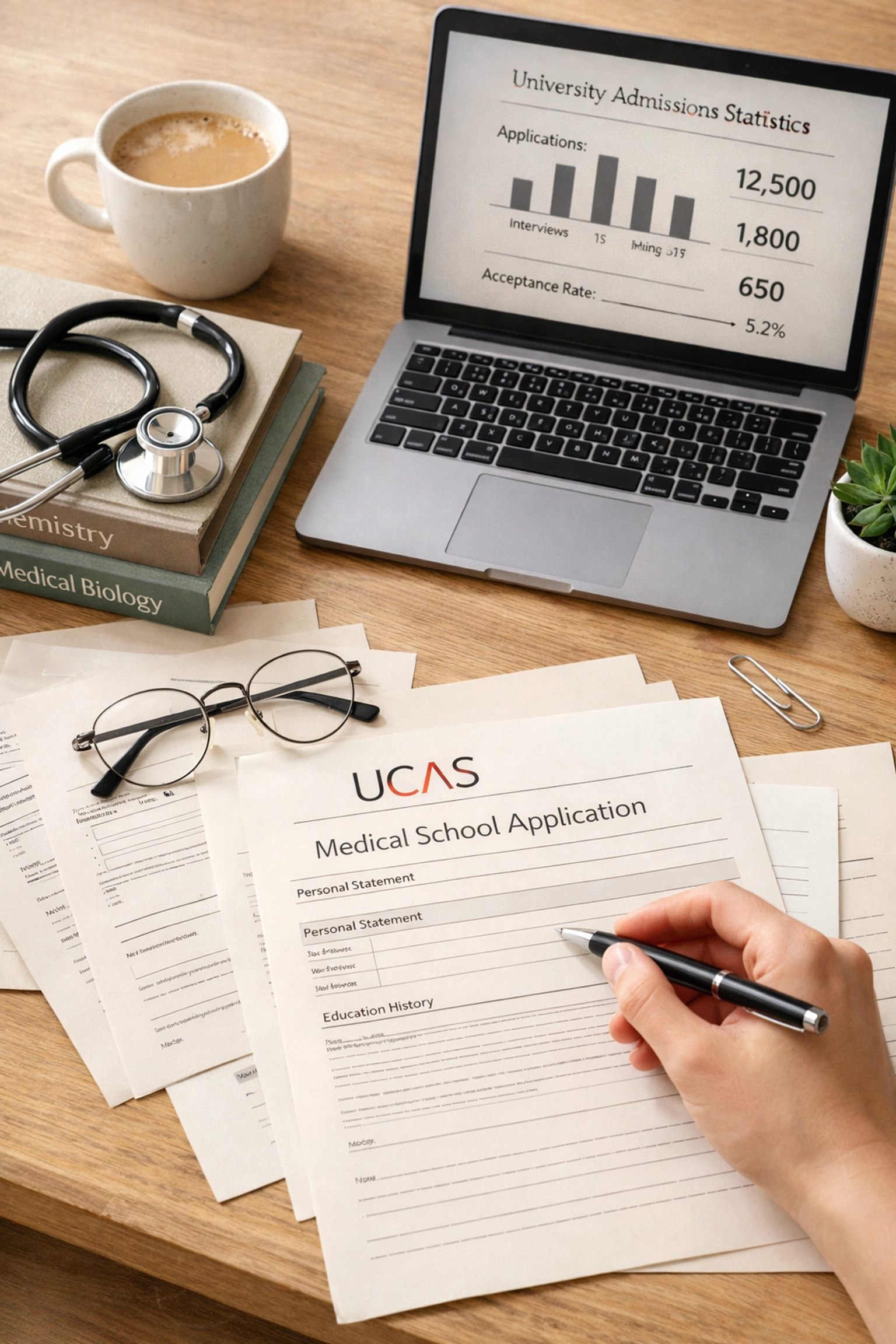
The latest UCAS figures for the 2026 cycle have just dropped, and they’re showing something I’ve been warning my MedAspire families about for months, a massive 10.4% surge in medical school applications. We’re now looking at roughly 25,770 students fighting for just over 8,100 seats across UK medical schools.
Do the maths. That’s three candidates for every single seat.
If your child is aiming for medicine, this isn’t just background noise, this is the reality they’re stepping into. And here’s the truth that I need you to understand: an A* in Chemistry is no longer the finish line. It’s the minimum requirement just to enter the race.
The 2026 Surge: What the Numbers Actually Mean
When I started tutoring A Level Chemistry years ago, securing a place at medical school was competitive, sure. But this? This is a different beast entirely.
Here’s what’s happening: More students than ever before are applying to medicine. The appeal of the profession, job security, prestige, the chance to make a real difference, hasn’t dimmed. If anything, it’s intensified. Post-pandemic, we’ve seen a wave of young people inspired to pursue healthcare careers, and that wave is cresting right now in 2026.
But here’s the kicker: medical school places haven’t increased at the same rate. Universities are constrained by clinical placement availability, funding, and infrastructure. So while demand has skyrocketed, supply has remained relatively static.
The result? Unprecedented competition.
For my families in Dubai, Singapore, and across the UAE, I’m seeing this play out in real-time. Parents come to me, often panicked, asking: “My daughter has predicted A*A*A*, surely that’s enough?”
And I have to give them the answer they don’t want to hear: It’s not.
Not anymore.
The International Factor: Why UAE Families Face Even Steeper Odds
If you’re reading this from Dubai or anywhere in the Middle East, I need you to pay extra attention to this section. The competition for international students is fiercer than you can imagine.
UK medical schools operate under strict quotas when it comes to international admissions. Typically, only 7.5% of places are allocated to non-UK students. That means we’re talking about approximately 600 spots across the entire country for international applicants.
Now factor in that international students often come from highly competitive educational systems, think IB programs, American curricula, and rigorous international schools. These students aren’t just academically strong; they’re exceptionally well-prepared and well-resourced.
The result? You’re looking at 10+ applicants per international place at top-tier universities.
I’ve worked with brilliant students in Dubai who had near-perfect grades, stellar UCAT scores, and impressive extracurriculars, and still didn’t receive offers. Why? Because at that level of competition, everyone looks perfect on paper.
This is where the Multiple Mini Interview (MMI) becomes absolutely critical. And it’s where most candidates, no matter how academically gifted, stumble.
The MMI: The Ultimate Filter
Let me be blunt: universities are drowning in A* students. Seriously. They have thousands of applicants with impeccable academic records, high UCAT scores, and glowing personal statements.
So how do they decide who actually gets an offer?
The MMI has become the ultimate filter.
For those unfamiliar, the Multiple Mini Interview is a circuit-style interview format where candidates rotate through multiple stations, each lasting 5-10 minutes. You might face:
- Ethical dilemmas (should a patient’s autonomy override medical advice?)
- Roleplay scenarios (breaking bad news to a “patient”)
- Data interpretation (analysing a graph about healthcare outcomes)
- Personal reflection (describing a time you showed empathy under pressure)
Here’s what medical schools are looking for: Can this student think on their feet? Do they have genuine empathy? Can they communicate complex ideas clearly? Do they understand medical ethics beyond textbook definitions?

And here’s the problem I see constantly: most tutors and schools focus exclusively on getting students those A* grades. Which is essential, don’t get me wrong. But it’s not enough.
Your child can know every single detail of the Krebs cycle, ace their organic chemistry mechanisms, and still completely bomb the MMI if they haven’t developed the soft skills and ethical reasoning that medical schools are desperate to find.
Why Chemistry Tutoring Alone Won’t Cut It
I’m a Chemistry tutor, it’s literally my job title. But I’m also a Functional Medicine Health Coach, and that dual perspective has taught me something crucial: medicine isn’t just about knowing the science. It’s about applying it with compassion, ethics, and real-world judgment.
When I started Chemistry with Chloe, I initially focused purely on exam technique, helping students master A Level Chemistry content, ace their GCSEs, and understand complex concepts. And that’s still a huge part of what I do.
But as I watched more and more of my students apply to medical school, I realised something: they needed more than just a Chemistry tutor. They needed someone who could bridge the gap between academic excellence and the holistic skills that medical schools actually value.
That’s why I created MedAspire.
The MedAspire Edge: Beyond the Syllabus
MedAspire isn’t your typical tutoring program. We don’t just teach the science, we teach the thinking.
Here’s what we actually do:
🩺 Ethical Case Studies: We work through real-world medical dilemmas. Should a 15-year-old be allowed to refuse life-saving treatment? How do you balance resource allocation in a pandemic? These aren’t hypothetical, these are the exact types of questions you’ll face in MMIs.
🩺 MMI Roleplay Sessions: We practice. A lot. You’ll roleplay breaking bad news, responding to angry “patients,” and handling communication breakdowns. By the time you walk into your actual interview, you’ve already done it dozens of times.
🩺 Critical Thinking Workshops: Medical schools want students who can analyse data, spot flaws in arguments, and think critically about healthcare systems. We build those skills deliberately and systematically.
🩺 Personal Statement Development: Your personal statement needs to tell a compelling story, one that shows genuine insight into medicine, not just a list of achievements. We work together to craft narratives that demonstrate depth, not just breadth.
And yes: we still cover the Chemistry. Because you absolutely need those A* grades to even be considered. But we go further. We turn “candidates” into “offer-holders.”
What Parents Are Telling Me
I’ve had parents from Dubai, London, and beyond reach out after their children secured offers to places like Imperial, UCL, and Cambridge. And the feedback is always the same:
“The MMI prep was what made the difference.”
“My daughter said she felt like she’d already lived through those scenarios: nothing surprised her.”
“The ethical discussions we had in MedAspire came up almost word-for-word in the interview.”
Look, I’m not saying MedAspire is a magic bullet. If your child doesn’t have the grades, they won’t get an interview in the first place. That’s non-negotiable.
But if they do? If they’re academically strong but need to develop the softer, harder-to-teach skills that distinguish a good candidate from an exceptional one? That’s exactly where we come in.
The Urgency of 2026
Here’s what I want you to understand: 2026 is not the year to wing it.
With three candidates per seat: and potentially 10+ for international spots: the margin for error has evaporated. You can’t afford to show up to an MMI unprepared. You can’t afford to submit a generic personal statement. You can’t afford to treat the UCAT as something you’ll “figure out later.”
Every single element of your child’s application needs to be exceptional.
And that takes time. It takes preparation. It takes guidance from someone who understands both the academic requirements and the less tangible qualities that medical schools are hunting for.
Here’s What I’m Offering
If your child is serious about medicine: if they’re willing to put in the work, embrace the challenge, and commit to becoming not just a great student but a great future doctor: then I’d love to invite them into MedAspire.
We offer:
✨ Group MedAspire sessions: Small cohorts working through MMI prep, ethical case studies, and critical thinking exercises together
✨ 1-1 tutoring: Personalised Chemistry tuition tailored to your child’s specific exam board, gaps in knowledge, and learning style: whether you’re in Dubai, London, or anywhere in between
✨ Online Chemistry tutoring: Flexible, high-quality support for families who need an online Chemistry tutor that fits around busy international schedules
For my UAE families specifically: I understand the unique pressures you’re facing. I know the international school systems, the cultural expectations, and the additional hurdles your children face as international applicants. And I’m here to help you navigate every single one.
The Bottom Line
Medical school in 2026 is a numbers game. But it’s also a skills game, a preparation game, and ultimately, a long game.
Your child’s A* in Chemistry? That’s your ticket to the race. But winning it? That takes something more.
If you’re ready to give your child that competitive edge: the kind that turns anxious applicants into confident, compelling candidates: let’s talk.
Because in a year where 25,770 students are fighting for 8,100 seats, every advantage matters. 🌟


Oxford-Educated Chemistry Specialist
With over 20 years of teaching experience at some of the UK’s top independent schools, I help ambitious students bridge the gap between hard work and top-tier results. I specialise in GCSE, A Level, and IB Chemistry tuition for students targeting Grade 9s and A*s. Based in the UK but working globally, I provide 1-1 online support for families in South and West London, Dubai, and Hong Kong, ensuring students are perfectly prepared for competitive medical applications and Oxbridge entries.
I’ve helped students achieve top grades from schools such as Alleyn’s, Dulwich College, Tonbridge, Sevenoaks, Brighton College, Wycombe Abbey, Caterham, St Paul’s, Dubai College, Dubai British School and Harrow International School Hong Kong.
Contact me archardchloe@gmail.com to discuss how I can help your child excel in Chemistry.