

Blog
7 Mistakes A Level Chemistry Students Make (and How a Tutor Can Fix Them)


A Level Chemistry is often called the “hardest A Level,” and honestly? There’s a reason for that reputation. It’s a massive leap from GCSE that catches even the brightest, most dedicated students completely off guard.
But here’s what I’ve learned after 20+ years of teaching Chemistry: most students aren’t struggling because they aren’t smart enough. They’re struggling because of a few common, completely fixable mistakes that nobody ever taught them to avoid.
The good news? Once you know what these traps are, you can sidestep them entirely. 🌟
Here are the 7 biggest mistakes I see A Level Chemistry students make: and exactly how we fix them together in my 1-1 tutoring sessions.
Mistake #1: The “Unit” Oversight
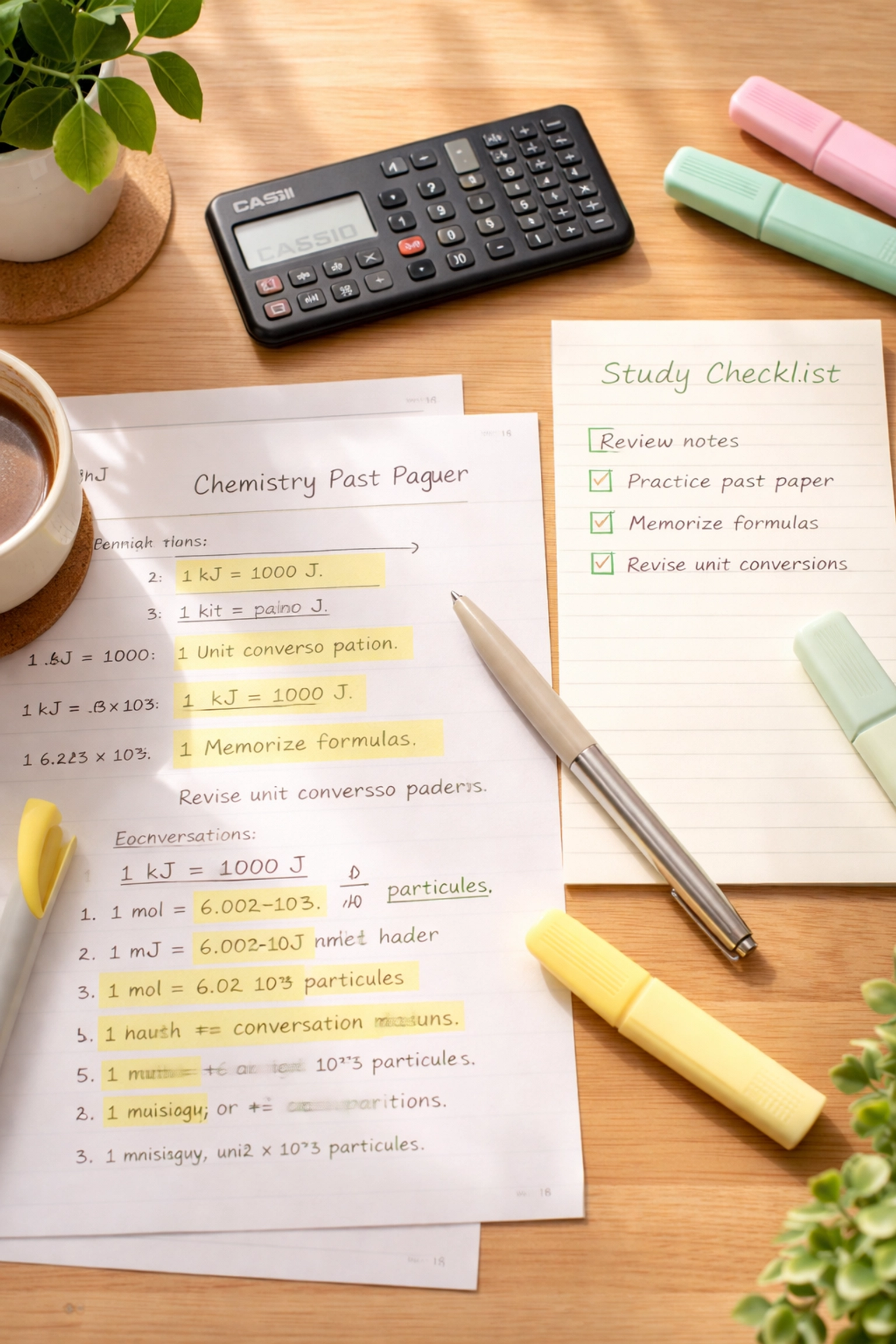
The Mistake: You calculate moles using cm³ instead of dm³. You forget to convert kJ to J. You mix up grams and kilograms. Sound familiar?
These aren’t “silly mistakes”: they’re systematic errors that cost students marks in nearly every single calculation question. And the frustrating part? You probably knew how to do the calculation. You just tripped over the units.
How a Tutor Fixes It: In my sessions, we build what I call “Calculation Checklists.” Before you even touch your calculator, I train you to highlight every single unit in the question. We go through past papers together, and I point out exactly where unit conversions are hiding.
After a few weeks of practice, those “silly mistakes” become a thing of the past. You’ll spot a sneaky cm³ from a mile away. ✨
Mistake #2: Memorising Mechanisms as Drawings
The Mistake: You’re staring at a nucleophilic substitution mechanism, trying to memorise where each curly arrow goes. But it’s just… lines and squiggles. It doesn’t mean anything to you, so it doesn’t stick.
This is one of the most common organic chemistry struggles I see. Students treat mechanisms like abstract art when they’re actually stories with characters and motives.
How a Tutor Fixes It: We ditch the rote memorisation entirely. Instead, I teach you to think of mechanisms as a narrative. There are “villains” (electrophiles) hungry for electrons, and “heroes” (nucleophiles) ready to donate their lone pairs and save the day.
Once you understand why the electrons move: because the nucleophile has a lone pair and the electrophile is electron-deficient: the curly arrows practically draw themselves. You’ll never forget a mechanism again because it finally makes sense. 🙌
Mistake #3: Ignoring State Symbols
The Mistake: You write a beautiful enthalpy equation, but you forget to add (s), (l), (g), or (aq). One missing state symbol = one lost mark. Sometimes more.
It seems so small, so insignificant. But examiners are ruthless about state symbols, especially in thermodynamics and equilibrium questions.
How a Tutor Fixes It: I train my students to treat state symbols as part of the chemical’s name. No symbol, no name, no mark. It’s that simple.
We practice this constantly until it becomes automatic. By the time you sit your exam, adding state symbols will feel as natural as writing the formula itself.
Mistake #4: The “Describe vs. Explain” Confusion
The Mistake: The question asks you to explain why ionisation energy increases across a period. You write: “It increases because it goes up.”
That’s a description, not an explanation. And it’s worth zero marks.
This is what I call the “Examiner’s Language” trap. Students know the content, but they don’t know how to translate it into mark-scheme speak.
How a Tutor Fixes It: We decode the command words together. I show you exactly what “describe,” “explain,” “suggest,” and “evaluate” actually require: and the specific key phrases you need to include for each one.
For example, an explanation of ionisation energy trends needs to mention “increased nuclear charge,” “same shielding,” and “stronger attraction.” We build a personal keywords bank so you never lose marks to vague wording again.
Mistake #5: “I’ll Learn Definitions Later”
The Mistake: You’re so focused on understanding reactions and calculations that you push definitions to the bottom of your revision list. “I’ll cram them the week before the exam,” you think.
Then exam day arrives, and you can’t remember whether it’s “minimum energy required” or “energy needed” for activation energy. Two marks gone.
How a Tutor Fixes It: Definitions are low-effort, high-reward marks: and we’re not leaving them on the table.
In my sessions, I integrate definitions into every single lesson. We use flashcards, we test recall, and we practice writing definitions word-perfect. By the time your exam rolls around, you’ll be able to define “First Ionisation Energy” in your sleep. 💪
Mistake #6: Showing No Working Out
The Mistake: You do a complex calculation, get the right answer in your head (or on your calculator), and write down just the final number.
Then you make one tiny error. And because there’s no working, the examiner can’t give you any method marks. You lose 3 or 4 marks instead of just 1.
How a Tutor Fixes It: I act as your “Exam Coach.” We go through your past papers together, and I physically highlight every place where you left marks on the table by skipping steps.
I teach you to write out your working as if you’re explaining it to someone who’s never seen the question before. It takes an extra 30 seconds and can save you an entire grade boundary.

Mistake #7: Relying on the Textbook Only
The Mistake: You read the textbook cover to cover. You highlight. You make notes. But when you sit a past paper, you realise the questions don’t quite look like what you revised.
That’s because every exam board has its quirks. AQA, OCR, and Edexcel all phrase questions differently, emphasise different topics, and have specific mark-scheme expectations that textbooks simply don’t cover.
How a Tutor Fixes It: I provide board-specific resources and mark-scheme-focused notes tailored to your exact exam. We don’t just learn Chemistry: we learn your Chemistry exam.
I know what AQA loves to ask about bonding. I know where OCR students tend to lose marks on organic synthesis. And I make sure you’re prepared for the specific challenges you’ll actually face.
The Real Secret? It’s Not About Working Harder
Here’s what I want you to take away from this: you don’t have to struggle through Chemistry alone.
Most of my students come to me feeling frustrated, overwhelmed, and convinced they’re “just not a Chemistry person.” But the truth is, they’re usually making just two or three of these mistakes on repeat: and once we fix them, everything changes.
A small shift in technique can lead to a huge jump in grades. I’ve seen it happen hundreds of times. 🌟
Ready to Fix These Mistakes Together?
If these mistakes are sounding a little too familiar, I’d love to help you turn things around.
Whether you’re based in the UK or Dubai, my 1-1 online tutoring sessions are designed to identify exactly where you’re losing marks and give you the personalised strategies to get them back.
We’ll decode the examiners, master the mark schemes, and transform your approach to A Level Chemistry: one session at a time.
Get in touch today and let’s get you on the path to that A*. You’ve got this. ❤️

Oxford-Educated Chemistry Specialist
With over 20 years of teaching experience at some of the UK’s top independent schools, I help ambitious students bridge the gap between hard work and top-tier results. I specialise in GCSE, A Level, and IB Chemistry tuition for students targeting Grade 9s and A*s. Based in the UK but working globally, I provide 1-1 online support for families in South and West London, Dubai, and Hong Kong, ensuring students are perfectly prepared for competitive medical applications and Oxbridge entries.
I’ve helped students achieve top grades from schools such as Alleyn’s, Dulwich College, Tonbridge, Sevenoaks, Brighton College, Wycombe Abbey, Caterham, St Paul’s, Dubai College, Dubai British School and Harrow International School Hong Kong.
Contact me archardchloe@gmail.com to discuss how I can help your child excel in Chemistry.