

Edexcel A Level Chemistry Topic 4: Inorganic Chemistry and The Periodic Table
Free Download: Edexcel Topic 4 Revision Notes
All 15 spec points covered (Groups 1 & 2, Halogens, and Inorganic Analysis) — written by Chloe Archard (MSc Biochemistry, Oxford-trained chemist). Print it, annotate it, and tick off each spec point as you revise.
Topic 4 is where inorganic chemistry really kicks off. You’ve got the s-block metals doing their thing, the halogens being dramatic, and a bunch of qualitative tests to memorise. Let’s break it all down so you’re exam-ready.
Group 2: The Alkaline Earth Metals
Group 2 contains beryllium, magnesium, calcium, strontium, barium, and radium. These elements all have two electrons in their outermost s-orbital, which they’re keen to lose to form 2+ ions.
Trend in Ionisation Energy
As you go down Group 2, the first ionisation energy decreases. Why? Three reasons working together:
- Increased atomic radius – more electron shells mean the outer electrons are further from the nucleus
- Increased shielding – inner electrons repel the outer electrons, reducing the nuclear pull
- Same nuclear charge increase is outweighed – yes, there are more protons, but the distance and shielding effects win
This means it gets easier to remove that outer electron as you go down the group.
Trend in Reactivity
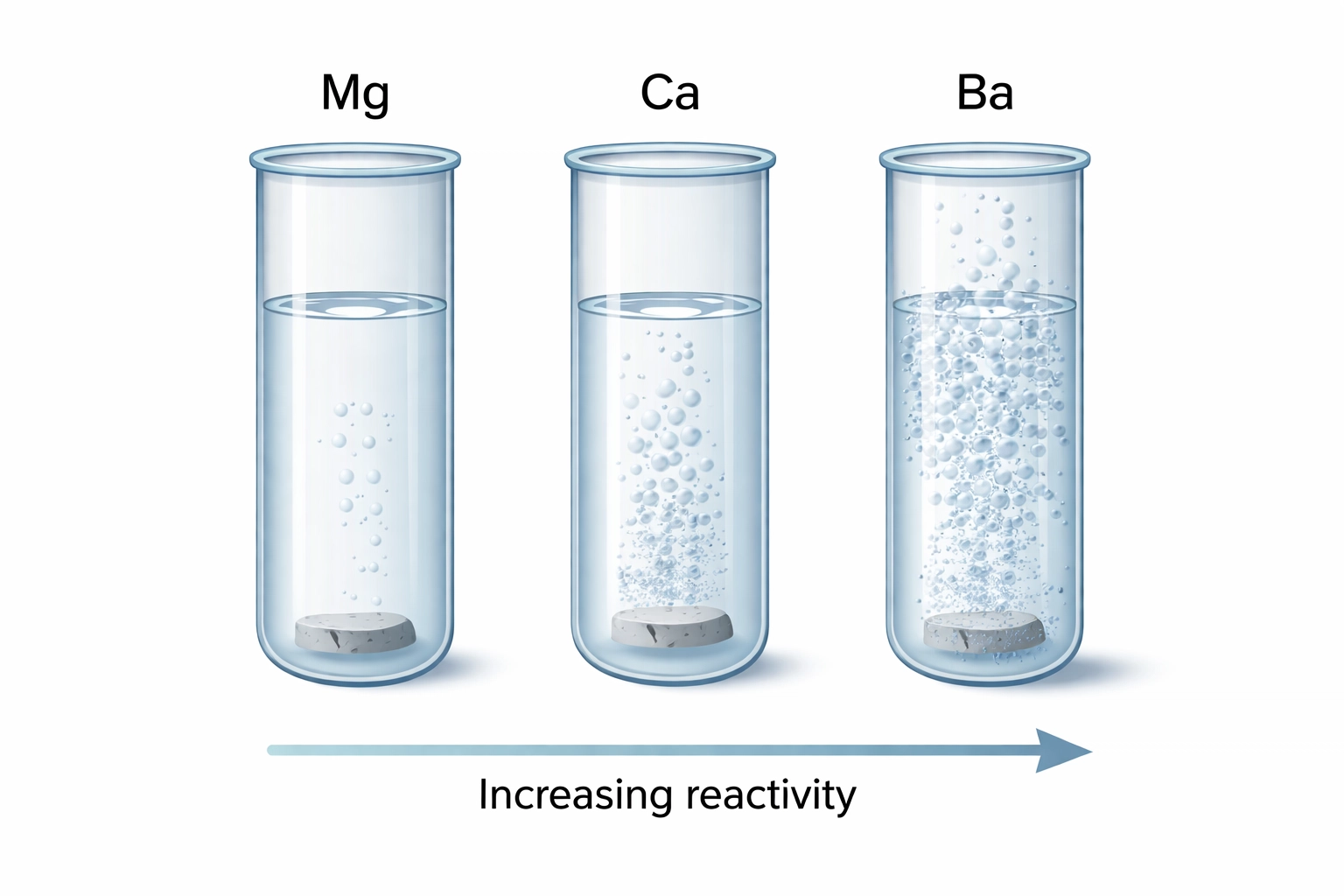
Because ionisation energy decreases down the group, reactivity increases. The metals lose their electrons more readily, making them better reducing agents. Barium fizzes violently with water, while magnesium barely reacts with cold water (though it does react with steam).
Reactions of Group 2 Metals
With oxygen:
All Group 2 metals burn in oxygen to form white metal oxides.
2Mg(s) + O?(g) ? 2MgO(s)
With chlorine:
They react vigorously to form white metal chlorides.
Ca(s) + Cl?(g) ? CaCl?(s)
With water:
Magnesium reacts very slowly with cold water but vigorously with steam:
Mg(s) + 2H?O(l) ? Mg(OH)?(aq) + H?(g)
Calcium onwards reacts readily with cold water, producing hydroxides and hydrogen gas. The reactivity increases down the group – barium reacts vigorously.
Reactions of Oxides and Hydroxides
Group 2 oxides are basic oxides. They react with water to form hydroxides:
CaO(s) + H?O(l) ? Ca(OH)?(aq)
Both oxides and hydroxides react with dilute acids in neutralisation reactions:
MgO(s) + 2HCl(aq) ? MgCl?(aq) + H?O(l)
Ca(OH)?(aq) + 2HNO?(aq) ? Ca(NO?)?(aq) + 2H?O(l)
Solubility Trends in Group 2
This is a classic exam question, so get these trends locked in:
| Compound Type | Trend Down Group 2 |
|---|---|
| Hydroxides | Solubility increases |
| Sulfates | Solubility decreases |
Magnesium hydroxide is barely soluble (it’s in milk of magnesia), while barium hydroxide dissolves readily. On the flip side, magnesium sulfate (Epsom salts) is soluble, but barium sulfate is so insoluble it’s used in barium meals for X-rays.
Thermal Stability of Nitrates and Carbonates
Here’s where polarising power comes into play.
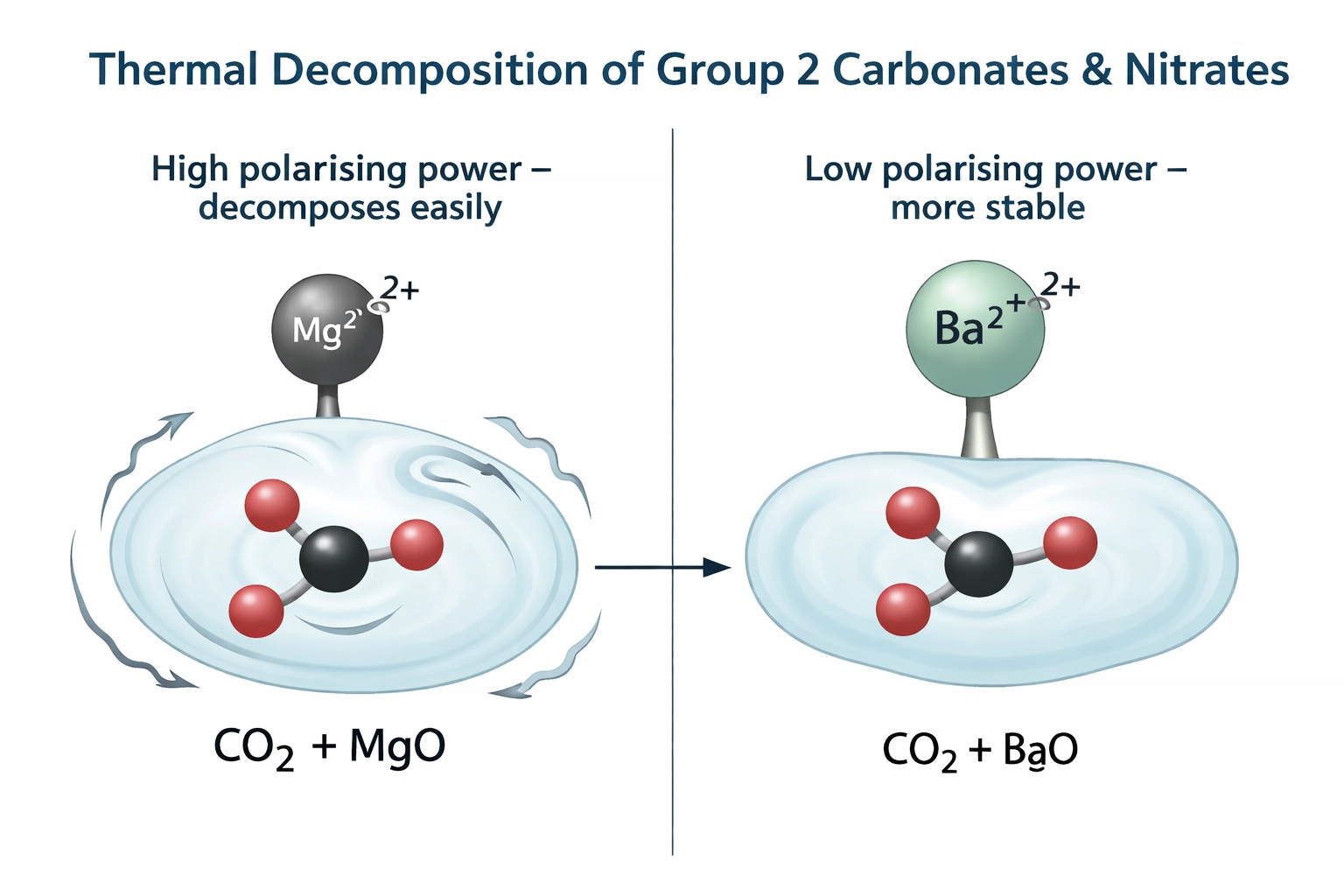
The trend: Thermal stability of both nitrates and carbonates increases down Groups 1 and 2.
The explanation: Smaller cations with higher charge density have greater polarising power. They distort the electron cloud of the anion (nitrate or carbonate), weakening the bonds and making decomposition easier.
- Group 2 compounds decompose more easily than Group 1 because 2+ ions have greater polarising power than 1+ ions
- Lithium carbonate decomposes on heating, but sodium carbonate doesn’t decompose at Bunsen temperatures
- Magnesium nitrate decomposes at lower temperatures than barium nitrate
Group 2 carbonates decompose like this:
CaCO?(s) ? CaO(s) + CO?(g)
Group 2 nitrates decompose to form the oxide, nitrogen dioxide (brown gas), and oxygen:
2Ca(NO?)?(s) ? 2CaO(s) + 4NO?(g) + O?(g)
Group 1 nitrates (except lithium) decompose to form the nitrite and oxygen:
2KNO?(s) ? 2KNO?(s) + O?(g)
Flame Tests and Electron Transitions
When compounds of s-block metals are heated in a flame, they produce characteristic colours. This isn’t magic – it’s quantum mechanics in action.
What’s happening:
- Heat energy excites electrons to higher energy levels
- When electrons fall back down, they release energy as visible light
- The colour depends on the energy gap between levels (specific to each element)
| Element | Flame Colour |
|---|---|
| Lithium | Crimson red |
| Sodium | Yellow |
| Potassium | Lilac |
| Calcium | Orange-red |
| Strontium | Red |
| Barium | Green |
Exam tip: The sodium flame is so intense it can mask other colours. Use a blue filter to observe potassium’s lilac flame when sodium is present.
Group 7: The Halogens
The halogens – fluorine, chlorine, bromine, iodine, and astatine – are in Group 17 (old Group 7). They all have seven electrons in their outer shell and need just one more to achieve a stable octet.
Physical Property Trends
As you go down Group 7:
- Melting and boiling points increase – more electrons mean stronger London forces between molecules
- Physical state at room temperature changes – F? and Cl? are gases, Br? is a liquid, I? is a solid
- Electronegativity decreases – larger atoms attract bonding electrons less strongly
Reactivity Trend
Reactivity decreases down Group 7. This is the opposite of Groups 1 and 2!
Halogens are oxidising agents – they gain electrons. Going down the group, the atoms get larger, so the incoming electron is further from the nucleus and experiences more shielding. This makes electron gain less favourable.
Chlorine is a stronger oxidising agent than bromine, which is stronger than iodine.
Halogen Displacement Reactions
A more reactive halogen will oxidise (displace) a less reactive halide ion. This is a key redox concept.
Cl?(aq) + 2Br?(aq) ? 2Cl?(aq) + Br?(aq)
Chlorine oxidises bromide ions to bromine. The chlorine is reduced (gains electrons), the bromide is oxidised (loses electrons).
Using organic solvents: Adding cyclohexane to these mixtures helps identify the halogen produced. The halogen dissolves in the organic layer:
| Halogen | Colour in Cyclohexane |
|---|---|
| Chlorine | Pale green |
| Bromine | Orange |
| Iodine | Purple |
Chlorine Disproportionation Reactions
Disproportionation is when the same element is simultaneously oxidised and reduced. Chlorine loves doing this.
With water (water treatment):
Cl?(g) + H?O(l) ? HClO(aq) + HCl(aq
Chlorine starts at oxidation state 0. In HClO, it’s +1 (oxidised). In HCl, it’s -1 (reduced). The HClO (chloric(I) acid) kills bacteria in water supplies.
With cold, dilute NaOH (making bleach):
Cl?(g) + 2NaOH(aq) ? NaCl(aq) + NaClO(aq) + H?O(l)
Sodium chlorate(I), NaClO, is the active ingredient in household bleach.
With hot, concentrated NaOH:
3Cl?(g) + 6NaOH(aq) ? 5NaCl(aq) + NaClO?(aq) + 3H?O(l)
Here, chlorine goes from 0 to -1 (in NaCl) and 0 to +5 (in sodium chlorate(V)).
Reactions of Halides with Concentrated Sulfuric Acid
This reaction demonstrates the trend in reducing ability of hydrogen halides, which increases down the group.
Sodium chloride + conc. H?SO?:
Steamy fumes of HCl form. No redox occurs – the chloride ion isn’t a strong enough reducing agent.
NaCl(s) + H?SO?(l) ? NaHSO?(s) + HCl(g)
Sodium bromide + conc. H?SO?:
Steamy fumes of HBr form initially, but then the bromide reduces the sulfuric acid, producing orange bromine vapour and SO?.
Sodium iodide + conc. H?SO?:
The iodide ion is the strongest reducing agent. You get HI, purple iodine vapour, SO?, H?S (rotten egg smell), and even some sulfur. It’s quite dramatic.

Qualitative Analysis Tests
Testing for Halide Ions
Add dilute nitric acid (to remove carbonates), then silver nitrate solution:
| Halide | Precipitate | Colour | Solubility in Ammonia |
|---|---|---|---|
| Cl? | AgCl | White | Soluble in dilute NH? |
| Br? | AgBr | Cream | Soluble in conc. NH? |
| I? | AgI | Yellow | Insoluble in conc. NH? |
Testing for Carbonate and Hydrogencarbonate Ions
Add dilute acid (e.g., HCl). Both produce effervescence (fizzing) and the gas turns limewater milky – it’s CO?.
CO?²?(aq) + 2H?(aq) ? H?O(l) + CO?(g)
Testing for Sulfate Ions
Add dilute hydrochloric acid (to remove carbonates), then barium chloride solution. A white precipitate of barium sulfate confirms sulfate ions.
Ba²?(aq) + SO?²?(aq) ? BaSO?(s)
Testing for Ammonium Ions
Add sodium hydroxide solution and warm gently. Ammonia gas is released, which turns damp red litmus paper blue and has a distinctive pungent smell.
NH??(aq) + OH?(aq) ? NH?(g) + H?O(l)
Quick Revision Checklist
- ? Group 2 reactivity increases down the group (easier to lose electrons)
- ? Group 7 reactivity decreases down the group (harder to gain electrons)
- ? Hydroxide solubility increases down Group 2; sulfate solubility decreases
- ? Thermal stability increases down Groups 1 and 2 (smaller ions = more polarising)
- ? Chlorine disproportionates differently with cold vs hot NaOH
- ? Iodide is the strongest reducing agent among halides
- ? Know your flame colours, precipitate colours, and test procedures
Free Download: Edexcel Topic 4 Revision Notes
All 15 spec points covered (Groups 1 & 2, Halogens, and Inorganic Analysis) — written by Chloe Archard (MSc Biochemistry, Oxford-trained chemist). Print it, annotate it, and tick off each spec point as you revise.
Get these concepts solid, and you’ll be well-prepared for both the written papers and any practical questions that come your way. Good luck!
Practise by topic, not just by paper. Edexcel A Level Chemistry questions by topic (9CH0) → — topic-to-paper mapping, the five-step method and marking like an examiner.
GO BEYOND THE FREE RESOURCES
The Edexcel A Level Chemistry Complete Revision Pack
Predicted Papers 1, 2 and 3 for June 2027 with full mark schemes, new spec-matched questions and a 40-mark topic test for every one of the 19 topics, Paper 3-style questions on all 16 core practicals, and a 16-week run-up plan to the exams. £24.99, instant download.
See the Edexcel Complete Revision Pack