

Blog
AQA A Level Chemistry 3.3.9: Carboxylic Acids and Derivatives — Complete Revision Notes

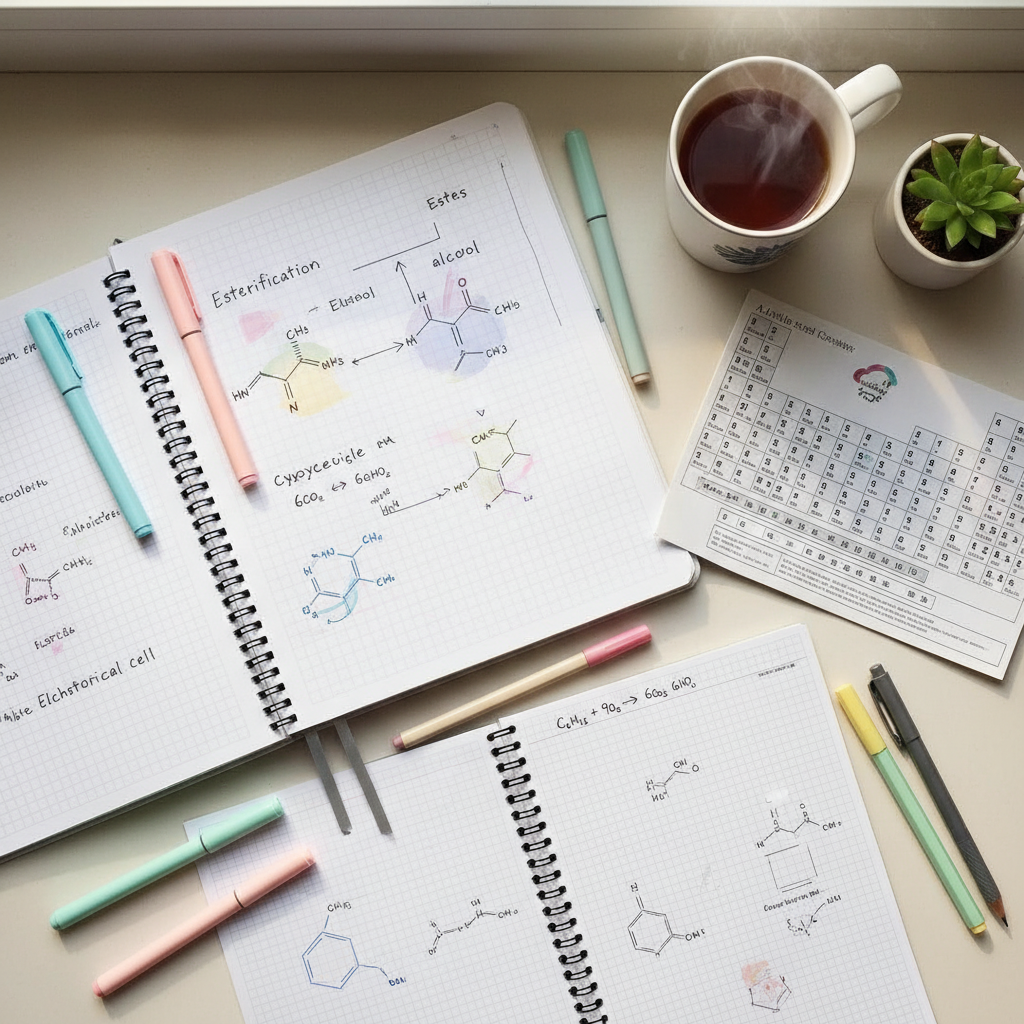
AQA A Level Chemistry — 3.3.9 Carboxylic Acids and Derivatives
Exam board: AQA A Level Chemistry 7405/2 (Paper 2: Organic Chemistry)
Specification focus: Structures, reactions and properties of carboxylic acids, esters, acyl chlorides and anhydrides
Key practicals: Esterification; oxidation of alcohols and aldehydes to carboxylic acids
3.3.9.1 Carboxylic Acids — Structure and Properties
The functional group: Carboxylic acids contain the –COOH group (a C=O bonded to an OH, always at the end of a chain).
Naming: Use the suffix –oic acid. The carboxylic acid carbon counts as carbon 1.
- CH3COOH = ethanoic acid
- CH3CH2COOH = propanoic acid
- HOOC–CH2–COOH = ethanedioic acid (oxalic acid)
Bonding in the carboxyl group: The C=O is a polar double bond (the carbonyl carbon is δ+). The O–H is polar, making the whole group very polarisable.
Hydrogen bonding: Carboxylic acids can form hydrogen bonds via:
- The O–H as a hydrogen bond donor
- The C=O (oxygen) as a hydrogen bond acceptor
In fact, carboxylic acids often form dimers — two molecules linked by two hydrogen bonds between the OH and C=O of adjacent molecules. This requires more energy to break apart and explains their unusually high boiling points compared to alcohols of similar molecular weight.
Physical properties:
- Boiling points: HIGH due to hydrogen bonding (and dimer formation). Much higher than alcohols or aldehydes of similar Mr.
- Solubility: Small carboxylic acids (formic, acetic, propionic) are soluble in water because they form hydrogen bonds with water. Larger carboxylic acids become less soluble as the hydrocarbon tail becomes more dominant.
- Smell: Often pungent and unpleasant (e.g. butyric acid smells of rancid butter).
Acidity of carboxylic acids:
Carboxylic acids are weak acids. They partially ionise in water:
RCOOH(aq) ↔ RCOO–(aq) + H+(aq)
The carboxylate ion (RCOO–) is stabilised by delocalisation of the negative charge over the two oxygen atoms of the C=O and O– bonds. This delocalisation makes the conjugate base more stable, making the proton easier to remove.
By comparison, alcohols (R–OH) are not acidic under normal conditions because the alkoxide ion (RO–) cannot delocalise the negative charge — there is only one oxygen atom.
Typical pH: A 0.1 mol dm–3 solution of ethanoic acid has pH ≈ 2.9 (not very acidic because it’s a weak acid and doesn’t fully ionise).
3.3.9.2 Preparation of Carboxylic Acids
From Primary Alcohols (oxidation)
Method: Heat a primary alcohol under reflux with acidified potassium dichromate(VI) solution.
RCHO2 + [O] → RCOOH
Conditions: K2Cr2O7/H2SO4, reflux
Observations: The orange dichromate solution turns green (Cr3+), indicating oxidation.
Mechanism: The alcohol is first oxidised to an aldehyde, then the aldehyde is further oxidised to the carboxylic acid. For this reason, use excess dichromate and reflux (not distillation) to ensure complete oxidation to the acid.
From Aldehydes (oxidation)
Method: Heat an aldehyde under reflux with acidified potassium dichromate(VI).
RCHO + [O] → RCOOH
Conditions: K2Cr2O7/H2SO4, reflux
Note: Aldehydes are oxidised much more easily than alcohols. Even mild oxidising conditions (e.g. Tollens’ reagent) can oxidise an aldehyde.
From Nitriles (hydrolysis)
Method: Heat a nitrile with dilute acid (HCl or H2SO4) and water under reflux.
R–C≡N + 2H2O + HCl(aq) → R–COOH + NH4Cl
Conditions: Dilute HCl, H2O, reflux (typically 1–2 hours)
Advantage: This is a carbon chain extension reaction. If you start with a 2-carbon nitrile, you get a 3-carbon carboxylic acid (one extra carbon in the chain).
Mechanism: The –C≡N is attacked by H2O (or H+) and hydrolysed in stages to –COOH. The ammonium salt (NH4Cl) is a byproduct.
3.3.9.3 Reactions of Carboxylic Acids
With Alcohols: Esterification
Reaction type: Condensation (nucleophilic acyl substitution)
RCOOH + R’OH ↔ RCOOR’ + H2O
Conditions: Concentrated H2SO4 (catalyst), heat (typically 70–80°C), not boiling
Reversibility: This is a reversible reaction. Equilibrium lies only slightly towards products, so:
- Use excess alcohol to push equilibrium to the right (Le Chatelier)
- Or use excess carboxylic acid (though alcohol excess is more common)
- Remove water as it forms (use a drying tube on the reflux apparatus)
Mechanism: Nucleophilic acyl substitution
- The lone pair on the oxygen of the carboxylic acid is protonated by H2SO4, making the carbonyl carbon more δ+
- The oxygen of the alcohol attacks the δ+ carbon (nucleophilic attack)
- A tetrahedral intermediate forms
- The H from the carboxylic acid OH is lost as H2O
- The C=O reforms and the ester is produced
Example: Ethanoic acid + ethanol → ethyl ethanoate + water
CH3COOH + CH3CH2OH ↔ CH3COOCH2CH3 + H2O
With Stronger Bases (neutralisation)
With NaOH: Produces a sodium salt and water
RCOOH + NaOH → RCOONa + H2O
With Na2CO3 or NaHCO3: Produces a salt, CO2 and water
2RCOOH + Na2CO3 → 2RCOONa + H2O + CO2
RCOOH + NaHCO3 → RCOONa + H2O + CO2
Observation: Effervescence (fizzing) with carbonates/bicarbonates due to CO2 gas evolution. This is a test for carboxylic acids.
With Phosphorus Pentachloride: Formation of Acyl Chlorides
Reaction: RCOOH + PCl5 → RCOCl + POCl3 + HCl
Conditions: Room temperature or gentle warming (do NOT heat strongly or HCl gas will escape)
Observations: Vigorous reaction. White fumes of HCl gas are produced. The carboxylic acid dissolves as it reacts.
Purpose: This converts the –COOH to –COCl (acyl chloride). Acyl chlorides are much more reactive than carboxylic acids and are useful intermediates in synthesis.
3.3.9.4 Esters: Structure, Properties and Reactions
Structure and Naming
An ester has the functional group –COO– (formed from a carboxylic acid and an alcohol).
General formula: RCOOR’
Naming: Name from the alcohol first, then the acid:
- CH3COOCH3 = methyl ethanoate (from methanol + ethanoic acid)
- CH3COOC2H5 = ethyl ethanoate (from ethanol + ethanoic acid)
- C2H5COOCH3 = methyl propanoate (from methanol + propanoic acid)
Physical Properties
- Boiling points: LOWER than equivalent carboxylic acids or alcohols because esters cannot form hydrogen bonds (no OH). They have only London forces and permanent dipole–dipole forces.
- Solubility: Slightly soluble in water (the –COO– can weakly hydrogen bond as an acceptor), but much more soluble in organic solvents.
- Smell: Pleasant, fruity smells. Used in flavourings and perfumes (e.g. ethyl ethanoate smells of pear drops).
Reactions of Esters: Hydrolysis
Reaction type: Nucleophilic acyl substitution (reverse of esterification)
RCOOR’ + H2O ↔ RCOOH + R’OH
Under acidic conditions (dilute H2SO4, room temperature):
- Reversible reaction
- Equilibrium favours hydrolysis if water is in excess
- Very slow at room temperature; typically refluxed for faster reaction
- Products: carboxylic acid + alcohol
Under alkaline conditions (aqueous NaOH, warm):
- Called saponification
- Irreversible (the carboxylic acid is immediately neutralised to its salt)
- Faster than acid hydrolysis
- Products: salt of the carboxylic acid + alcohol
- Equation: RCOOR’ + NaOH → RCOONa + R’OH
Example: Ethyl ethanoate hydrolysis
CH3COOC2H5 + H2O ↔ CH3COOH + C2H5OH (with dilute H2SO4)
CH3COOC2H5 + NaOH → CH3COONa + C2H5OH (saponification)
Mechanism (acid-catalysed): Similar to esterification, but in reverse. The C=O is protonated, water attacks, and the alcohol leaves.
3.3.9.5 Acyl Chlorides: Structure and Reactions
Structure and Preparation
Functional group: –COCl (much more reactive than –COOH or –COO–)
Preparation: From carboxylic acids + PCl5 (as shown above)
General formula: RCOCl
Examples:
- CH3COCl = ethanoyl chloride
- C2H5COCl = propanoyl chloride
Reactivity
Acyl chlorides are highly reactive because the Cl is a good leaving group and the carbonyl carbon is very δ+. They react readily with nucleophiles.
Reaction with Water
RCOCl + H2O → RCOOH + HCl
Conditions: Room temperature (vigorous, sometimes violent)
Observations: Steamy white fumes of HCl gas. Heat is released (exothermic).
Mechanism: The water attacks the δ+ carbonyl carbon, Cl leaves as a leaving group, and HCl is released.
Reaction with Alcohols
RCOCl + R’OH → RCOOR’ + HCl
Conditions: Room temperature (often with a base like NaOH or pyridine to neutralise the HCl)
Advantages over esterification from carboxylic acids:
- Irreversible (no equilibrium)
- Much faster
- Higher yields (no water removal needed)
- Useful for preparing esters from hindered alcohols
Reaction with Ammonia and Amines
RCOCl + 2NH3 → RCONH2 + NH4Cl
RCOCl + 2RNH2 → RCONHR + RNH3Cl
Products: Primary amides (RCONH2) or secondary amides (RCONHR)
Conditions: Excess NH3 or amine (the excess reacts with the HCl produced)
Advantage: Much easier route to amides than carboxylic acids (which require heating and don’t readily form amides)
3.3.9.6 Anhydrides (A-Level Only)
Functional group: (RCO)2O or RCOCOR
Preparation: From two carboxylic acid molecules (condensation, loss of water) or from carboxylic acid + acyl chloride + base
Reactivity: Less reactive than acyl chlorides but more reactive than carboxylic acids or esters
Reaction with Water
(RCO)2O + H2O → 2RCOOH
Example: Ethanoic anhydride + water → ethanoic acid
(CH3CO)2O + H2O → 2CH3COOH
Reaction with Alcohols
(RCO)2O + R’OH → RCOOR’ + RCOOH
Example: Ethanoic anhydride + methanol → methyl ethanoate + ethanoic acid
(CH3CO)2O + CH3OH → CH3COOCH3 + CH3COOH
Exam Tip — Distinguishing Between Carboxylic Acids, Esters, and Acyl Chlorides in Spectra
Infrared spectroscopy:
- Carboxylic acid: Broad O–H stretch (2500–3300 cm–1) overlapping with C–H stretch, plus strong C=O stretch (1680–1750 cm–1, lower frequency than esters due to resonance)
- Ester: NO O–H stretch, strong C=O stretch (1730–1750 cm–1, higher frequency than carboxylic acids)
- Acyl chloride: NO O–H stretch, strong C=O stretch (1790–1815 cm–1, highest frequency due to C–Cl)
Mass spectrometry: Look for loss of OH (17), OR (alcohol side chain), or Cl (35)
Key learning outcome: You should be able to draw mechanisms for esterification, ester hydrolysis, and acyl chloride reactions. You should know the conditions, understand why each reaction is reversible or irreversible, and predict products given a carboxylic acid, ester, or acyl chloride and a reagent.
📄 Free AQA A Level Chemistry Revision Guides

Oxford-Educated Chemistry Specialist
With over 20 years of teaching experience at some of the UK’s top independent schools, I help ambitious students bridge the gap between hard work and top-tier results. I specialise in GCSE, A Level, and IB Chemistry tuition for students targeting Grade 9s and A*s. Based in the UK but working globally, I provide 1-1 online support for families in South and West London, Dubai, and Hong Kong, ensuring students are perfectly prepared for competitive medical applications and Oxbridge entries.
I’ve helped students achieve top grades from schools such as Alleyn’s, Dulwich College, Tonbridge, Sevenoaks, Brighton College, Wycombe Abbey, Caterham, St Paul’s, Dubai College, Dubai British School and Harrow International School Hong Kong.
Contact me archardchloe@gmail.com to discuss how I can help your child excel in Chemistry.