

Blog
Edexcel International A Level Chemistry vs the UK A Level: What Actually Differs


Edexcel International A Level Chemistry (YCH11) covers content comparable to the UK A Level, but is assessed modularly across six unit papers that can be sat in January, June, or October, with individual units available for resit. There is no coursework and no practical endorsement — practical skills are examined in writing, in Units 3 and 6.
If your child attends a British international school in Hong Kong, there is a reasonable chance their chemistry papers are labelled WCH11 or WCH14 rather than the codes you might have seen on a UK exam timetable. That is because they are sitting the Pearson Edexcel International Advanced Level, not the domestic UK A Level — two qualifications that share most of their chemistry and almost none of their structure.
This matters more than it sounds. Parents ask me about it constantly, and the question underneath the question is almost always the same one: is my child at a disadvantage? The short answer is no. The longer answer is that the international specification asks for the same chemistry in a different shape, and there are two or three decisions inside that shape that families routinely get wrong — not through carelessness, but because nobody told them the decisions existed.
Here is what actually differs, and what to do about it. If your child is starting sixth form this August, it is also worth reading alongside what A Level Chemistry looks like at Nord Anglia Hong Kong.
The short answer
Your child is not sitting an easier or a lesser qualification. Pearson designed the International Advanced Level to be comparable in content and standard to the UK GCE A Level, and UK universities treat it that way.
What changes is the architecture. The UK A Level is linear: everything is taught across two years and examined in three papers at the very end. The International A Level is modular — six separate unit papers, each available three times a year, each individually resittable, with the first three units forming a standalone International Advanced Subsidiary qualification that also counts for half of the full A Level.
That last clause is the one to read twice.
On the UK A Level, Year 12 is a rehearsal. On the International A Level, it is half the final grade.
Side by side
| Edexcel International A Level (YCH11) | UK A Level (domestic) | |
|---|---|---|
| Structure | Modular — six unit papers | Linear — three papers at the end |
| Exam sessions | January, June, and October | Summer only |
| Resits | Individual units can be resat | The whole qualification |
| Does Year 12 count? | Yes — the IAS is 50% of the final grade | No — Year 12 assessment is internal only |
| Practical assessment | Written papers (Units 3 and 6), 20% of the grade | Separately reported practical endorsement, pass or fail |
| Core practicals | 16 | 12 to 16, depending on board |
| Total exam time | 9 hours 10 minutes across six papers | Around 6 hours across three papers |
| Total marks | 440 | Around 300 |
| Codes | XCH11 (IAS), YCH11 (IAL), units WCH11–WCH16 | Board-specific, e.g. 9CH0, 7405, H432 |
If you want to see how the domestic side is organised for comparison, my Edexcel A Level Chemistry topic pages cover the UK specification topic by topic.
How the qualification is built
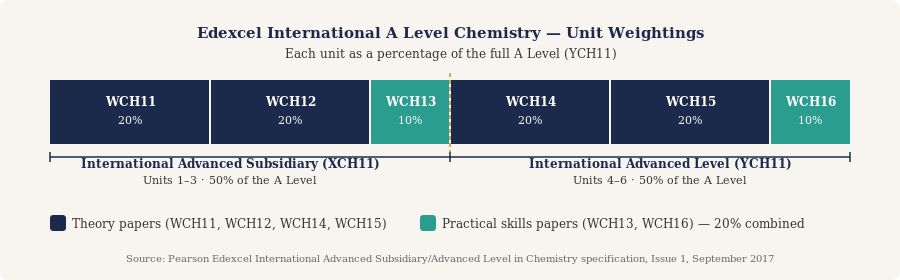
Six units, in two halves. Units 1 to 3 make up the International Advanced Subsidiary (XCH11). Units 4 to 6 complete the full International Advanced Level (YCH11).
-
Unit 1 — Structure, Bonding and Introduction to Organic Chemistry
WCH11 · 1 hr 30 · 80 marks · 20% of the A Level
Formulae and amount of substance, atomic structure, bonding, introductory organic and alkanes, alkenes. Two sections: multiple choice, then short-answer and calculation.
-
Unit 2 — Energetics, Group Chemistry, Halogenoalkanes and Alcohols
WCH12 · 1 hr 30 · 80 marks · 20% of the A Level
Energetics, intermolecular forces, redox and Groups 1, 2 and 7, introductory kinetics and equilibria, alcohols and halogenoalkanes, mass spectra and infrared. Three sections, the third being a contemporary context question.
-
Unit 3 — Practical Skills in Chemistry I
WCH13 · 1 hr 20 · 50 marks · 10% of the A Level
A written paper on the experimental work done across Units 1 and 2.
-
Unit 4 — Rates, Equilibria and Further Organic Chemistry
WCH14 · 1 hr 45 · 90 marks · 20% of the A Level
Kinetics, entropy and lattice energy, Kc and Kp, acid-base equilibria and buffers, carbonyls, carboxylic acids, chirality, and NMR. This paper carries the heaviest mathematical demand of the six.
-
Unit 5 — Transition Metals and Organic Nitrogen Chemistry
WCH15 · 1 hr 45 · 90 marks · 20% of the A Level
Redox equilibria and electrode potentials, transition metal chemistry, arenes, amines and amino acids, organic synthesis.
-
Unit 6 — Practical Skills in Chemistry II
WCH16 · 1 hr 20 · 50 marks · 10% of the A Level
The second written practical paper, covering the work done across Units 4 and 5.
Every unit is available in January, June, and October, and every unit is externally examined. There is no coursework anywhere in the qualification.
Is it harder?
This is the wrong question, and I say that as someone who has taught both for two decades.
The international papers are not a softer option. What they are is differently distributed. A student sitting Unit 1 is examined on five topics rather than on two years of accumulated content, which genuinely does reduce the load at any single sitting. That is a real advantage and it suits students who struggle to hold a great deal in mind at once.
But the demand comes back in other places. Units 2 and 5 each close with a contemporary context question — an unfamiliar scenario that has to be read, interpreted, and answered using chemistry taught elsewhere in the course. That is precisely the skill that separates an A from an A*, and it is the hardest thing to revise for, because you cannot revise a context you have not seen. Unit 4 carries the highest proportion of higher-level mathematics on the specification. And across the whole qualification a student sits nine hours and ten minutes of examination, against roughly six for a domestic A Level.
More assessment, spread more thinly, with the genuinely difficult marks concentrated in places students do not expect. Not harder. Differently shaped — and the shape is what to prepare for.
What modular assessment actually does to revision
Here is the part I would most want a parent to take away.
Because the IAS counts for half the International A Level, a grade banked in Year 12 is not a practice grade. It is fifty per cent of the final result, already fixed. Families who have come from a UK context often carry an assumption that Year 12 is a rehearsal — because on a linear A Level, it is. On this specification it is not, and by the time that becomes obvious, half the qualification is behind you.
The resit provision looks like the answer to this, and sometimes it is. But I have watched the same pattern often enough to name it. A student sits Unit 1 in January of Year 12, gets a grade below where they want to be, and decides to resit later. Later arrives with Units 4, 5, and 6 to prepare for. The resit requires revising material last studied eighteen months ago, alongside the hardest content on the course, in the same term. It very often does not happen.
A resit is not a second chance. It is a second workload, arriving in the busiest term of the two years.
The practical response is not to avoid resits. It is to treat every unit entry as a real entry, and to decide in advance — with the school, before the January of Year 12 — which units are being sat when and why. Flexibility is only an advantage if somebody is actively using it. Working through Edexcel International A Level Chemistry past papers in the right order, unit by unit, is the single most useful thing a student can do between now and their next sitting.
No practical endorsement — and why that matters
On a domestic A Level, practical competence is assessed by teachers across the course and reported separately as a pass or fail alongside the grade. On the International A Level there is no endorsement. Instead, Units 3 and 6 examine practical skills in writing: apparatus selection, controlling variables, measurement uncertainty, significant figures, evaluating method, and drawing conclusions from data.
Those two papers are worth 20% of the final grade. A fifth of the qualification.
They are also, in my experience, the two papers students revise least — partly because “practical” sounds like something you do rather than something you write about, and partly because there is no textbook chapter called Unit 3. A student can carry out all sixteen core practicals conscientiously and still lose marks on WCH13 because nobody taught them how to write about percentage error, or why the examiner wants “repeat and calculate a mean” rather than “do it again”. My core practicals guide covers the write-up technique that these papers reward.
If your child sits this specification, ask how the school prepares for Units 3 and 6 specifically. It is a reasonable question and a good school will have a clear answer.
Do UK universities accept it?
Yes. Pearson consulted UK and international universities during the qualification’s development, and it carries UCAS points in the same way as a domestic A Level.
One point of honesty, because you may come across it and wonder: the specification states that these qualifications are not accredited or regulated by any UK regulatory body. That sounds alarming and is not. Ofqual regulates qualifications delivered in England; the International A Level is designed for centres outside the UK, so it sits outside that remit. It is awarded by Pearson, the same awarding body behind the domestic Edexcel A Level, to a standard Pearson designs as comparable. Admissions tutors are entirely familiar with it.
What this means for how your child is taught
Three practical implications.
The specification codes matter. A tutor teaching to domestic Edexcel is teaching adjacent content in the wrong structure, to the wrong mark schemes, with the wrong past papers. Ask which specification any support is built around, and expect a unit code in the answer.
The unit calendar is a decision, not a default. Which units, sat when, is worth an actual conversation at the start of Year 12 rather than a form filled in at the end of it.
Units 3 and 6 need deliberate preparation. Twenty per cent of the grade should not be the part nobody plans for.
If your child is sitting Edexcel International A Level Chemistry and you would like to talk through where the marks are actually going, I am happy to have a look with you.
Book a free 15-minute conversation
Fifteen minutes on Zoom. No obligation, and no sales pitch — just a straight assessment of what would help.
Common questions
Is the International A Level easier than the UK A Level?
No. The content is comparable and the total assessment is longer — nine hours ten minutes against roughly six. The difference is distribution, not difficulty.
Can my child resit individual units?
Yes. Units can be resat and the better result counts. But a resit in Year 13 competes directly with Units 4, 5, and 6 for revision time, so it is worth planning rather than assuming.
Does the AS year count towards the final grade?
Yes. Units 1 to 3 form the International Advanced Subsidiary and contribute 50% of the full International Advanced Level.
Is there any coursework?
None. Every unit is externally examined, including the two practical skills papers.
What are the specification codes?
XCH11 for the International Advanced Subsidiary, YCH11 for the full International Advanced Level. The individual unit papers are WCH11 to WCH16.
How many times a year can units be sat?
Three — January, June, and October.
Unit codes, paper durations, mark totals, and weightings in this article are taken from the Pearson Edexcel International Advanced Subsidiary/Advanced Level in Chemistry specification, Issue 1, September 2017. Verified 25 July 2026.
GO BEYOND THE FREE RESOURCES
The Edexcel A Level Chemistry Complete Revision Pack
Predicted Papers 1, 2 and 3 for June 2027 with full mark schemes, new spec-matched questions and a 40-mark topic test for every one of the 19 topics, Paper 3-style questions on all 16 core practicals, and a 16-week run-up plan to the exams.

Oxford-Educated Chemistry Specialist
With over 20 years of teaching experience at some of the UK’s top independent schools, I help ambitious students bridge the gap between hard work and top-tier results. I specialise in GCSE, A Level, and IB Chemistry tuition for students targeting Grade 9s and A*s. Based in the UK but working globally, I provide 1-1 online support for families in South and West London, Dubai, and Hong Kong, ensuring students are perfectly prepared for competitive medical applications and Oxbridge entries.
I’ve helped students achieve top grades from schools such as Alleyn’s, Dulwich College, Tonbridge, Sevenoaks, Brighton College, Wycombe Abbey, Caterham, St Paul’s, Dubai College, Dubai British School and Harrow International School Hong Kong.
Contact me archardchloe@gmail.com to discuss how I can help your child excel in Chemistry.