

AQA A-Level Chemistry: 3.2 Inorganic Chemistry
AQA A Level Chemistry 3.2 Inorganic Chemistry
3.2.1 Periodicity
The Periodic Table organizes elements based on atomic structure, revealing patterns in properties.
3.2.1.1 Classification
Elements are classified into blocks based on the highest energy sub-shell containing electrons:
| Block | Outer Electron Configuration | Groups |
|---|---|---|
| s-block | s¹ or s² | Groups 1 & 2 |
| p-block | s²p¹ to s²p⁶ | Groups 3 to 8 (13-18) |
| d-block | 3d¹⁻¹⁰ 4s² | Transition metals (Groups 3-12) |
| f-block | 4f/5f orbitals | Lanthanides & Actinides |
Example: Sodium [Ne]3s¹ → s-block; Chlorine [Ne]3s²3p⁵ → p-block
3.2.1.2 Physical Properties of Period 3 (Na → Ar)
| Property | Trend Across Period 3 | Explanation |
|---|---|---|
| Atomic Radius | Decreases | Increasing nuclear charge pulls electrons closer; similar shielding. |
| First Ionisation Energy | General increase (with dips at Al & S) | Nuclear charge increases, radius decreases → harder to remove electrons. Dip at Al: Electron removed from p orbital (higher energy than s). Dip at S: Electron-electron repulsion in paired p orbital. |
| Melting Point | Increases Na→Si, then decreases P→Ar | Na, Mg, Al: Metallic bonding strength ↑ with ↑ charge density. Si: Giant covalent, very strong. P₄, S₈, Cl₂, Ar: Simple molecular, weak van der Waals. |
3.2.2 Group 2: Alkaline Earth Metals
Trends in Properties (Mg → Ba)
- Atomic Radius: Increases (extra electron shells).
- First Ionisation Energy: Decreases (increased shielding outweighs nuclear charge).
- Melting Point: Generally decreases (metallic bonding weakens as ions get larger).
Reactions with Water
- Mg: Very slow with cold water, faster with steam → Mg(OH)₂ + H₂
- Ca, Sr, Ba: React more vigorously → M(OH)₂ + H₂
- Reactivity increases down group (easier to lose electrons).
Important Reactions & Uses
- Extraction of Titanium:
[ \text{TiCl}_4(g) + 2\text{Mg}(s) \rightarrow \text{Ti}(s) + 2\text{MgCl}_2(s) ] - Flue Gas Desulfurisation:
- CaO + SO₂ → CaSO₃
- CaCO₃ + SO₂ → CaSO₃ + CO₂
Solubility Trends
- Hydroxides: Solubility increases down group.
- Mg(OH)₂: Sparingly soluble (used in antacids).
- Ca(OH)₂: Slightly soluble (limewater, agriculture).
- Sulfates: Solubility decreases down group.
- BaSO₄: Insoluble (used in “barium meals” for X-rays).
Testing for Sulfate Ions
- Acidify with dilute HCl/HNO₃ (to remove CO₃²⁻, SO₃²⁻ interference).
- Add BaCl₂ solution.
- White precipitate = BaSO₄ → confirms SO₄²⁻.
3.2.3 Group 7: Halogens
3.2.3.1 Trends in Properties
| Property | Trend Down Group | Explanation |
|---|---|---|
| Electronegativity | Decreases | Larger atoms attract bonding pair less. |
| Boiling Point | Increases | Larger molecules → stronger van der Waals. |
| Oxidising Power | Decreases | Harder to gain electrons as atomic size increases. |
Displacement Reactions
- Cl₂ + 2Br⁻ → 2Cl⁻ + Br₂ (orange solution)
- Br₂ + 2I⁻ → 2Br⁻ + I₂ (brown solution)
- Cl₂ + 2I⁻ → 2Cl⁻ + I₂
More reactive halogen displaces less reactive halide.

Reducing Ability of Halide Ions
Increases down group (I⁻ > Br⁻ > Cl⁻ > F⁻).
Reaction with Conc. H₂SO₄:
- NaCl: Steamy fumes of HCl (not redox).
- NaBr: HBr + SO₂ (redox: Br⁻ reduces S from +6 to +4).
- NaI: HI + H₂S (redox: I⁻ reduces S from +6 to -2).
Testing for Halide Ions
- Acidify with dilute HNO₃ (removes CO₃²⁻ interference).
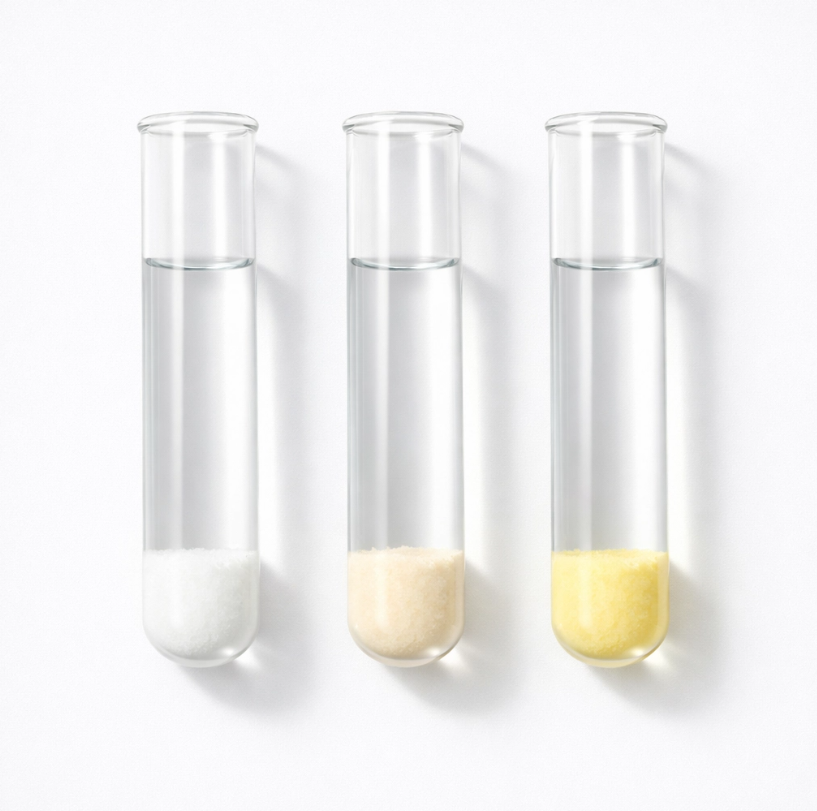
- Add AgNO₃ solution:
- AgCl: White precipitate (soluble in dilute NH₃)
- AgBr: Cream precipitate (soluble in conc. NH₃)
- AgI: Yellow precipitate (insoluble in NH₃)
3.2.3.2 Uses of Chlorine
- Water Treatment: Kills bacteria (Cl₂ + H₂O → HClO + HCl).
- Bleaching: Cl₂ + 2NaOH → NaCl + NaClO + H₂O (chlorate(I) ions bleach).
Balance: Health benefits vs. toxicity risks.
Required Practical 4: Test-tube reactions for cations and anions.
AQA A Level Chemistry Redox, Group 2 and Group 7 Topic Test (Practice Test)
AQA A Level Chemistry Redox, Group 2 and Group 7 Mark Scheme
3.2.4 Period 3 Oxides (A-Level)
Formation from Elements
- Na → Na₂O, Mg → MgO, Al → Al₂O₃, Si → SiO₂, P → P₄O₁₀, S → SO₂/SO₃
- Bonding changes: Metallic → Giant covalent → Simple molecular.
Melting Points of Oxides
- Na₂O, MgO, Al₂O₃: High mp (ionic/giant).
- SiO₂: Very high mp (macromolecular).
- P₄O₁₀, SO₂, SO₃: Low mp (molecular).
Reactions with Water & pH
| Oxide | Reaction with Water | pH of Solution |
|---|---|---|
| Na₂O | Na₂O + H₂O → 2NaOH | Strongly alkaline (13-14) |
| MgO | MgO + H₂O → Mg(OH)₂ | Weakly alkaline (9-10) |
| Al₂O₃ | No reaction | – |
| SiO₂ | No reaction | – |
| P₄O₁₀ | P₄O₁₀ + 6H₂O → 4H₃PO₄ | Acidic (1-2) |
| SO₂ | SO₂ + H₂O ⇌ H₂SO₃ | Acidic (2-3) |
| SO₃ | SO₃ + H₂O → H₂SO₄ | Very acidic (0-1) |
Acid-Base Behaviour
- Basic: Na₂O, MgO (react with acids).
- Amphoteric: Al₂O₃ (reacts with acids AND bases).
- Acidic: SiO₂, P₄O₁₀, SO₂, SO₃ (react with bases).
AQA A Level Chemistry Period 3 Elements and Their Oxides Topic Test (Practice Test)
AQA A Level Chemistry Period 3 Elements and Their Oxides Mark Scheme
3.2.5 Transition Metals (A-Level)
3.2.5.1 General Properties
Definition: Element with incomplete d-subshell in atom/ion.
Key Properties:
- Formation of coloured ions
- Variable oxidation states
- Catalytic activity
- Complex formation
Complex Ion Terminology
- Ligand: Molecule/ion donating electron pair to metal.
- Complex: Metal ion surrounded by ligands.
- Coordination Number: Number of coordinate bonds.
- Types: Monodentate (1 bond), bidentate (2 bonds), multidentate (many).
3.2.5.2 Substitution Reactions
Common Ligand Exchanges
- [M(H₂O)₆]²⁺ + 6NH₃ → [M(NH₃)₆]²⁺ + 6H₂O (same coordination number)
- Co²⁺: [Co(H₂O)₆]²⁺ (pink) → [CoCl₄]²⁻ (blue) with conc. HCl (coordination number 6→4)
Chelate Effect
Multidentate ligands replace monodentate ligands because:
- Entropy increases (more particles in solution).
- ΔG becomes more negative (feasible).
Haemoglobin
- Fe(II) complex with porphyrin (multidentate ligand).
- O₂ binds reversibly to Fe(II).
- CO poisoning: CO binds more strongly than O₂.
3.2.5.3 Shapes & Isomerism
| Shape | Coordination | Examples | Isomerism |
|---|---|---|---|
| Octahedral | 6 | [Co(NH₃)₆]³⁺, [Fe(H₂O)₆]²⁺ | cis-trans, optical |
| Tetrahedral | 4 | [CoCl₄]²⁻ | Optical |
| Square planar | 4 | [Pt(NH₃)₂Cl₂] | cis-trans (cisplatin) |
| Linear | 2 | [Ag(NH₃)₂]⁺ | – |
Cisplatin: Anti-cancer drug (cis isomer binds to DNA).
3.2.5.4 Coloured Ions
Origin of Colour:
- d-electrons absorb visible light → excitation.
- ΔE = hν = hc/λ
- Colour seen is complementary to colour absorbed.
Factors Affecting Colour:
- Oxidation state (Fe²⁺ vs Fe³⁺)
- Ligand (H₂O vs NH₃)
- Coordination number
Colorimetry: Measure concentration of coloured solutions using calibration curve.
3.2.5.5 Variable Oxidation States
Common Examples:
- V: +5 (VO₂⁺), +4 (VO²⁺), +3 (V³⁺), +2 (V²⁺)
- Mn: +2, +4, +6, +7
- Fe: +2, +3
Redox Titrations:
- Fe²⁺ with MnO₄⁻ (acidified):
[ 5\text{Fe}^{2+} + \text{MnO}_4^- + 8\text{H}^+ \rightarrow 5\text{Fe}^{3+} + \text{Mn}^{2+} + 4\text{H}_2\text{O} ] - C₂O₄²⁻ with MnO₄⁻:
[ 5\text{C}_2\text{O}_4^{2-} + 2\text{MnO}_4^- + 16\text{H}^+ \rightarrow 10\text{CO}_2 + 2\text{Mn}^{2+} + 8\text{H}_2\text{O} ]
Tollens’ Reagent: [Ag(NH₃)₂]⁺ oxidises aldehydes → silver mirror.
3.2.5.6 Catalysts
Heterogeneous: Different phase from reactants.
- Contact Process: V₂O₅ catalyzes SO₂ → SO₃
- Haber Process: Fe catalyzes N₂ + 3H₂ → 2NH₃
Homogeneous: Same phase (forms intermediate).
- Example: Fe²⁺ catalyzes I⁻ + S₂O₈²⁻ reaction.
Autocatalysis: Mn²⁺ catalyzes MnO₄⁻ + C₂O₄²⁻ reaction.
3.2.6 Reactions in Aqueous Solution (A-Level)
Metal-Aqua Ions
- [M(H₂O)₆]²⁺: M = Fe²⁺ (pale green), Cu²⁺ (blue)
- [M(H₂O)₆]³⁺: M = Al³⁺ (colourless), Fe³⁺ (yellow/brown)
Acidity: [M(H₂O)₆]³⁺ more acidic than [M(H₂O)₆]²⁺ due to higher charge/size ratio.
Test-Tube Reactions
With OH⁻ (NaOH):
| Ion | Observation |
|---|---|
| [M(H₂O)₆]²⁺ | |
| Cu²⁺ | Blue precipitate [Cu(H₂O)₄(OH)₂] |
| Fe²⁺ | Green precipitate, turns brown |
| [M(H₂O)₆]³⁺ | |
| Al³⁺ | White precipitate, dissolves in excess |
| Fe³⁺ | Brown precipitate |
With NH₃:
- Similar to OH⁻, but some complexes dissolve in excess NH₃.
- [Cu(H₂O)₆]²⁺ → blue ppt → deep blue solution with excess.
With CO₃²⁻:
- M²⁺: Insoluble carbonate formed.
- M³⁺: CO₃²⁻ acts as base → hydroxide + CO₂ gas.
Required Practical 11: Identify transition metal ions in solution.
Key Summary Table: Period 3 Oxides
| Element | Oxide | Structure | Bonding | MP | Reaction with Water | pH |
|---|---|---|---|---|---|---|
| Na | Na₂O | Ionic lattice | Ionic | High | Forms NaOH | 13-14 |
| Mg | MgO | Ionic lattice | Ionic | High | Forms Mg(OH)₂ | 9-10 |
| Al | Al₂O₃ | Ionic lattice | Ionic | High | No reaction | – |
| Si | SiO₂ | Macromolecular | Covalent | Very high | No reaction | – |
| P | P₄O₁₀ | Molecular | Covalent | Low | Forms H₃PO₄ | 1-2 |
| S | SO₂/SO₃ | Molecular | Covalent | Low | Forms H₂SO₃/H₂SO₄ | 0-3 |
Practical Skills Highlight
- Group 2 tests: Solubility trends, sulfate test.
- Halogen tests: Displacement, silver nitrate, reducing power.
- Transition metal tests: NaOH/NH₃/CO₃²⁻ reactions, colour changes.
- Colorimetry: Determine concentration of coloured ions.
- Redox titrations: MnO₄⁻ with Fe²⁺ or C₂O₄²⁻.
Remember: Always consider explanations in terms of:
- Atomic structure (radius, nuclear charge, shielding)
- Bonding type (ionic, covalent, metallic)
- Entropy/enthalpy changes
- Charge/size ratios
For more resources and practice questions, visit Chemistry with Chloe!