

Blog
Beyond the A*: Why the UK Chemistry Olympiad Gold is the Ultimate UCAS Stand-Out


So here we are, late January results anxiety season. If your teen sat the Round 1 UK Chemistry Olympiad (UKChO) two weeks ago, you’re probably in that strange limbo where they’re simultaneously convinced they’ve bombed it and secretly hopeful they nailed it. I’ve seen this cycle with dozens of my students, from Dubai College to Westminster School, and I promise you: just sitting that paper was an achievement in itself.
But let’s talk about what happens if they do land a Gold or Silver. Because here’s the truth that most parents don’t realize until it’s UCAS season: an A* in A-Level Chemistry is the baseline now, not the crown jewel. For Oxbridge, Imperial, or any competitive Chemistry or Medicine course, you need something that makes admissions tutors sit up and actually notice your application in a sea of straight-A candidates.
That something? A Chemistry Olympiad medal. 🏅
The A* Problem: When Excellence Becomes the Average
Let me paint you a picture. Last year, I worked with a brilliant Year 13 student in Dubai, predicted A*A*A* across Chemistry, Maths, and Biology. Immaculate predicted grades. Beautiful personal statement. But when she applied to Cambridge for Natural Sciences, her application felt… quiet. There was nothing that screamed “I live and breathe chemistry beyond what’s required of me.”
Compare that to another student I tutored who achieved UKChO Silver in Year 12. His predicted grades? A*AA. Not quite as polished. But his UCAS application had a story: “I’m the kid who voluntarily sat a brutal 2-hour exam full of problems I’d never seen before, and I thrived.” Guess which one got the Cambridge interview?
The Olympiad isn’t just an exam, it’s a signal. It tells top universities that your child doesn’t just memorize reaction mechanisms; they can think like a chemist when faced with the unknown. And in 2026, with record numbers of students achieving top grades, that differentiation is everything.
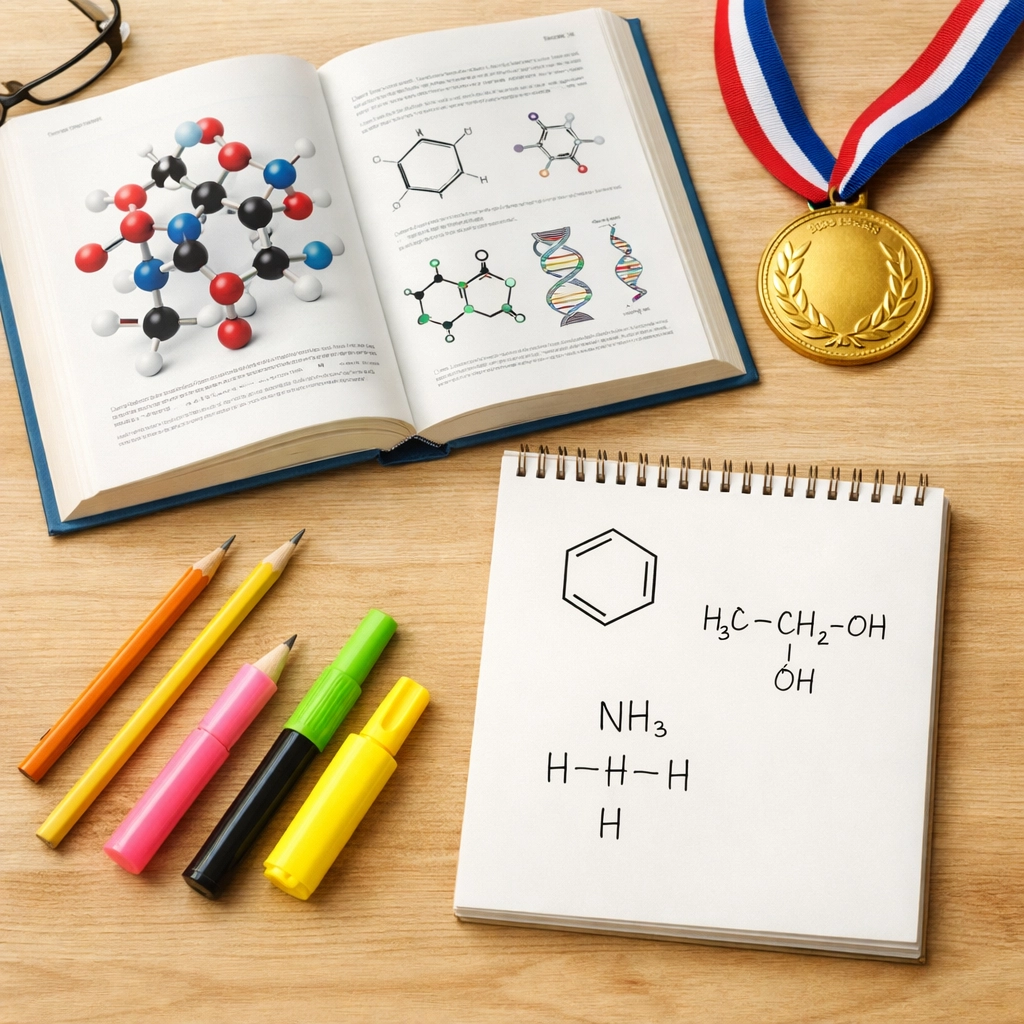
What Makes UKChO Gold So Rare (and So Valuable)
Here’s the reality check: only the top 7-8% of UK entrants achieve Gold. In a competition where thousands of the country’s most ambitious chemistry students enter, that’s an incredibly selective club. To put it in perspective, getting an A* in A-Level Chemistry puts you in roughly the top 25% of candidates. A UKChO Gold? You’re in a completely different league.
And this isn’t about memorizing more content. The Round 1 paper throws problems at students that require multi-step reasoning, unfamiliar contexts, and genuine chemical intuition. I’ve watched students with perfect recall stumble because they couldn’t adapt their knowledge to a brand-new scenario. The Olympiad tests whether you can think like a chemist, not just whether you’ve done your flashcards.
For admissions tutors at Oxford, Cambridge, or Imperial, a Gold certificate is shorthand for: “This student has the intellectual agility we need.” It’s proof that when your teen hits a problem in their degree that wasn’t in the lecture notes, they won’t panic, they’ll figure it out.
The 2026 Context: Intellectual Bravery Counts, Even Without the Medal
Now, I know what some of you are thinking: “But my child found Round 1 really difficult. They don’t think they’ll place.” And honestly? That’s completely normal. The UKChO is designed to be intimidating. Those questions about obscure reaction mechanisms and data interpretation from research papers? They’re meant to stretch even the strongest students.
But here’s what I tell my students, especially those in Dubai and Hong Kong who sometimes feel like they’re competing against the entire UK: the act of sitting that exam matters. Even if you don’t medal, the fact that you voluntarily signed up for one of the toughest chemistry challenges in the country shows intellectual bravery. That’s something you can mention in your personal statement. It shows curiosity. It shows ambition. And for competitive courses, that narrative, “I pushed myself beyond the curriculum because I genuinely love this subject”, is gold dust. 🌟
Why It’s the Ultimate UCAS Differentiator
Let’s get practical. You’re targeting Medicine at UCL, or Chemistry at Durham, or Natural Sciences at Cambridge. Your competition? Hundreds of other students with near-perfect predicted grades, glowing references, and work experience. Everyone has ticked the boxes.
A UKChO Gold (or Silver) is the thing that makes your application memorable. It’s tangible proof of:
- Higher-order problem solving: You’ve tackled problems that go beyond A-Level specification
- Academic passion: You didn’t have to do this, you chose to challenge yourself
- Resilience: You sat a notoriously difficult exam and performed under pressure
- Competitive edge: You’ve been benchmarked against the best chemistry students nationally
For courses like Medicine, where chemistry knowledge is foundational but not always the focus, a medal shows you have the analytical rigor to handle anything the degree throws at you. For straight Chemistry degrees, it’s a signal that you’re not just interested in passing exams, you’re genuinely curious about the why behind reactions, mechanisms, and molecular behavior.
Round 2 Prep: For Those Expecting High Marks
Okay, so let’s say your teen is quietly confident about Round 1. Maybe they’ve mentioned a few questions they think they nailed, or they have a track record of thriving under pressure. If they’re invited to Round 2 (the more elite cohort), here’s what they need to know: it’s a completely different beast.
Round 2 questions are unstructured. There’s no “show that…” followed by a scaffolded series of steps. Instead, you get a research abstract, some experimental data, and a vague prompt like “suggest a mechanism for this transformation.” You’re expected to synthesize everything you know about chemistry, organic mechanisms, thermodynamics, spectroscopy, and build an argument from scratch.
Here’s my top tip for Round 2 preparation: practice multi-step synthesis problems without looking at mark schemes first. Get comfortable sitting with uncertainty. Work through problems from past papers where you genuinely don’t know the answer immediately. The goal isn’t to memorize pathways; it’s to develop the confidence to construct a logical solution when faced with ambiguity.
I also recommend focusing on data interpretation. Round 2 loves giving you IR spectra, NMR data, or kinetic graphs and asking you to draw conclusions. If you can fluently read analytical data and connect it to mechanistic reasoning, you’ll be miles ahead.
And honestly? If your child is at this level and needs that strategic push, that’s where working with an experienced online chemistry tutor (yes, like me 😊) can make all the difference. I’ve guided students through Olympiad prep from Dubai to London, and the key is learning how to approach unfamiliar problems, not just drilling more content.
The Dubai (and Global) Advantage
If you’re reading this from Dubai, Hong Kong, or any other expat hub, here’s what you need to know: the UKChO is a global benchmark for excellence. Whether your child attends Dubai College, JESS, or North London Collegiate School Dubai, participating in this competition puts them on the same playing field as students from Westminster or St. Paul’s in London.
And that matters. Because when UK universities review your UCAS application, they want to see that you’re operating at the same rigorous standard as domestic students: if not higher. A UKChO medal from an international school is a powerful signal that your education is world-class, even if you’re learning chemistry in 35°C heat instead of a drizzly London suburb.
For expat families, I always emphasize the importance of maintaining UK curriculum alignment while also building those competitive extras. If you’re moving between education hubs: say, from London to Dubai mid-Year 12: having an Olympiad medal on your UCAS application is a brilliant way to show continuity and ambition, regardless of which school you’re attending.

Beyond the Grade: The Critical Thinking Olympiad Students Develop
Here’s what I’ve observed after years of working with Olympiad participants: they think differently. Even if they don’t medal, students who engage with these problems develop a kind of intellectual flexibility that serves them far beyond chemistry.
They learn to:
- Break down complex, unfamiliar problems into manageable parts
- Stay calm when they encounter something they’ve never seen before
- Draw connections between disparate areas of chemistry (organic + kinetics + thermodynamics)
- Communicate their reasoning clearly, even when uncertain
These are the skills that make you successful in a Chemistry degree, in medical school, in research, in consulting, basically anywhere that requires analytical rigor and adaptability. The Olympiad is just the training ground. 💪
What If Your Teen Didn’t Sit Round 1 This Year?
If you’re reading this thinking, “We missed the boat for 2026,” don’t worry. There’s always next year if your child is in Year 12 now. And in the meantime, there are other ways to build that “intellectual curiosity” narrative on a UCAS application:
- Chemistry journal clubs (reading and discussing recent research)
- Independent extended projects on topics beyond the syllabus
- Attending lectures at universities (many offer open days with taster sessions)
- Working through past Olympiad papers as practice, even if not sitting the official exam
The goal is to show admissions tutors that your teen doesn’t just study chemistry because it’s required: they study it because they find it genuinely fascinating.
Let’s Get Your Teen Olympiad-Ready
If your child is serious about standing out on UCAS: whether they’re aiming for Oxbridge, Russell Group Medicine, or any competitive STEM course: Olympiad-level critical thinking is the bridge. It’s the difference between being a strong candidate and being an unforgettable one.
I specialize in helping ambitious students (especially those navigating A-Levels from Dubai, Hong Kong, and other global hubs) develop the problem-solving skills that make them thrive in these high-stakes competitions. We work on tackling unfamiliar problems, building mechanistic intuition, and developing the confidence to approach the “impossible” questions without panic.
If your teen is expecting Round 1 results soon and wants to hit the ground running for Round 2: or if they’re in Year 12 and want to start preparing for next year’s competition: let’s chat. I offer online 1-1 tutoring tailored specifically to bridging the gap between A-Level theory and Olympiad-level reasoning.
Because here’s the truth: an A* will get your application read. But a UKChO Gold? That’ll get you remembered. ✨


Oxford-Educated Chemistry Specialist
With over 20 years of teaching experience at some of the UK’s top independent schools, I help ambitious students bridge the gap between hard work and top-tier results. I specialise in GCSE, A Level, and IB Chemistry tuition for students targeting Grade 9s and A*s. Based in the UK but working globally, I provide 1-1 online support for families in South and West London, Dubai, and Hong Kong, ensuring students are perfectly prepared for competitive medical applications and Oxbridge entries.
I’ve helped students achieve top grades from schools such as Alleyn’s, Dulwich College, Tonbridge, Sevenoaks, Brighton College, Wycombe Abbey, Caterham, St Paul’s, Dubai College, Dubai British School and Harrow International School Hong Kong.
Contact me archardchloe@gmail.com to discuss how I can help your child excel in Chemistry.