

Blog
Chemistry vs. Chemical Engineering: Which Career Path is Right for You?

Here’s the question that every Chemistry student asks me at least once: “Chloe, should I do Chemistry or Chemical Engineering at uni?”
And honestly? It’s one of the most important career forks you’ll face. Because while these two paths start in the same place, your A-Level Chemistry classroom, they lead to completely different daily lives.
So let me break it down for you. Do you want to discover the molecule or build the factory? Let’s find out.
The Fundamental Difference: Scientists vs. Engineers
Here’s the simplest way to think about it:
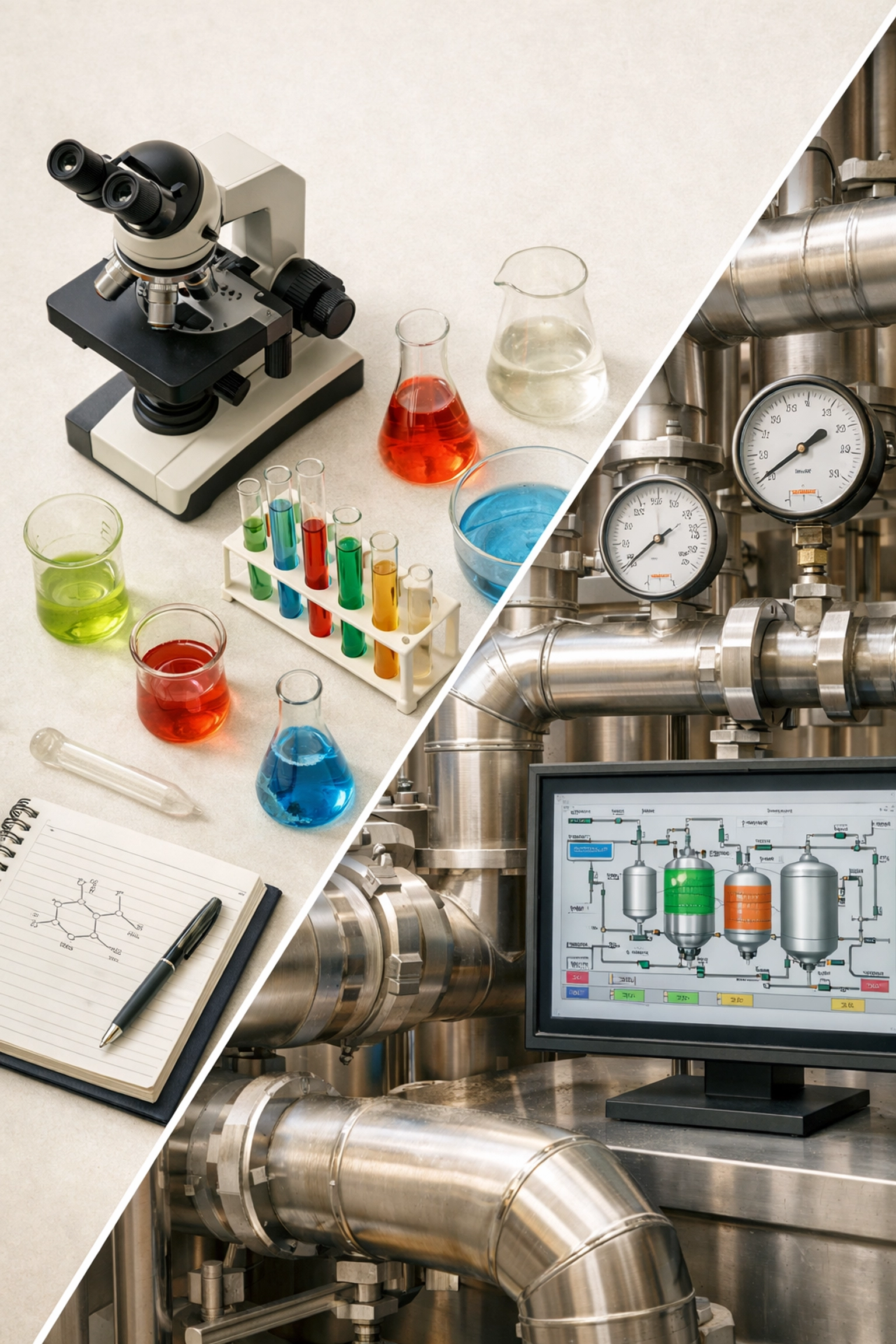
Chemists ask “Why does this happen?” and “What can we create?” They’re the explorers of the molecular world, working in labs with beakers and spectrometers, running experiments to understand how substances behave and react.
Chemical Engineers ask “How do we make this at scale?” and “How much will it cost?” They’re the builders, taking that lab discovery and figuring out how to produce 10,000 litres of it per hour without blowing up the factory or going bankrupt.
Think of it like this: A chemist discovers a new cancer drug in a petri dish. A chemical engineer designs the multi-million-pound production plant that makes that drug available to patients worldwide. Both are essential. Both start with the same Chemistry A-Level foundation. But they’re very different jobs.
The Research Chemist: The Explorer 🔬
If you’re the type of person who gets genuinely excited about why reactions happen and loves the idea of spending your days in a lab coat, this might be your path.
What Do Research Chemists Actually Do?
Research Chemists work in laboratories, running experiments to:
- Develop new materials (think stronger plastics, biodegradable packaging, or next-gen batteries)
- Synthesize new compounds for pharmaceuticals or cosmetics
- Analyze substances to understand their properties and behaviour
- Test products for quality and safety
You might work for a pharmaceutical company developing medicines, a cosmetics brand formulating new skincare products, or even a government lab testing environmental samples for pollutants.
The Education Path
Most entry-level roles require a Bachelor’s degree in Chemistry, but here’s the reality: if you want to lead research projects or work on cutting-edge discoveries, you’ll probably need a PhD. That’s 3-4 extra years after your undergrad, but it opens doors to roles where you’re the one making the breakthrough.
Bachelor’s and Master’s graduates often start as lab technicians, absolutely valid roles where you’ll support research and gain hands-on experience, but you won’t be the one designing the experiments.
The Day-to-Day Life
Expect to spend your time:
- Running controlled experiments with small volumes of chemicals
- Recording data meticulously (seriously, your lab book is your bible)
- Using analytical instruments like NMR spectrometers, mass spectrometers, or chromatography equipment
- Writing up findings for publication or internal reports
It’s detail-oriented, intellectually stimulating, and perfect if you love solving puzzles at the molecular level.
The Chemical Engineer: The Builder 🏭
If you’re more interested in the real-world application, taking scientific knowledge and turning it into products people actually use, then chemical engineering might be calling your name.
What Do Chemical Engineers Actually Do?
Chemical Engineers design and optimize large-scale production processes. They work on:
- Process design: Creating the systems that turn raw materials into finished products (from crude oil to petrol, from wood pulp to paper)
- Equipment specification: Choosing and designing reactors, distillation columns, heat exchangers
- Safety management: Ensuring processes don’t explode, leak, or poison anyone
- Efficiency optimization: Making production faster, cheaper, and more sustainable
You might work in oil and gas refineries, pharmaceutical manufacturing plants, food production facilities, or even in environmental management designing water treatment systems.

The Education Path
Here’s the good news: a Bachelor’s degree in Chemical Engineering is often enough to launch a solid career. You don’t necessarily need a PhD unless you’re going into academic research or highly specialized R&D roles.
Your degree will include modules on:
- Thermodynamics (energy and heat transfer)
- Fluid mechanics (how liquids and gases flow)
- Process control (automation and monitoring)
- Reactor design (where the chemistry actually happens at scale)
The Day-to-Day Life
Expect to spend your time:
- Working with massive volumes of materials (think thousands of litres, not millilitres)
- Using computer simulations to model processes before building them
- Collaborating with project managers, safety teams, and operations staff
- Troubleshooting production issues when things go wrong (and they will)
It’s hands-on, collaborative, and perfect if you love problem-solving in the real world rather than just in theory.
Let’s Talk Money and Lifestyle 💰
I’m not going to pretend salary doesn’t matter, it absolutely does.
According to recent data, chemists earn a median salary of around £30,000-£35,000 starting out in the UK, rising to £45,000-£55,000 with experience. In the US, that’s approximately $79,430 per year.
Chemical engineers, on the other hand, start closer to £28,000-£32,000 but quickly climb to £40,000-£60,000+ with a few years under their belt. In the US, the median is around $105,550, that’s roughly 33% higher than chemists.
So yes, chemical engineering typically pays more, especially as you progress into management or consultancy roles.
But here’s what the salary stats don’t tell you:
Chemists often have more “bench-side” discovery excitement. There’s something magical about being the first person to synthesize a new molecule or figure out why a reaction works. If intellectual curiosity drives you more than your paycheck, chemistry might be more fulfilling.
Chemical engineers get the satisfaction of seeing their work at scale. You’re not just making a few grams of a compound, you’re making tonnes of it. Your work has immediate, tangible impact on products people use every day.
The Shared Starting Point: Why A-Level Chemistry is Non-Negotiable 🎯
Here’s the thing that students don’t always realize: you can’t design the factory if you don’t understand the molecule.
Both career paths require a deep understanding of:
- Chemical reactions (rates, equilibria, mechanisms)
- Organic chemistry (structure, synthesis, functional groups)
- Physical chemistry (thermodynamics, kinetics, electrochemistry)
- Practical skills (lab techniques, data analysis, scientific communication)
Chemistry A-Level is the gatekeeper subject. Without it, you’re locked out of both university courses. And not just any grade will do, most competitive universities want an A or A* to prove you’ve got the scientific rigour they’re looking for.
I’ve worked with students who thought they could “scrape through” Chemistry and still get into Chemical Engineering. It doesn’t work like that. Engineering courses are just as academically demanding as pure Chemistry degrees, and admissions tutors want evidence that you can handle the mathematical and conceptual challenges.
How I Help: Keeping Both Doors Open 🚪
This is where my tutoring comes in.
I work with students who are still deciding between these paths (and that’s totally fine, you don’t need to know at 16!). My job is to make sure you get the A-Level Chemistry grade that keeps both options available when you apply to university.
Whether you end up as a Research Chemist discovering the next breakthrough drug, or a Chemical Engineer designing sustainable production processes, you need the same foundation: mastery of A-Level Chemistry.
I focus on:
- Exam technique that turns your knowledge into marks
- Conceptual understanding (not just memorization, you need to get it)
- Practical skills for Paper 3 and required practicals
- Confidence building so you walk into that exam ready to smash it
Because here’s the truth: Chemistry is hard. Organic mechanisms, equilibrium calculations, electrode potentials, they’re not intuitive. But with the right support, they’re absolutely achievable.
So, Which Path Is Right for You?
Ask yourself these questions:
Do you prefer working on small-scale experiments or large-scale systems?
Chemists work with small volumes in controlled lab settings. Engineers work with industrial-scale operations.
Do you want to discover new knowledge or apply existing knowledge?
Chemists push the boundaries of what we know. Engineers take what we know and make it useful.
Are you more excited by theoretical research or practical problem-solving?
Both involve problem-solving, but the context is different.
Are you willing to do a PhD?
If yes, Chemistry research might be for you. If you’d rather start earning sooner, Engineering offers faster career progression.
The good news? You don’t have to decide today. What you do need to decide is whether you’re going to nail your Chemistry A-Level and keep both paths open: or let a mediocre grade close doors before you’ve even walked through them.
If you’re serious about getting the grade you need, let’s chat. I offer online Chemistry tutoring that’s designed specifically for students targeting top universities and competitive courses. Whether you end up in a lab coat or a hard hat, Chemistry is your starting point. Let’s make sure you ace it. 🧪✨


Oxford-Educated Chemistry Specialist
With over 20 years of teaching experience at some of the UK’s top independent schools, I help ambitious students bridge the gap between hard work and top-tier results. I specialise in GCSE, A Level, and IB Chemistry tuition for students targeting Grade 9s and A*s. Based in the UK but working globally, I provide 1-1 online support for families in South and West London, Dubai, and Hong Kong, ensuring students are perfectly prepared for competitive medical applications and Oxbridge entries.
I’ve helped students achieve top grades from schools such as Alleyn’s, Dulwich College, Tonbridge, Sevenoaks, Brighton College, Wycombe Abbey, Caterham, St Paul’s, Dubai College, Dubai British School and Harrow International School Hong Kong.
Contact me archardchloe@gmail.com to discuss how I can help your child excel in Chemistry.