

Blog
GCSE Science Mocks Not Gone to Plan? Why Your Child’s Results Don’t Define Their Final Grade


A lower-than-expected mock grade can feel like a heavy blow for both you and your teen. Perhaps you’ve seen the disappointment on their face, or noticed them quietly retreating to their room, unsure of what to do next. It’s completely understandable to feel concerned.
But here’s something we want you to know: a mock result isn’t a prediction of the future. It’s simply a piece of data showing us exactly where to focus next.
We’ve worked with hundreds of students over the years who have walked into our classrooms feeling deflated after their mocks, and walked out of their final exams with grades that genuinely surprised them. The difference? A shift in perspective and a clear, structured plan.
Understanding What Mock Exams Actually Tell Us
First, let’s take a breath and look at what mock exams are really designed to do.
Mock exams are internal assessments that replicate the format, difficulty, and timing of real GCSEs. They’re deliberately scheduled early in the year, typically in the autumn or winter term of Year 11, for a very specific reason: to give students and teachers time to identify gaps and address them before the exams that actually count.
The results provide a snapshot of your child’s performance under exam conditions at one particular moment in time. They highlight strengths, certainly, but more importantly, they pinpoint the specific areas that need attention. That’s incredibly valuable information.
What mocks don’t do is determine your child’s final grade. Those papers from January or February have no bearing on the certificate they’ll receive in August.
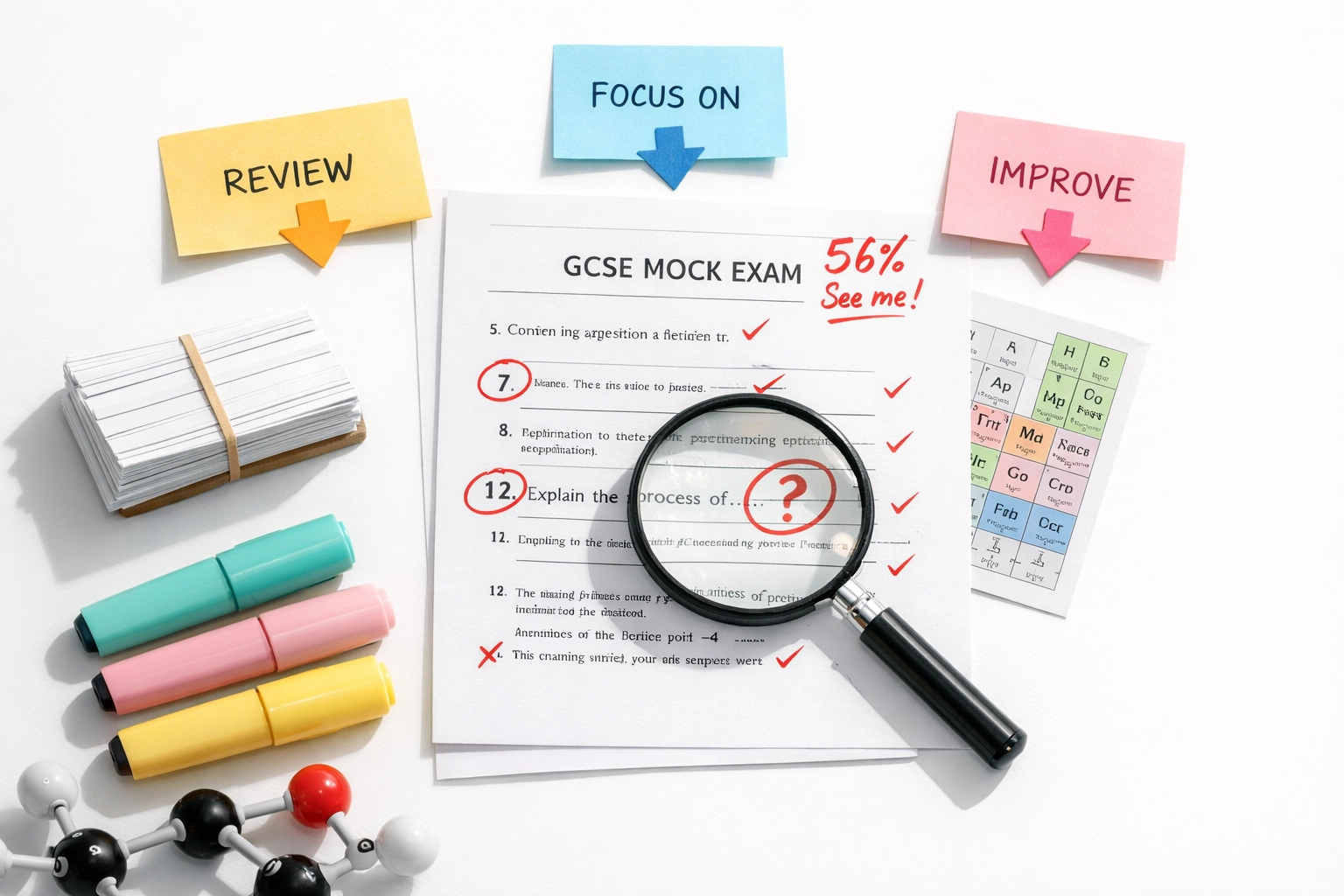
The “Data” Mindset: Turning Disappointment Into Direction
We often talk to parents about adopting what we call the “data mindset” when it comes to mock results.
Rather than viewing a grade 5 when you were hoping for a 7 as a failure, we encourage families to see it as a roadmap. That paper contains detailed information about which topics need reinforcing, which exam techniques need polishing, and which types of questions are causing the most difficulty.
When we sit down with a student’s mock paper, we’re not looking at the grade on the front page. We’re looking at the individual questions:
- Did they lose marks on calculation questions because of a simple mathematical slip, or because they didn’t understand the underlying concept?
- Are they struggling to structure their six-mark answers effectively?
- Did they run out of time, suggesting they need to work on exam pacing?
- Are there specific topics, rates of reaction, perhaps, or the carbon cycle, where the foundations aren’t quite solid?
Each of these scenarios requires a different approach. And once we know what we’re dealing with, we can create a focused plan that addresses those specific weaknesses.
This is far more productive than the vague sense of “needing to revise more” that often follows a disappointing result.
Why Solo Cramming Often Increases Stress
After a difficult mock, many students respond by doubling down on independent revision. They’ll spend hours in their bedroom, surrounded by textbooks and revision guides, trying to absorb as much information as possible.
We understand the impulse, it feels proactive. But we’ve seen time and again that this approach often leads to more stress rather than genuine progress.
Here’s why: when a student is struggling with a topic, simply re-reading the same material that confused them the first time rarely helps. They need someone to explain it differently, to ask the right questions, to identify exactly where their understanding has gone awry.
There’s also the confidence piece. After a disappointing mock, many students experience a dip in self-belief that makes independent study feel overwhelming. They sit down to revise, feel anxious, struggle to concentrate, and end up feeling worse than when they started.
What often makes the difference is having someone in their corner, a calm, knowledgeable presence who can break things down, answer questions without judgement, and help them see that improvement is genuinely possible.
A Tactical Reset: How Focused Support Changes the Trajectory
This is where structured, expert-led revision becomes so valuable.
At Success in STEM, we’ve designed our Easter GCSE Science Revision Course specifically to act as a turning point for students who need to reset their approach before the final exams.
Over four days, we don’t simply “go over” the syllabus. Instead, we work methodically through the areas that cause the most difficulty for GCSE Science students, unpicking the misconceptions that typically lead to lost marks.
We focus heavily on exam technique, teaching students how to approach different question types, how to structure their longer answers, and how to manage their time effectively. These are skills that can make a significant difference to a student’s grade, and they’re often under-taught in busy classroom settings.
Our groups are kept deliberately small. This allows our teachers to give individual attention, to notice when a student is struggling with a particular concept, and to adapt explanations accordingly. It’s a very different experience from watching a revision video alone at home.
The Team Behind the Teaching
The course is led by experienced teachers who understand exactly what exam boards are looking for.
Kate, Ruth, and I have all spent years teaching GCSE Science, including experience at schools like Alleyn’s. Between us, we’ve marked thousands of exam papers, prepared countless students for their finals, and seen the full range of starting points and outcomes.
What we’ve learned is that students at this stage don’t need more content thrown at them. They need clarity, structure, and confidence. They need someone who can look at their mock paper and say, “Right, I can see exactly what’s happening here, and here’s how we’re going to fix it.”
We’ve seen students improve by two grades or more between their mocks and their final exams. It happens more often than you might think, when the right support is in place.
Local, Focused, and Designed for Your Child
Our course runs from 7th to 10th April 2026 at Harris Boys Academy in East Dulwich, a convenient location for families across South London.
We focus specifically on the AQA and Edexcel Triple Science specifications, ensuring that every minute of the course is relevant to what your child will face in their actual exams. We know these exam boards inside out, including the common pitfalls that trip students up year after year.
The in-person format matters too. There’s something about being in a classroom with other motivated students, working alongside teachers who genuinely know their subject, that online learning simply can’t replicate. Students leave each day having made tangible progress, and feeling it.
What Happens Next
If your child’s mock results weren’t what you’d hoped for, please know that this is a moment, not a verdict.
The weeks between now and the summer exams represent a genuine opportunity for change. With the right support, the right approach, and a clear focus on the areas that matter most, significant improvement is absolutely within reach.
We’d love to help your child make that shift.
Our GCSE Science Revision Course is designed to provide exactly the kind of structured, expert-led support that makes a real difference during this crucial period. Places are limited to ensure every student receives the individual attention they deserve.
If this feels like the right fit for your child, we’d be very happy to welcome them. You can find full details and booking information on our courses page.
In the meantime, if you have any questions at all, about the course, about how to support your child’s revision at home, or about anything else, please don’t hesitate to get in touch. We’re always happy to help.

Oxford-Educated Chemistry Specialist
With over 20 years of teaching experience at some of the UK’s top independent schools, I help ambitious students bridge the gap between hard work and top-tier results. I specialise in GCSE, A Level, and IB Chemistry tuition for students targeting Grade 9s and A*s. Based in the UK but working globally, I provide 1-1 online support for families in South and West London, Dubai, and Hong Kong, ensuring students are perfectly prepared for competitive medical applications and Oxbridge entries.
I’ve helped students achieve top grades from schools such as Alleyn’s, Dulwich College, Tonbridge, Sevenoaks, Brighton College, Wycombe Abbey, Caterham, St Paul’s, Dubai College, Dubai British School and Harrow International School Hong Kong.
Contact me archardchloe@gmail.com to discuss how I can help your child excel in Chemistry.