

Blog
How to Tackle Equations and Calculations in A Level Chemistry (and Actually Understand Them!)


Let’s be honest, if you’ve ever stared at an A Level Chemistry calculation question and felt your brain go completely blank, you’re not alone. I’ve worked with so many brilliant students who absolutely understand the concepts but freeze the moment numbers and equations appear on the page.
Here’s the thing: struggling with calculations doesn’t mean you’re bad at Chemistry. It doesn’t mean you’re “not a maths person.” It simply means you haven’t yet found the right approach, one that actually makes sense to you. And that’s exactly what we’re going to fix today. 🌟
Whether you’re studying in Dubai, the UK, or anywhere else in the world, this guide will give you practical, confidence-boosting strategies to tackle those tricky equations head-on. No jargon, no overwhelming formulas, just clear steps that work.
Why Do Chemistry Calculations Feel So Terrifying?
Before we dive into the solutions, let’s talk about why these questions feel so difficult in the first place.
A Level Chemistry calculations often throw everything at you at once: moles, molar mass, concentrations, volumes, ratios… It’s a lot! And when you’re under exam pressure, it’s easy to panic and forget where to even start.
The truth is, most calculation questions follow the exact same pattern. Once you see that pattern clearly, everything becomes so much more manageable. The problem isn’t your ability, it’s that nobody has shown you the simple structure hiding behind all those intimidating numbers.
That’s about to change.

The Three Magic Formulas You Need to Know
Here’s a little secret that every successful A Level Chemistry Tutor knows: almost every calculation question relies on just three core equations. Master these, and you’ve got the foundation for nearly everything.
1. Moles = Mass ÷ Molar Mass
This is your best friend. If a question gives you a mass in grams and asks about moles (or vice versa), this formula is your starting point. Remember, molar mass is just the relative atomic or formula mass expressed in g/mol.
2. Moles = Concentration × Volume
This one pops up constantly in solution chemistry questions. Just make sure your concentration is in mol/dm³ and your volume is in dm³ (not cm³, watch out for that sneaky trap!).
3. Avogadro’s Constant = 6.02 × 10²³
Whenever a question mentions “number of particles” or “number of atoms/molecules,” you’ll need this magical number to convert between moles and actual particle counts.
Write these three formulas on a sticky note. Put it on your wall. These are your calculation superpowers. 💪
A Step-by-Step Approach That Actually Works
Now let’s talk about how to approach any calculation question systematically. This is the method I teach every student I work with as an Online Chemistry Tutor, and it transforms confusion into confidence.
Step 1: Read the Question Twice (Seriously!)
I know this sounds obvious, but so many marks are lost because students rush. Circle or underline exactly what the question is asking you to find. Is it mass? Moles? Concentration? Volume? Get crystal clear on your destination before you start the journey.
Step 2: Write Down Everything You’re Given
List every piece of data from the question with its units. This simple habit prevents so many silly mistakes. For example:
- Mass of NaOH = 4.0 g
- Volume of solution = 250 cm³
- Molar mass of NaOH = 40 g/mol
Step 3: Convert to Moles First
Here’s the golden rule: always convert your starting quantity into moles. Moles are the universal currency of chemistry calculations. Whatever information you’re given, your first job is to find out how many moles you’re working with.
Step 4: Use the Balanced Equation Ratios
This is where stoichiometry comes in: but don’t let that word scare you! It simply means using the numbers in front of the chemicals in a balanced equation to work out ratios.
For example, in the equation N₂ + 3H₂ → 2NH₃, the numbers tell you that 1 mole of nitrogen reacts with 3 moles of hydrogen to produce 2 moles of ammonia. These ratios are your roadmap for converting between different substances.
Step 5: Convert Back to What the Question Wants
Finally, take your answer in moles and convert it to whatever the question actually asked for: mass, volume, concentration, or number of particles.
That’s it. Every single calculation follows this pattern: convert to moles → use ratios → convert to answer. 🎯

Balancing Equations: The Foundation You Can’t Skip
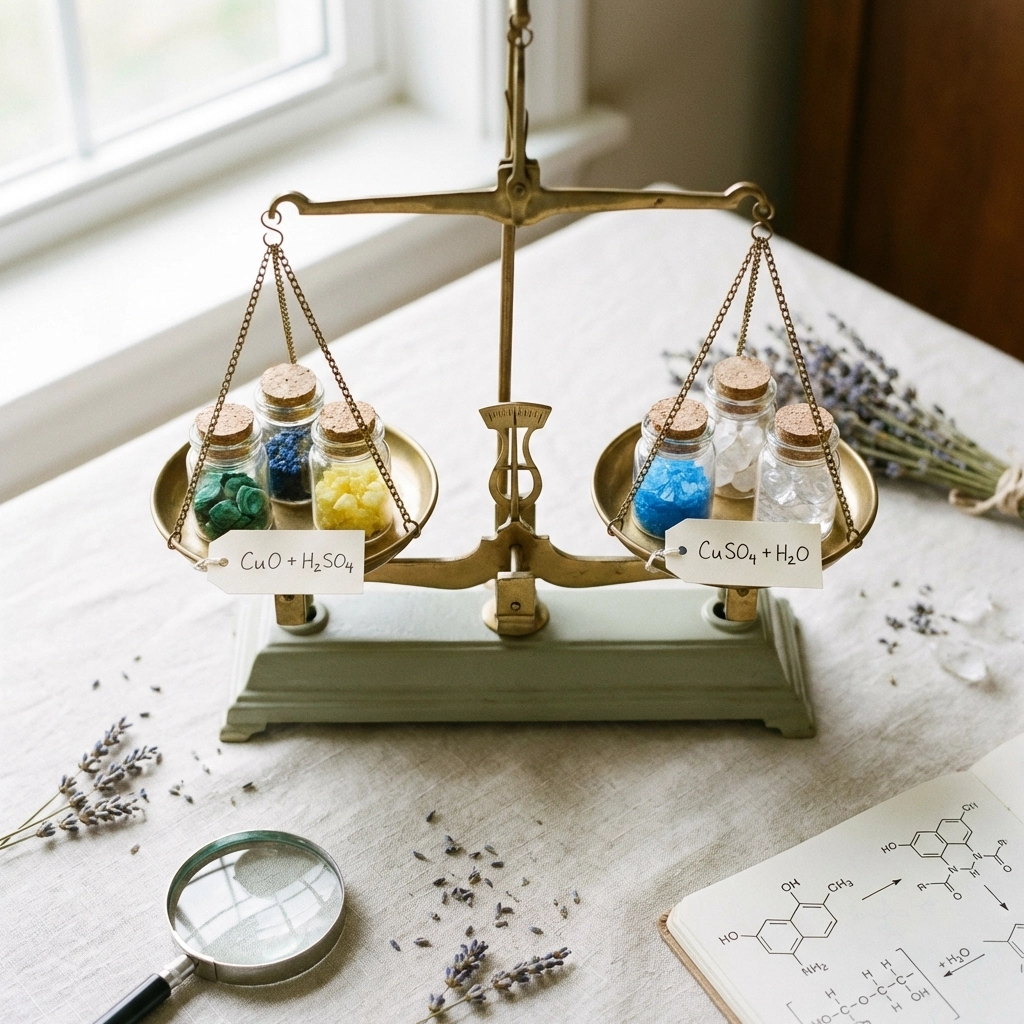
Before you can use those lovely stoichiometric ratios, you need a balanced equation. This trips up so many students, but the principle is beautifully simple: atoms are never created or destroyed in reactions.
Whatever atoms you have on the left side of the arrow must appear on the right side too. Your job is to add numbers in front of chemicals (never change the actual formulas!) until both sides match.
Quick tips for balancing:
- Count atoms of each element on both sides
- Start with the most complex molecule and work outwards
- For combustion reactions, balance carbon first, then hydrogen, then oxygen last
- Double-check your work by counting everything again
For example, to balance Mg + O₂ → MgO, notice you have 2 oxygen atoms on the left but only 1 on the right. The balanced version is 2Mg + O₂ → 2MgO. Now both sides have 2 magnesium atoms and 2 oxygen atoms. Perfect! ✨
Practical Tips to Build Real Understanding
Getting the right answer is great, but understanding why it’s right is what makes the difference between scraping through and truly excelling. Here are some strategies that help my students build genuine confidence:
Practice with intention, not just volume. Don’t just plough through random past papers hoping something sticks. Instead, focus on one calculation type at a time: spend a week on moles calculations, then move to concentration problems, then titrations. This targeted approach builds mastery much faster.
Always check your answer makes sense. If you calculate that a reaction produces 500 kg of product from 2 grams of reactant, something has gone wrong! Develop the habit of asking yourself, “Does this number seem reasonable?”
Show every step of your working. This isn’t just about picking up method marks in exams (though that helps!). Writing out each step forces you to think logically and makes it much easier to spot where you went wrong if your answer doesn’t work out.
Teach it to someone else. Explaining a calculation to a friend, sibling, or even your pet is one of the most powerful ways to cement your understanding. If you can teach it, you truly know it.
How Working with an Online Chemistry Tutor Can Transform Your Confidence
Sometimes, no matter how many revision guides you read, you need someone to show you personally where you’re going wrong: and more importantly, how to fix it.
That’s exactly what I love doing as a Chemistry Tutor Dubai students and families trust. Working one-to-one, I can spot the specific places where your understanding breaks down and give you personalised strategies that actually work for your brain.
The beauty of online tutoring is that it fits around your life. No stressful commutes, no rigid schedules: just focused, supportive sessions from wherever you are. We work through real exam questions together, and I explain not just what the answer is, but why it makes sense.
My students often tell me they finally “get it” after years of feeling confused. That moment when everything clicks? It’s honestly the best part of my job. 🌟
If calculations are holding you back from the Chemistry grade you deserve, you don’t have to struggle alone. I offer a calm, patient, no-pressure approach that meets you exactly where you are: and helps you get where you want to be.
You’ve Got This!
Here’s what I want you to take away from this post: Chemistry calculations follow a predictable pattern, and once you see it, they become so much less scary. You’re not missing some special “maths gene”: you just need the right approach and a bit of guided practice.
Start with those three core formulas. Follow the step-by-step method. Practice with intention. And if you’d like personalised support from an experienced A Level Chemistry Tutor, I’d love to help you build the confidence and skills to smash those exams.
Ready to transform your Chemistry results? Get in touch and let’s chat about how I can support you. You’ve absolutely got this! ❤️

Oxford-Educated Chemistry Specialist
With over 20 years of teaching experience at some of the UK’s top independent schools, I help ambitious students bridge the gap between hard work and top-tier results. I specialise in GCSE, A Level, and IB Chemistry tuition for students targeting Grade 9s and A*s. Based in the UK but working globally, I provide 1-1 online support for families in South and West London, Dubai, and Hong Kong, ensuring students are perfectly prepared for competitive medical applications and Oxbridge entries.
I’ve helped students achieve top grades from schools such as Alleyn’s, Dulwich College, Tonbridge, Sevenoaks, Brighton College, Wycombe Abbey, Caterham, St Paul’s, Dubai College, Dubai British School and Harrow International School Hong Kong.
Contact me archardchloe@gmail.com to discuss how I can help your child excel in Chemistry.