

Blog
Is Chemistry the Most Versatile Subject? Why High-Achieving Students are Choosing the “Central Science”


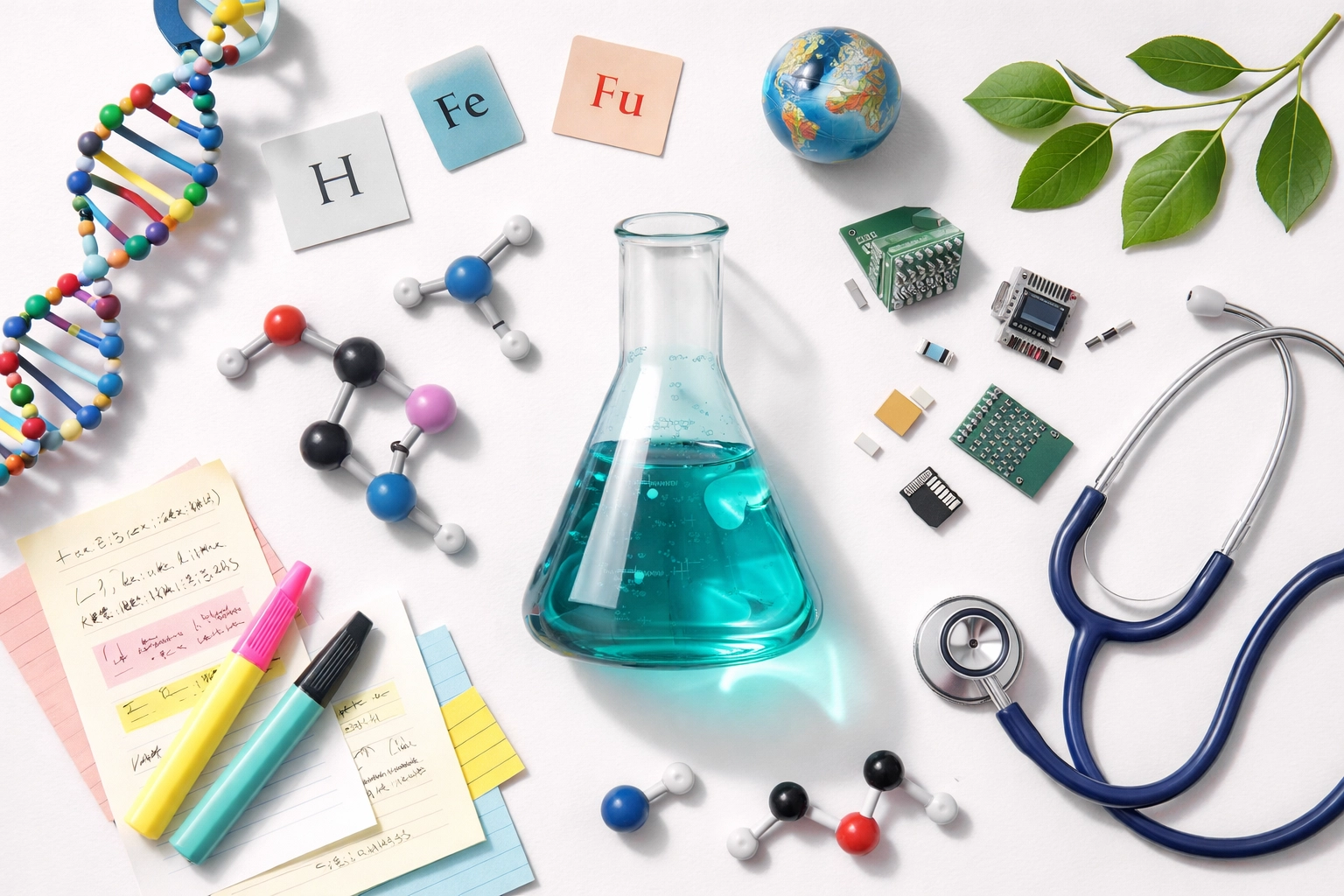
It’s called the “Central Science” for a reason. Chemistry doesn’t just sit between Physics and Biology on a curriculum chart: it’s the bridge that connects everything from the inner workings of our cells to the composition of distant stars. For high-achieving students thinking strategically about their futures, it’s often one of the most thoughtful choices they can make.
But what does this actually mean for your child? And why are we seeing more ambitious students gravitate towards Chemistry, even when their ultimate career goals might seem far removed from laboratory work?
Let’s explore why Chemistry has earned its reputation as the foundation stone for so many different paths.
Understanding the “Central Science”
The term “Central Science” isn’t marketing: it’s a description of where Chemistry sits in the scientific landscape. Chemistry provides the molecular-level understanding that underpins both Physics and Biology. It explains why biological processes work at a cellular level, and it applies the fundamental principles of Physics to real-world materials and reactions.
This positioning makes Chemistry uniquely powerful. A student who truly understands Chemistry has the conceptual toolkit to engage meaningfully with almost any scientific or technical field.
Consider a few examples:
Drug development relies entirely on understanding how molecules interact with biological systems. Without Chemistry, modern medicine simply wouldn’t exist.
Climate science requires a deep understanding of atmospheric Chemistry: how greenhouse gases behave, how pollutants form, and how we might develop solutions to capture carbon.
Materials engineering: from the semiconductors in your phone to the polymers in medical devices: is fundamentally Chemistry applied to real-world problems.
Food science, forensics, environmental protection, energy storage: the list continues. Chemistry isn’t just one subject among many. It’s the connective tissue that holds modern science together.
Beyond the Lab: Where Chemistry Actually Takes You
Here’s something we often discuss with parents: Chemistry isn’t just for students who want to become chemists, doctors, or pharmacists. The skills developed through rigorous Chemistry study are valued far beyond traditional science careers.
Financial services and consulting firms actively recruit Chemistry graduates. Why? Because someone who can balance complex equations, interpret data critically, and work through multi-step problems with precision brings exactly the analytical rigour these industries need.
Technology companies value the systematic thinking that Chemistry develops. The ability to hypothesise, test, analyse, and refine is the same process that drives product development and innovation.
Environmental consultancy and policy increasingly requires people who understand the science behind the issues they’re addressing. A Chemistry background provides credibility and depth that purely policy-focused graduates often lack.
Patent law and science journalism are both fields where a solid Chemistry foundation opens doors that remain closed to those without scientific literacy.
The versatility stems from something quite simple: Chemistry teaches students to handle complexity without becoming overwhelmed by it. That’s a transferable skill with remarkable staying power.
The Competitive Edge: What Universities Are Looking For
We’ve worked with many students preparing for competitive university applications, and one pattern emerges consistently: admissions tutors at selective universities value “hard” subjects.
Chemistry is widely recognised as one of these subjects. It requires students to:
- Handle abstract concepts and apply them to unfamiliar situations
- Manage mathematical reasoning within a scientific context
- Synthesise information across different topic areas
- Demonstrate precision and attention to detail
These aren’t just academic skills: they’re evidence of intellectual resilience. When an admissions tutor sees a strong Chemistry grade, they’re seeing proof that a student can handle demanding material and emerge successfully.

For students considering Medicine, Veterinary Science, Dentistry, or Biochemistry, Chemistry is typically a requirement. But even for students heading towards Engineering, Economics, or Law, a Chemistry qualification signals something important: this is a student who doesn’t shy away from challenge.
We’ve seen this play out in practice. Students who’ve developed genuine confidence in Chemistry often approach university interviews and personal statements with a particular kind of intellectual curiosity. They’ve learned to ask “why” and “how” rather than simply memorising answers: and that mindset serves them well regardless of their chosen field.
Starting at GCSE: Building the Foundation
If Chemistry offers all these advantages, when should students start taking it seriously?
The honest answer is: earlier than many families realise.
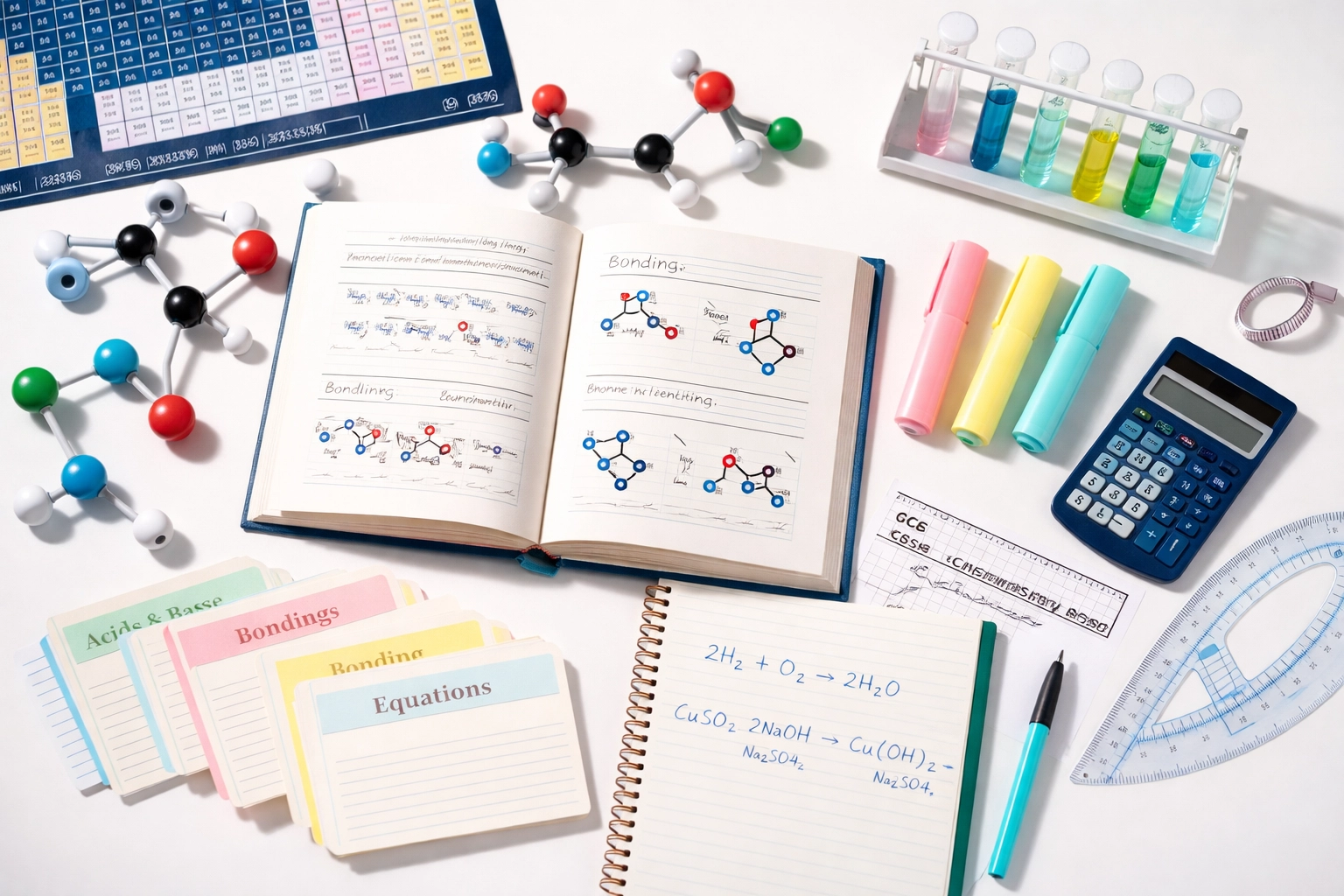
A strong GCSE Chemistry grade: typically 7, 8, or 9: isn’t just a number on a certificate. It represents a foundation of understanding that makes A-Level Chemistry manageable rather than overwhelming. Students who arrive at A-Level with gaps in their GCSE knowledge often find themselves struggling to keep pace, not because they lack ability, but because they’re trying to build on an unstable foundation.
We see this regularly. A student might have achieved a respectable grade at GCSE but never quite understood certain core concepts: moles calculations, for instance, or the logic behind electron configuration. At A-Level, these gaps compound quickly.
The good news is that GCSE is exactly the right time to address this. With proper support, students can develop both the knowledge and the confidence they need to approach A-Level Chemistry: and everything that follows: from a position of strength.
The Success in STEM Approach
At Success in STEM, we’ve developed our approach around a simple observation: most students who struggle with Chemistry aren’t struggling because the subject is beyond them. They’re struggling because somewhere along the way, the underlying logic got lost beneath a pile of equations and terminology.
Our role is to help students see past that overwhelm and find the elegant patterns underneath. Chemistry, at its heart, is remarkably logical. Once students understand why reactions happen: not just what happens: everything becomes more manageable.
We work with small groups, which allows our tutors to identify exactly where each student’s understanding is strong and where it needs reinforcement. This isn’t about cramming facts before an exam. It’s about building genuine comprehension that serves students well beyond their GCSEs.
Our tutors: Kate, Chloe, and Ruth: bring experience from schools like Alleyn’s, combined with a shared belief that every student can succeed in science with the right support. We’ve found that when students feel genuinely supported and unhurried, their confidence grows alongside their knowledge.
A Thoughtful Next Step
If your child is approaching their GCSE Science exams and you’d like them to have dedicated, expert-led support, our Easter GCSE Science Revision Course might be a good fit.
Course details:
- Dates: 7–10 April 2026
- Location: Harris Boys Academy, East Dulwich
- Format: 4-day intensive revision
- Tutors: Kate, Chloe, and Ruth
We keep groups small so every student receives individual attention. The course covers Chemistry alongside Biology and Physics, with a focus on exam technique, confidence-building, and genuine understanding.
If this feels like the right support for your child, you can find more information and book a place at success-in-stem.com/courses.
We’d be very happy to welcome them.
Chemistry’s reputation as the “Central Science” is well-earned. For students willing to engage with its challenges, it offers something genuinely valuable: a foundation that supports almost any ambitious path they might choose. Whether your child ultimately pursues medicine, engineering, finance, or something entirely different, a strong grounding in Chemistry will serve them well.
And that’s exactly what we help students build.

Chloe Archard | Oxford-Educated Chemistry Specialist
With over 20 years of teaching experience at some of the UK’s top independent schools, I help ambitious students bridge the gap between hard work and top-tier results. I specialise in GCSE, A Level, and IB Chemistry tuition for students targeting Grade 9s and A*s. Based in the UK but working globally, I provide 1-1 online support for families in South and West London, Dubai, and Hong Kong, ensuring students are perfectly prepared for competitive medical applications and Oxbridge entries. Contact me archardchloe@gmail.com to discuss how I can help your child excel in Chemistry.