

Blog
Mastering the MMI Roleplay: How to Act Your Way into Medical School (Without the Drama Degree)


Roleplay stations are the marmite of medical school interviews. You either love the chance to step into a doctor’s shoes, or the mere thought of “acting” makes you want to hide under your A-Level Chemistry lab bench. 🧪
But here’s the secret that’ll change everything: they aren’t looking for an Oscar-winning performance. They’re looking for an empathetic future doctor who can communicate clearly, think on their feet, and make a stranger feel heard in under seven minutes.
If you’ve been losing sleep over the prospect of “performing” in your MMI, take a deep breath. Let’s break down exactly what these stations are really testing, and how to ace them without a drama degree.
What’s Actually Happening in That Room?
Picture this: You walk into a room. There’s an examiner with a clipboard (they’re silent observers, by the way, don’t expect nods or smiles). And there’s an actor playing a patient, a colleague, a friend, or a family member.
Your job? Have a meaningful conversation.
That’s it. No theatrical monologues. No memorized speeches. Just you, demonstrating that you can:
- React appropriately to unknown situations (because medicine is full of surprises)
- Communicate clearly using language that a non-medic can understand
- Build rapport with someone you’ve never met before
- Stay composed when emotions run high
Medical schools explicitly state they’re not assessing your acting ability, they’re collecting feedback from both the examiner and the actor themselves. Did you make them feel at ease? Were you courteous? Did you listen? That’s what counts.

The “Doctor Persona” Cheat Sheet 🩺
You don’t need to transform into a different person, but there are four golden rules that’ll instantly make you sound more professional and empathetic:
1. Eye Contact & Active Listening
Nod. Affirm. Don’t interrupt.
When the actor is speaking, your job is to listen, not mentally rehearse your next line. If they mention they’re “worried about missing work” or “upset about letting their family down,” acknowledge it directly:
“I can hear that you’re really worried about your job security, that’s completely understandable.”
This shows you’re genuinely listening, not just waiting for your turn to talk.
2. Body Language Speaks Volumes
Open posture. No fidgeting. Lean slightly forward.
Crossed arms = defensive. Checking your watch = disinterested. Tapping your pen = nervous. None of these say “I’m a calm, caring future doctor.”
Instead, keep your hands visible (maybe resting on your lap or the table), maintain an open stance, and use small gestures to emphasize empathy. A slight nod when they’re explaining their concerns can work wonders.
3. Slow. Down. Your. Pace.
If you’re nervous, you probably talk too fast. I’ve seen it a thousand times with my Dubai students prepping for UK medical schools, adrenaline makes your mouth run at double speed.
Here’s the fix: Pause before answering. Take a breath. Speak at a pace where each word has space to land. It makes you sound more thoughtful and gives you time to actually think about what you’re saying.
4. Start with the Basics
Always introduce yourself.
“Hi, I’m [Your Name], and I’m a medical student. Thank you for speaking with me today.”
It’s simple, professional, and sets the right tone. And when you leave? Thank both the examiner and the actor. Manners matter more than you think.

The Frameworks That’ll Save Your Life (A.K.A. The “Cheat Codes”) 🔑
You know how in Chemistry we’ve got reaction mechanisms that guide you through complex processes? Communication frameworks are the same thing, they’re your roadmap when your brain goes blank.
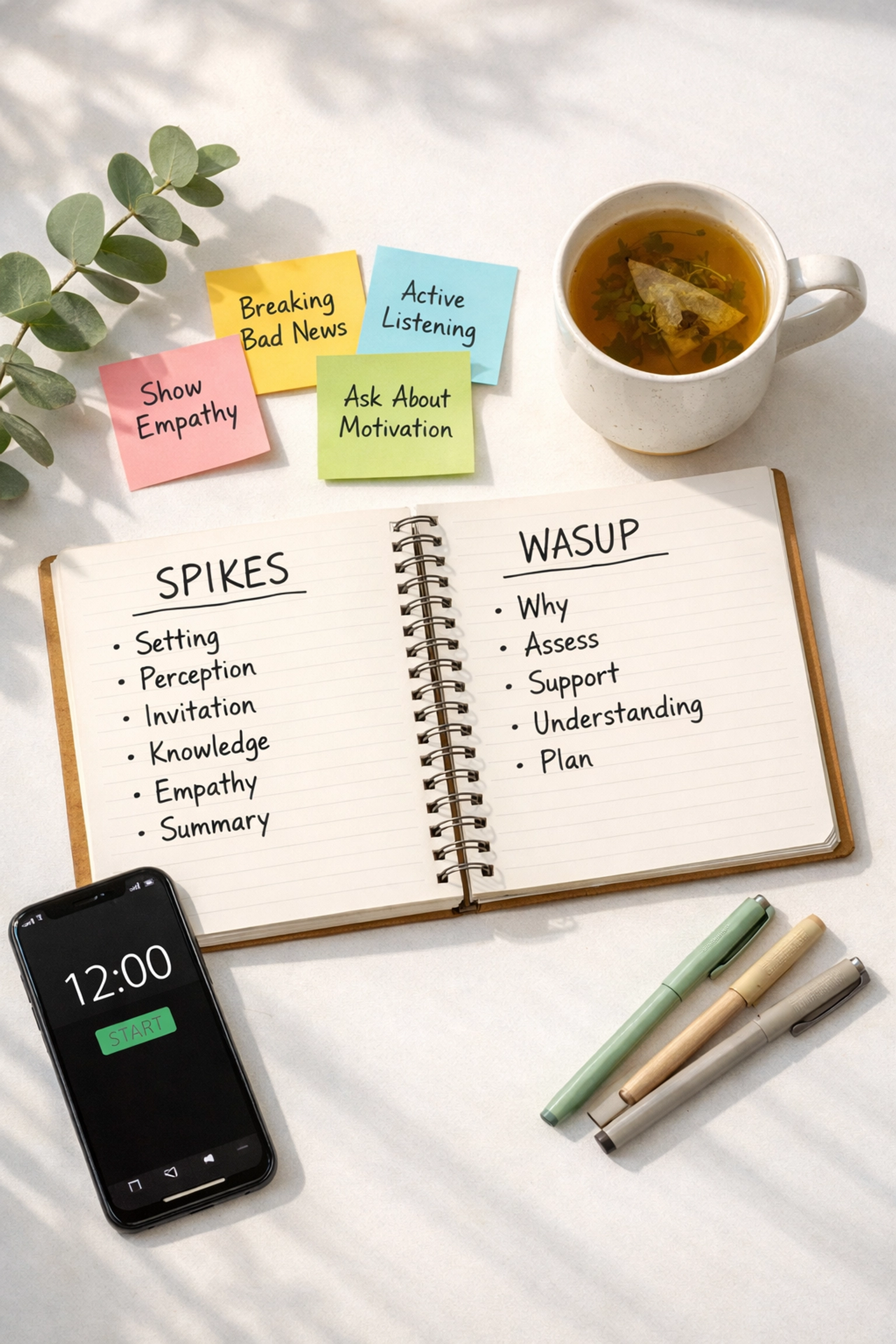
SPIKES (Breaking Bad News)
This is your best friend when you need to deliver difficult information. Here’s the breakdown:
- Setting: Create a private, comfortable environment
- Perception: Find out what they already know (“What’s your understanding of the situation?”)
- Invitation: Ask if they want to hear the information (“Would you like me to explain what we found?”)
- Knowledge: Give the information clearly and simply (no jargon!)
- Emotions: Acknowledge their emotional response with empathy
- Strategy & Summary: Discuss next steps and offer support
Example in action:
“I can see this news is really difficult to hear. It’s completely normal to feel upset. Let’s talk about what we can do moving forward, you’re not going through this alone.”
WASUP (Admitting a Mistake)
Nobody’s perfect, and medicine is all about accountability. If you’re in a scenario where you’ve messed up (lost something, made an error, broken a promise), WASUP is your framework:
- Warning shot: “I need to tell you something that’s difficult for me to say…”
- Apology: “I’m really sorry.”
- Situation: Explain what happened (honestly, no excuses)
- Understanding: Show you understand the impact (“I know you were counting on me…”)
- Plan: Explain how you’ll fix it or prevent it happening again
The key? Don’t be defensive. Own it, apologize genuinely, and show you’ve learned from it.

Scenarios You’ll Probably See (And How to Handle Them)
The Non-Medical Explanation
The Task: Explain how to take ibuprofen to your “dad,” or how an inhaler works to a “patient.”
The Trap: Using medical jargon.
The Solution: Pretend you’re explaining it to your younger sibling. Use everyday language. “This medicine helps reduce inflammation, that’s the swelling that makes your ankle hurt. You should take it with food because it can upset your stomach on its own.”
The Ethical Dilemma
The Scenario: Your friend asks you to sign them into a lecture they missed so they don’t get penalized.
The Trap: Being judgmental or preachy.
The Solution: Show empathy for their situation, but stand firm on your ethical boundaries. “I really understand you’re in a tough spot, and I’d love to help you out. But I can’t sign you in because that wouldn’t be honest, and integrity is really important to me, especially as we’re training to be doctors. Can we think of another way I can support you?”
The “Broken Bike” (Accountability Test)
The Scenario: You borrowed your friend’s bike and it got stolen. You need to tell them.
The Trap: Making excuses or minimizing their feelings.
The Solution: Use WASUP. Own it completely. “I’m so sorry, I know that bike was really important to you, and I feel terrible that this happened while it was in my care. I’d like to help replace it or contribute toward a new one.”
Empathy vs. Sympathy: Know the Difference ❤️
This is crucial and often misunderstood.
Sympathy = “I feel so sorry for you.” (This creates distance, you’re looking down at them from a position of pity)
Empathy = “I can see this is really difficult for you.” (This creates connection, you’re standing alongside them, acknowledging their feelings without drowning in them)
Medical schools want empathy. They want doctors who can acknowledge emotions without being overwhelmed by them. You need to stay composed and professional while still showing genuine care.
Magic phrases to practice:
- “That sounds really challenging.”
- “I can understand why you’d feel that way.”
- “This must be incredibly difficult for you.”
- “It’s completely normal to feel [emotion] in this situation.”
Practice Makes Perfect (Yes, Even the Awkward Bits) 🎭
Here’s the thing about roleplay stations: you cannot think your way through them. You have to do them.
Grab a friend, a parent, your flatmate, or literally anyone willing to help, and run through scenarios. Here’s how to practice effectively:
1. Don’t read the prompt beforehand. Have your practice partner give you the scenario at the door (just like the real thing).
2. Time yourself. You’ve got 5-7 minutes in the real interview. Practice under time pressure.
3. Record yourself (if you can bear it). You’ll notice verbal tics, filler words (“um,” “like”), and pace issues you’d never catch otherwise.
4. Practice variety. Do breaking bad news, conflict resolution, mistake admission, and patient education scenarios. The core skills (empathy, communication, composure) are the same, but variety keeps you flexible.
5. Get feedback. Ask your practice partner: “Did I make you feel heard? Did I sound genuine? Was there anything I said that came across as dismissive?”
The more you practice, the more natural the “doctor voice” becomes. You’ll stop overthinking every word and start genuinely responding to what the actor is saying: which is exactly what the examiners want to see.
The Bottom Line: Chemistry Gets You the Interview, Communication Gets You the Degree 🧬
Let’s be real for a second: you need stellar A-Level Chemistry grades to even get a medical school interview. That’s non-negotiable. The competition is fierce, especially for UK medical schools, and your Chemistry results are often the first hurdle.
But once you’re in that interview room? Your ability to communicate, empathize, and stay calm under pressure matters just as much as knowing your organic mechanisms and equilibrium constants.
If you’re a Dubai-based student aiming for UK medical schools, you’re juggling Chemistry mastery and interview prep: and that’s where I come in. My MedAspire course gives you tailored interview coaching alongside the Chemistry expertise you need to hit those grade boundaries.
Because here’s the truth: roleplay stations aren’t theater exams. They’re assessments of the interpersonal and ethical qualities you’ll need as a doctor. Focus on genuine communication, flexibility, and empathy rather than performance technique: and you’ll be absolutely fine. 🌟
Now stop stressing about “acting,” and go practice having some real conversations. You’ve got this.

Chloe Archard | Oxford-Educated Chemistry Specialist
With over 20 years of teaching experience at some of the UK’s top independent schools, I help ambitious students bridge the gap between hard work and top-tier results. I specialise in GCSE, A Level, and IB Chemistry tuition for students targeting Grade 9s and A*s. Based in the UK but working globally, I provide 1-1 online support for families in South and West London, Dubai, and Hong Kong, ensuring students are perfectly prepared for competitive medical applications and Oxbridge entries. Contact me archardchloe@gmail.com to discuss how I can help your child excel in Chemistry.