

Blog
Mind the Gap: How to Conquer the GCSE to A Level Chemistry Transition

If your teen has just started A Level Chemistry and is feeling like they’ve walked into a completely different subject, I need you to know something: you’re not imagining it, and they’re not struggling because they’re not smart enough.
The jump from GCSE to A Level Chemistry is genuinely one of the biggest academic leaps students face. I see it every September, bright, capable students who sailed through their GCSEs suddenly feeling completely lost. And here’s the thing: it’s not about working harder. It’s about working differently.
Let me explain what’s really happening here and, more importantly, how to fix it before confidence crumbles. 🌟
Why It Feels Like a Different Subject
At GCSE, Chemistry is largely about memory and recognition. You learn the reactivity series, you memorise some equations, you recognise patterns. Get the facts right, and you get the marks. It’s structured, it’s manageable, and honestly? Most students can do well with solid revision in the weeks before exams.
A Level Chemistry? That’s a completely different beast.
A Level Chemistry is about logic, application, and deep understanding. You’re not just recalling that ionic bonding exists, you’re explaining why sodium chloride has a high melting point based on its structure, then comparing it to covalent substances, then predicting what would happen in an unfamiliar scenario you’ve never seen before.
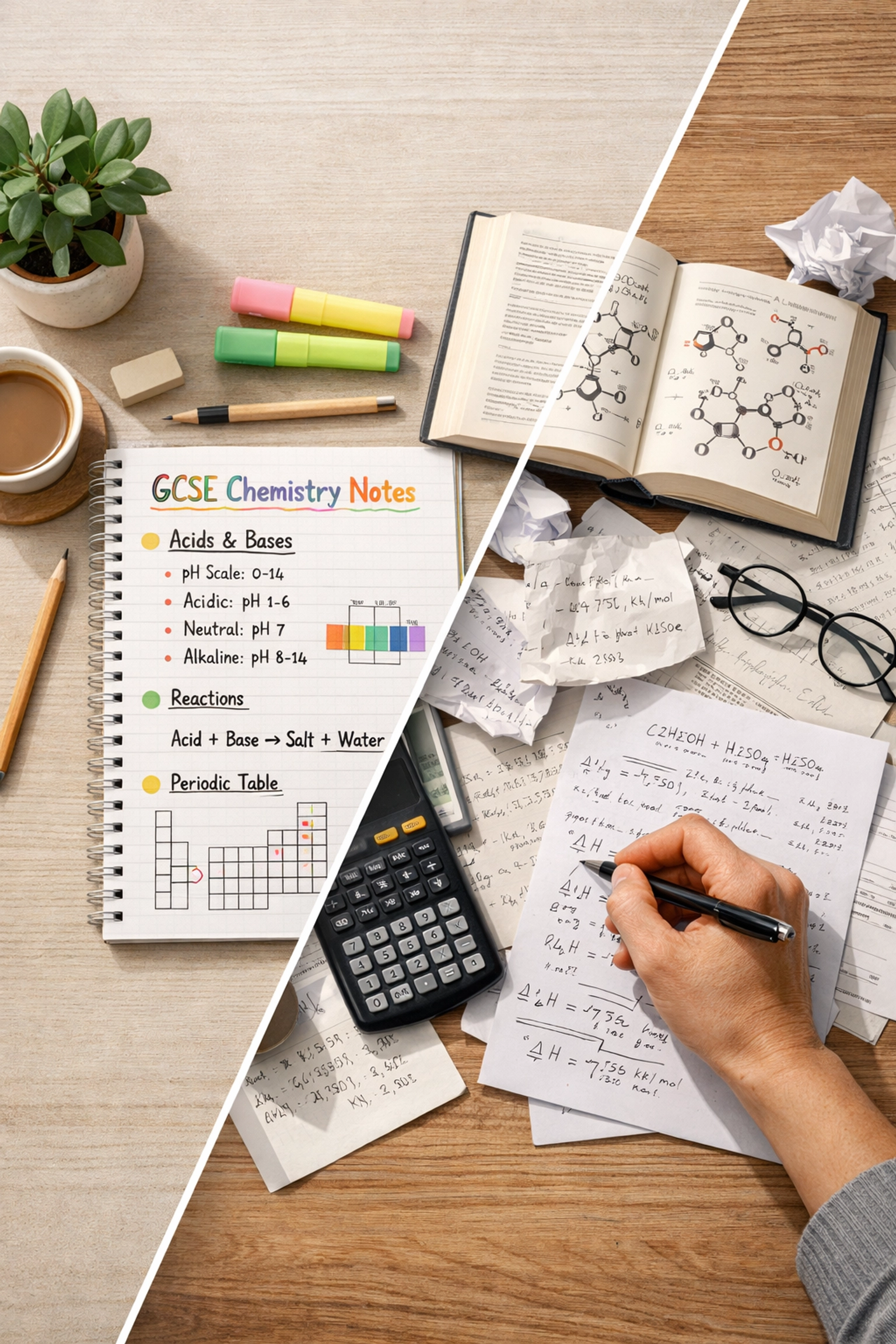
The shift is seismic. Suddenly, you can’t just “revise harder” the night before a test. You need to understand the underlying principles so deeply that you can apply them to anything the exam board throws at you.
And here’s the kicker: the pace is relentless. While GCSE gave you time to revisit topics and consolidate before moving on, A Level marches forward at breakneck speed. Miss one concept, and suddenly three more topics don’t make sense because they all build on that foundation you didn’t quite grasp.
This is where the panic sets in. By half-term of Year 12, I get phone calls from parents saying, “She was predicted a 9 at GCSE, but now she’s struggling to understand anything.”
And I always say the same thing: this is fixable. But we need to act now, not later.
The Three Foundation Pillars You Can’t Afford to Get Wrong
If I could go back and tell every new A Level Chemistry student just three things to master early, before everything else, it would be these. I call them the Foundation Pillars, and they’re non-negotiable if you want to thrive (not just survive) at A Level.
1. Moles and Quantitative Chemistry
I know, I know. Everyone dreads moles. But here’s the truth: moles are the language of A Level Chemistry. If you don’t speak this language fluently, you’ll spend the next two years constantly playing catch-up.
At GCSE, you dabbled in mole calculations. At A Level, every single topic uses them, stoichiometry, titrations, gas calculations, energetics, equilibria, everything. You need to be able to convert between moles, mass, concentration, and volume in your sleep.
The students who master moles early? They’re the ones who find A Level challenging but manageable. The ones who don’t? They’re drowning by November.
Parent tip: If your child is shaky on mole calculations by October of Year 12, that’s your red flag. This is the moment to intervene, not in March when they’re panicking about mocks. 🚨
2. Bonding and Structure
GCSE teaches you that there are three types of bonding: ionic, covalent, and metallic. Job done, right?
Wrong. A Level takes those three types and asks you to explain properties, trends, exceptions, and predictions based on bonding and structure. Why does diamond have a higher melting point than graphite? Why is ammonia more soluble than methane? How do you predict the shape of an unfamiliar molecule?

Bonding and structure is the lens through which you’ll understand almost every topic in A Level Chemistry. If this foundation is shaky, topics like organic chemistry, periodicity, and transition metals will feel impossibly confusing.
3. Atomic Structure
At GCSE, atomic structure is fairly straightforward: protons, neutrons, electrons, shells. At A Level, you dive into electron configurations, ionisation energies, and how atomic structure explains the entire Periodic Table.
This isn’t just memorisation, it’s about seeing patterns and making predictions. Why does first ionisation energy increase across a period (but not perfectly)? Why are Group 2 elements more reactive as you go down the group?
If atomic structure isn’t rock-solid, you’ll struggle to understand periodicity, bonding trends, and even redox chemistry later on.
The Window of Opportunity (And Why Waiting is Dangerous)
Here’s what I’ve learned from working with hundreds of A Level students: there’s a critical window between September and Christmas of Year 12 where early intervention makes all the difference.
Students start A Level full of optimism. By October, they’re a bit confused but still hopeful. By Christmas, many have lost confidence completely. They’re behind, they don’t know how behind, and they’ve convinced themselves they’re just “not good at Chemistry anymore.”
Parents often wait until mocks to see how things are going. But by then, six months of shaky foundations have compounded into a crisis. Suddenly you’re not just fixing one topic, you’re rebuilding understanding from the ground up while your child is also trying to keep up with new content.
The best time to get support? The moment your child says, “I don’t really understand moles,” or “Bonding doesn’t make sense anymore.” That’s not a casual comment, that’s a foundation pillar cracking. And if we catch it early, it’s a quick fix. Leave it until March, and it’s major structural repair.
How 1-1 Tuition Bridges This Specific Gap
Look, I’m not here to tell you that every student needs a tutor. But I am here to tell you that the GCSE to A Level transition is the moment where 1-1 support has the biggest impact.
Why? Because this transition isn’t about learning more, it’s about learning differently. And that’s exactly where an A Level Chemistry Tutor can transform everything.
In a classroom of 25 students, your child’s teacher simply doesn’t have time to stop and say, “Okay, let’s make sure everyone truly understands why electron configurations explain ionisation energy trends before we move on to the next topic.” They’re on a tight curriculum schedule, and they have to keep moving.
But in a 1-1 session, we can do exactly that. We can:
✅ Identify the exact misconception that’s causing confusion (often it’s something tiny from GCSE that was never quite understood)
✅ Rebuild understanding from the ground up, not just patch over gaps
✅ Teach exam technique that’s specific to A Level: how to approach application questions, how to structure long-answer responses, how to spot what examiners are actually asking for
✅ Work like chemists, not like memorisers: I teach students to think logically and see patterns, so they can tackle any question, not just the ones they’ve practised
And crucially, we can do this before confidence crashes. That’s the game-changer.
I’ve worked with students who were genuinely considering dropping Chemistry in Year 12, and within a few focused sessions, they’ve gone from panicked to confident. Not because they suddenly became “smarter,” but because someone finally helped them learn how to learn at A Level standard.
If you’re looking for an Online Chemistry Tutor who specialises in this exact transition, someone who understands that it’s not about endless hours of rote learning but about elite efficiency and logical thinking: that’s exactly what I offer. My 1-1 sessions aren’t about cramming more information in. They’re about making the information you already have click.
Practical Steps You Can Take Right Now
Whether you’re a student reading this or a parent wondering how to support your teen, here’s what you can do this week:
For students:
- Test yourself on mole calculations. Can you convert between moles, mass, and concentration fluently? If not, this is priority number one.
- Revisit your GCSE notes on bonding. Make sure you can explain ionic, covalent, and metallic bonding from first principles: not just recall definitions.
- Practice electron configurations until they’re second nature. If you can’t write the electron configuration for any element on the Periodic Table in under 30 seconds, you need more practice.
For parents:
- Ask your child, “On a scale of 1-10, how confident do you feel about moles, bonding, and atomic structure?” If any answer is below a 7, that’s your cue to act.
- Don’t wait for mocks. Early intervention = quick fixes. Delayed intervention = major catch-up.
- Consider finding an A Level Chemistry Tutor who focuses on understanding, not just content coverage.
The Bottom Line
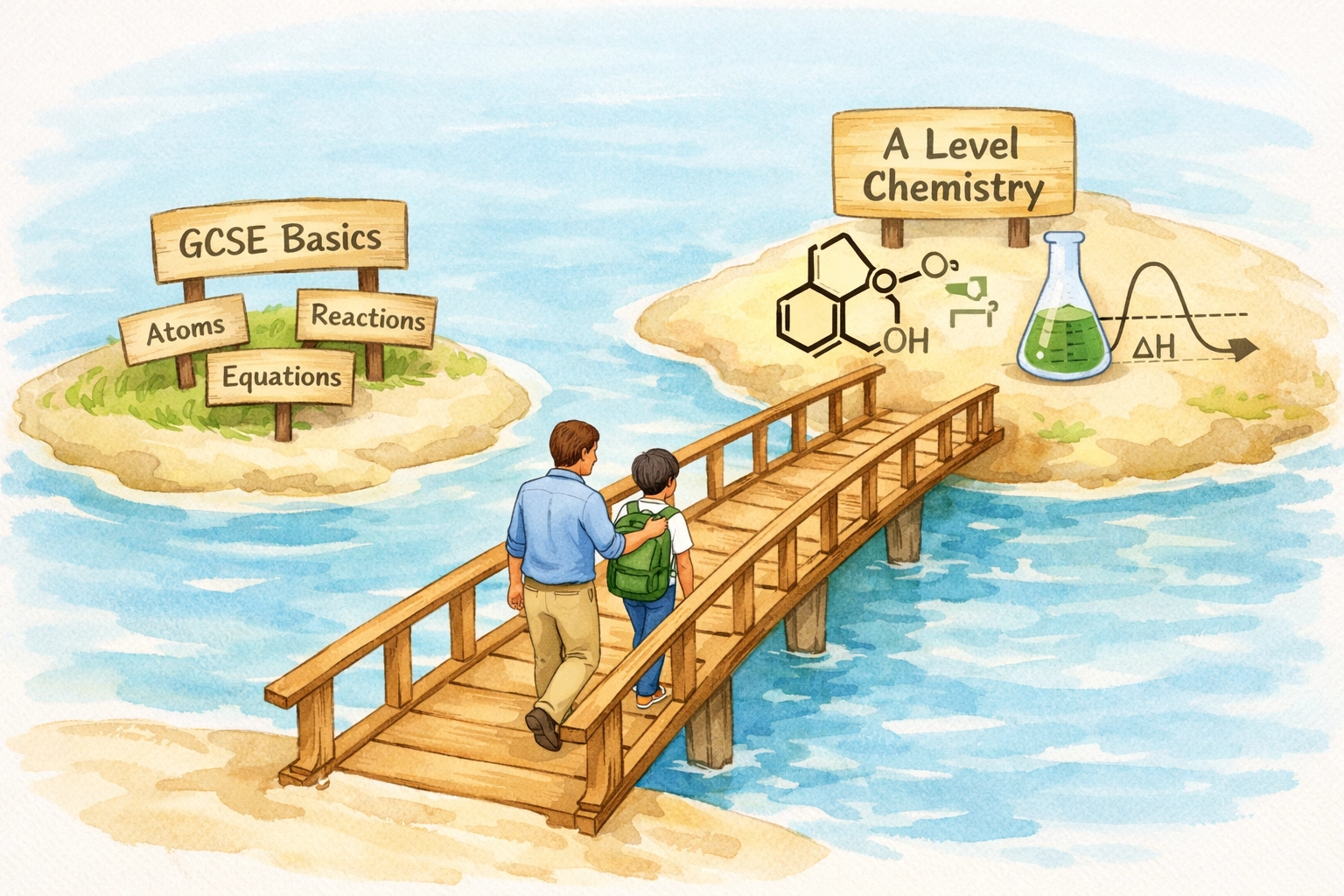
The GCSE to A Level Chemistry transition is tough. But it’s not insurmountable. With the right foundations, the right mindset, and the right support at the right time, your teen can absolutely thrive.
I’ve seen it happen over and over again. The students who succeed aren’t necessarily the ones who got the highest grades at GCSE: they’re the ones who embrace the shift from memory to logic and who get the support they need before the gaps become chasms.
If you’re feeling overwhelmed, if your child is already struggling, or if you just want to make sure they’re set up for success from the start: reach out. Let’s make sure those foundation pillars are rock-solid before we start building the rest of the A Level Chemistry house. 🏗️
Because here’s what I believe: every student can excel at A Level Chemistry with the right approach. It’s not about working harder. It’s about working smarter. And that starts with understanding exactly where the gap is: and closing it before it becomes a canyon.
You’ve got this. And if you need a hand? I’m here. 💙


Oxford-Educated Chemistry Specialist
With over 20 years of teaching experience at some of the UK’s top independent schools, I help ambitious students bridge the gap between hard work and top-tier results. I specialise in GCSE, A Level, and IB Chemistry tuition for students targeting Grade 9s and A*s. Based in the UK but working globally, I provide 1-1 online support for families in South and West London, Dubai, and Hong Kong, ensuring students are perfectly prepared for competitive medical applications and Oxbridge entries.
I’ve helped students achieve top grades from schools such as Alleyn’s, Dulwich College, Tonbridge, Sevenoaks, Brighton College, Wycombe Abbey, Caterham, St Paul’s, Dubai College, Dubai British School and Harrow International School Hong Kong.
Contact me archardchloe@gmail.com to discuss how I can help your child excel in Chemistry.