

Blog
Revision Not Working? Here’s Why Your Hard Work Isn’t Turning Into Top Chemistry Grades

You’ve been at your desk for hours. Your notes are colour-coded, your highlighters are running dry, and you’ve read through your textbook more times than you can count. You’re doing everything you’re supposed to do, so why aren’t your grades reflecting all that effort?
If this sounds familiar, I want you to know something important: you’re not alone, and you’re definitely not incapable. The truth is, so many motivated GCSE Chemistry and A Level Chemistry students fall into the same trap. They work incredibly hard, but they’re working in ways that feel productive without actually being productive.
Let’s change that today. 🌟
Here’s why your revision might not be working, and more importantly, exactly how to fix it.
The “Fluency Trap”: Why Reading Your Notes Feels Like Progress (But Isn’t)
Here’s something that might sting a little: reading and highlighting your notes is one of the least effective revision strategies out there.
I know, I know. It feels so satisfying to see all those neat highlights and underlines. Your brain recognises the information, and that recognition creates a sense of familiarity. You think, “Yes, I know this!” But here’s the problem, recognition is not the same as recall.
When you’re sitting in an exam hall, nobody is going to show you your highlighted notes and ask if you recognise them. You need to pull that information out of your brain from scratch, under pressure, with a ticking clock. That’s a completely different skill.
This is what psychologists call the “fluency trap”, the illusion that because something feels easy to read, you’ve actually learned it. Your brain is essentially lying to you, telling you that you’re prepared when you’re not.
The fix? Stop reading passively. Start testing yourself actively. More on that in a moment.

Passive vs. Active Revision: The Game-Changing Shift
Let’s get specific about what actually works.
Passive revision includes things like:
- Re-reading your notes or textbook
- Watching YouTube videos without pausing
- Copying out notes in different colours
- Highlighting everything
Active revision looks completely different:
- Flashcards where you quiz yourself (and actually try to answer before flipping)
- Blurting, writing everything you know about a topic from memory, then checking what you missed
- Past papers under timed conditions
- Teaching the concept to someone else (or even to your wall)
The difference? Active revision forces your brain to retrieve information, which strengthens those neural pathways and makes recall easier in the actual exam. It’s harder, it’s less comfortable, and it might make you realise you don’t know as much as you thought, but that’s exactly why it works.
Think of it this way: passive revision is like watching someone else do squats at the gym. Active revision is actually doing the squats yourself. Only one of those is going to make you stronger.
So next time you sit down to revise, ask yourself: “Am I actually making my brain work here, or am I just looking at chemistry?”
Ignoring Mark Schemes: The Secret Language of Examiners
Here’s a revision mistake I see constantly: students who know their chemistry inside out but still drop marks because they don’t understand what the examiner actually wants.
Examiners aren’t trying to trick you, but they are looking for very specific things. There’s a particular language, a certain way of phrasing answers, and key terms that need to appear for you to get full marks.
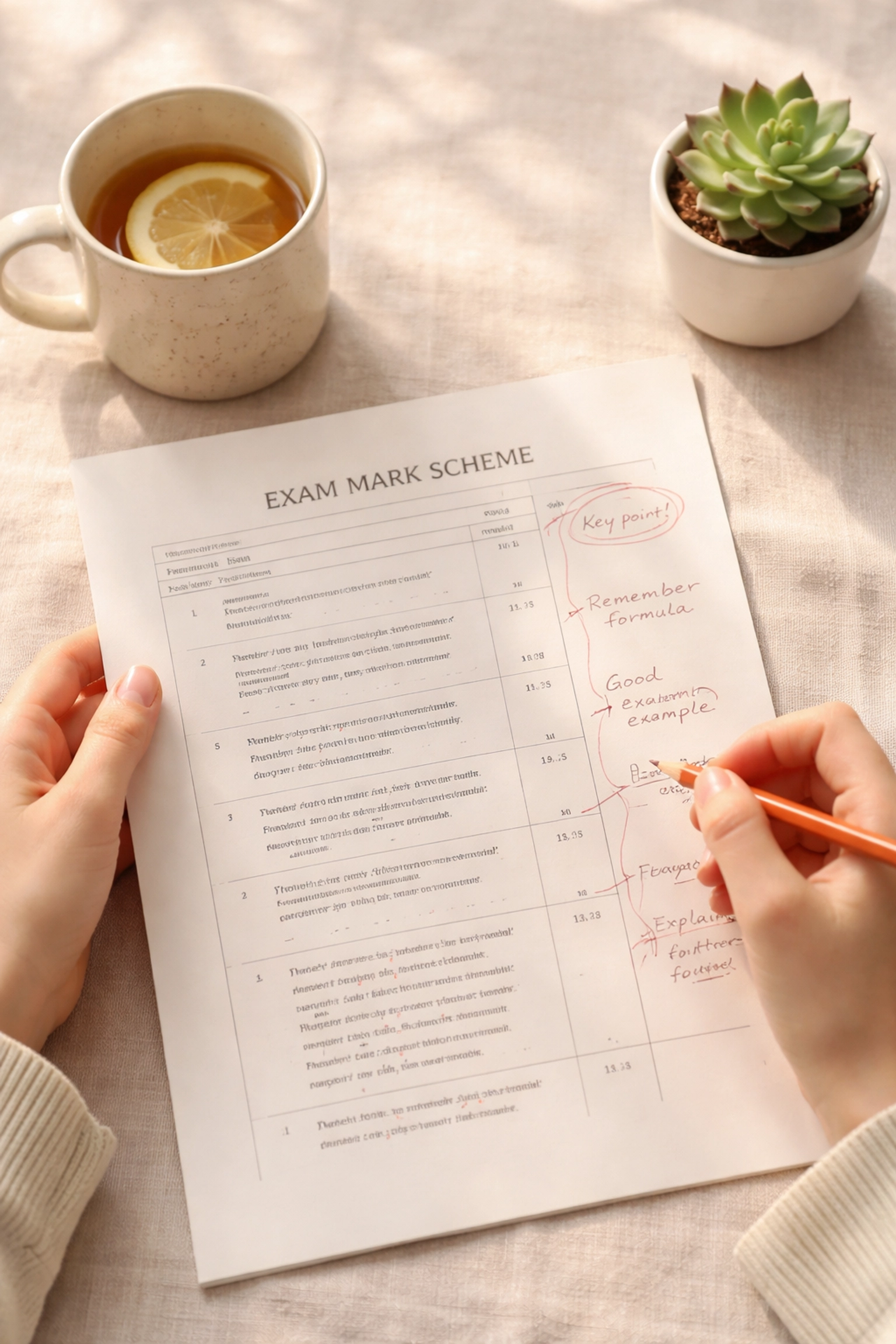
The only way to learn this language is to study mark schemes religiously.
When you do a past paper, don’t just check if you got the answer “right” in a general sense. Look at exactly what the mark scheme says. Notice which words are underlined or in bold. Pay attention to phrases like “must mention…” or “accept alternatives such as…”
This is honestly one of the biggest shortcuts to better grades. You could know the chemistry perfectly, but if you write “the particles move faster” instead of “the particles have greater kinetic energy,” you might lose a mark. Frustrating? Yes. Avoidable? Absolutely.
Pro tip: Keep a little notebook of “examiner phrases” and common ways marks are lost. You’ll start to see patterns, and those patterns will save you marks on the real day. ✨
The Missing Link: Why You Need to Tackle Your Weak Topics First
Let me guess, when you sit down to revise, you probably gravitate towards the topics you already feel confident about. Organic chemistry feels solid? Let’s do more of that! Electrochemistry gives you nightmares? Maybe tomorrow…
This is completely natural. Our brains prefer comfort. But it’s also one of the biggest reasons your revision isn’t translating into better grades.
Here’s the thing: you don’t gain many extra marks by perfecting topics you’re already good at. The real gains come from turning your weakest areas into strengths. If you’re scoring 8/10 on organic questions but 3/10 on electrochemistry, guess where your focus should be?
I know it’s uncomfortable. Sitting with a topic that makes you feel confused and frustrated isn’t fun. But that discomfort is actually a sign that real learning is happening. Your brain is building new connections, filling in gaps, and getting stronger.
Try this: Before your next revision session, honestly identify your three weakest topics. Not the ones you find boring, the ones where you genuinely struggle. Then commit to spending at least 50% of your time on those areas. It’s uncomfortable in the short term but transformative for your grades.
Timing Is Everything: Spaced Repetition Over Cramming
Let’s talk about when you’re revising, not just how.
If you’re the type of student who leaves everything until the week before the exam and then tries to cram everything in… I get it. Life happens, time flies, and suddenly your exam is next Tuesday. But this approach almost guarantees that most of what you “learn” won’t stick.
Your brain needs time to consolidate information. When you learn something once and never revisit it, it fades rapidly, usually within days. But when you revisit that same information at spaced intervals, it gets locked into long-term memory.
This is called spaced repetition, and it’s backed by decades of cognitive science research.
Here’s how to make it work practically:
- Day 1: Learn a new topic
- Day 3: Quickly test yourself on it
- Day 7: Test yourself again
- Day 14: One more time
Each time you revisit, you’re strengthening that memory. Apps like Anki or Quizlet can automate this process for you, showing you flashcards exactly when you’re about to forget them.
The key is starting early enough that you have time for those intervals. Cramming might feel productive, but spaced repetition actually is productive.
Turning Frustration Into A* Results
If you’ve been working hard and feeling frustrated with your results, please hear this: you’re not lacking ability: you just need better strategies.
The students who get top grades in GCSE Chemistry and A Level Chemistry aren’t necessarily smarter than you. They’ve just figured out (or been taught) how to revise effectively. And now you know too.
To recap:
- Escape the fluency trap by testing yourself, not just reading
- Switch to active revision methods like blurting, flashcards, and past papers
- Study mark schemes to learn the examiner’s language
- Prioritise weak topics even when it feels uncomfortable
- Use spaced repetition instead of last-minute cramming
Small shifts in how you approach your revision can lead to massive improvements in your grades. You’ve got this. 🙌
Need Some Extra Support?
Sometimes the hardest part isn’t knowing what to do: it’s actually doing it, consistently, with guidance when you get stuck.
That’s exactly why Chemistry with Chloe exists. Whether you’re looking for structured revision courses or personalised 1-1 support from an experienced online chemistry tutor, I’d love to help you bridge the gap between hard work and the grades you deserve.
Whether you’re based in London, Dubai, or anywhere else in the world, support is just a click away. Let’s turn that frustration into results: together. ❤️

Oxford-Educated Chemistry Specialist
With over 20 years of teaching experience at some of the UK’s top independent schools, I help ambitious students bridge the gap between hard work and top-tier results. I specialise in GCSE, A Level, and IB Chemistry tuition for students targeting Grade 9s and A*s. Based in the UK but working globally, I provide 1-1 online support for families in South and West London, Dubai, and Hong Kong, ensuring students are perfectly prepared for competitive medical applications and Oxbridge entries.
I’ve helped students achieve top grades from schools such as Alleyn’s, Dulwich College, Tonbridge, Sevenoaks, Brighton College, Wycombe Abbey, Caterham, St Paul’s, Dubai College, Dubai British School and Harrow International School Hong Kong.
Contact me archardchloe@gmail.com to discuss how I can help your child excel in Chemistry.