

Blog
Struggling with Chemistry Calculations? Here’s How to Break the Cycle and Finally Make Sense of Them!

Let’s be honest for a moment. If you’ve ever stared at a chemistry calculation question and felt your mind go completely blank, you’re not alone. Whether it’s moles, concentrations, gas volumes, or titration calculations, this is the exact moment where so many students lose their confidence: and sometimes their love for chemistry altogether.
But here’s the thing: chemistry calculations aren’t actually that scary. I know, I know: easy for me to say, right? But after over 20 years of teaching students just like you (both in the UK and Dubai), I’ve seen the same patterns over and over again. And I’ve also seen hundreds of students go from completely confused to totally confident once they understand a few key principles. 🌟
So let’s break this cycle together, shall we?
Why Chemistry Calculations Feel So Overwhelming
Here’s what usually happens. You learn a formula in class: maybe it’s n = m/M or concentration = moles/volume. You memorise it, you use it in a few practice questions, and everything feels fine. Then the exam comes along, throws a multi-step problem at you, and suddenly nothing makes sense anymore.
Sound familiar?
The problem isn’t your intelligence. The problem is that rote learning formulas simply doesn’t work when questions get tricky. Examiners know you’ve memorised these equations: that’s why they design questions that require you to understand them, not just regurgitate them.

When you truly understand why a formula works and when to use it, everything clicks into place. You stop panicking and start problem-solving. And that’s exactly what we’re going to work on today.
Tip #1: Units Are Your Map 🗺️
This is genuinely one of the most underrated tips I give my students, and it transforms their accuracy almost overnight.
Every chemistry calculation is essentially a journey from one unit to another. You might start with grams and need to end up with moles. Or you might start with concentration and volume and need to find mass. Your units tell you exactly where you are and where you need to go.
Here’s how to use this to your advantage:
- Write down your units at every single step. Don’t skip this: it takes seconds and saves you from so many silly mistakes.
- Check that your units cancel correctly. If you’re dividing grams by grams per mole (g ÷ g/mol), you should end up with moles. If your answer doesn’t have the right units, something’s gone wrong.
- Use units to guide your method. Not sure whether to multiply or divide? Look at your units. They’ll tell you.
I’ve lost count of the number of students who’ve told me this single tip boosted their calculation marks by 10-15%. It’s that powerful.
Tip #2: The Mole Is Your Bridge 🌉
Here’s a secret that will simplify almost every chemistry calculation you’ll ever do: everything goes through the mole.
Think of the mole as your universal translator. Want to convert between mass and number of particles? Go through moles. Want to relate reactants to products? Go through moles. Working with gases, solutions, or solids? Moles are always your middle step.
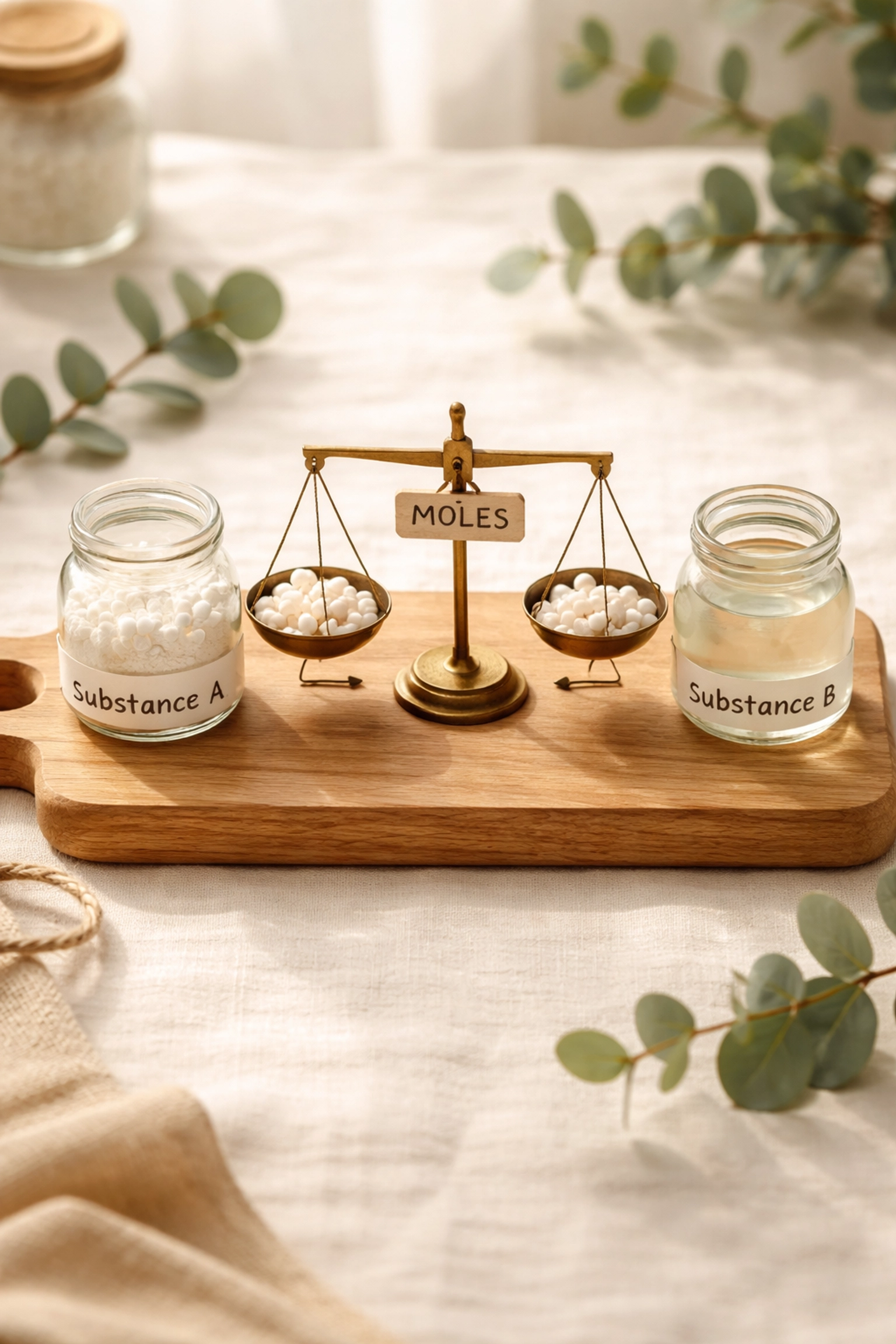
The systematic approach looks like this:
- Convert what you’re given into moles (using molar mass, concentration × volume, or the molar gas volume)
- Use the balanced equation to find the mole ratio between substances
- Convert moles into whatever the question asks for
This three-step process works for stoichiometry, limiting reactant calculations, titrations: you name it. Once you see this pattern, you’ll realise that most chemistry calculations are actually the same calculation in disguise.
And don’t forget: before you do anything, always write and balance your chemical equation first. Those coefficients give you the mole ratios you need, and without them, you’re essentially working blind.
Tip #3: Practice With Purpose 📚
Now, I’m not going to tell you that practice isn’t important: of course it is! But there’s a difference between mindless repetition and purposeful practice.
Here’s what purposeful practice looks like:
- Start simple. Master one-step calculations before moving to multi-step problems. Build your confidence gradually.
- Identify your weak spots. Do you always mess up unit conversions? Forget to use the mole ratio? Keep making calculator errors? Once you know your pattern, you can fix it.
- Work through exam-style questions. The more familiar you are with how examiners phrase things, the less likely you are to panic in the real exam.
- Review your mistakes properly. Don’t just look at the mark scheme and move on. Ask yourself: why did I get this wrong? What will I do differently next time?
If you’re looking for more calculation-specific strategies, I’ve written another post on how to tackle calculations without panic that goes into even more detail. It’s packed with revision tips for both A Level and GCSE Chemistry students. ❤️
Tip #4: Don’t Fear the Maths 🔢
I hear this all the time: “I’m rubbish at maths, so I’ll never be good at chemistry calculations.”
Let me gently push back on that. Chemistry maths is not the same as A Level Maths. You’re not doing calculus or complex algebra. You’re mostly using:
- Multiplication and division
- Rearranging simple formulas
- Basic ratio work
- Maybe a bit of logarithms if you’re doing pH calculations
The maths is simply a tool to describe what’s happening in the science. When you understand the chemistry: when you can visualise atoms reacting, moles being used up, products being formed: the maths becomes much less intimidating.
And here’s a little calculator tip: use parentheses generously. When you’re doing multi-step calculations (especially temperature conversions or complex divisions), entering everything in one go with proper brackets minimises errors and saves time.
Why Personalised Support Makes All the Difference 🙌
Here’s something I’ve learned after two decades as an A Level Chemistry Tutor and Online Chemistry Tutor: every student has their own unique “block” when it comes to calculations.
For some students, it’s understanding what moles actually mean. For others, it’s knowing when to use which formula. Some students fly through the chemistry but make consistent calculator errors. And some just need someone to slow down and explain things in a different way.

This is exactly why personalised tutoring is so transformative. In a 1-1 session or small group, I can identify your specific sticking point and address it directly. We don’t waste time on things you already understand: we focus on the exact concept that will make everything click for you.
Whether you’re a GCSE student building foundations, an A Level student aiming for that A*, or studying from Dubai and looking for expert UK-based support, the right guidance can make all the difference. I work with students across the UK and internationally, and seeing that lightbulb moment never gets old. 🌟
If you’re a parent supporting your child through their chemistry journey, you might also find this guide helpful: it’s all about reducing stress while still getting results.
Ready to Finally Crack Chemistry Calculations?
You absolutely can master chemistry calculations. It’s not about being naturally “good at numbers” or having some mysterious gift. It’s about understanding the underlying logic, building systematic habits, and getting the right support when you need it.
So here’s my challenge to you: pick one tip from this post and commit to using it in your next study session. Track your units. Think about the mole as your bridge. Practice with purpose. Whatever resonates most with you: start there.
And if you’re ready to take things to the next level, I’d love to help. Whether it’s a 1-1 tutoring session to work through your specific challenges or exploring calculation-focused resources, you can find everything you need at Chemistry with Chloe.
You’ve got this. And I’m here to help you prove it. 💪

Oxford-Educated Chemistry Specialist
With over 20 years of teaching experience at some of the UK’s top independent schools, I help ambitious students bridge the gap between hard work and top-tier results. I specialise in GCSE, A Level, and IB Chemistry tuition for students targeting Grade 9s and A*s. Based in the UK but working globally, I provide 1-1 online support for families in South and West London, Dubai, and Hong Kong, ensuring students are perfectly prepared for competitive medical applications and Oxbridge entries.
I’ve helped students achieve top grades from schools such as Alleyn’s, Dulwich College, Tonbridge, Sevenoaks, Brighton College, Wycombe Abbey, Caterham, St Paul’s, Dubai College, Dubai British School and Harrow International School Hong Kong.
Contact me archardchloe@gmail.com to discuss how I can help your child excel in Chemistry.