

Blog
Struggling With Curly Arrows and Organic Mechanisms? 7 Mistakes You’re Making (And the Simple Fix Top A Level Students Use)


Let’s be honest: organic chemistry is often the part of the A Level syllabus where even the brightest students start to feel the pressure. 😅 You’re cruising through calculations, smashing energetics, and then BAM, you hit mechanisms. Those curly arrows start to look like a toddler’s doodle, and suddenly you’re wondering if you’ve accidentally enrolled in an art class instead of Chemistry.
But here’s the thing: curly arrows aren’t random squiggles. They’re actually the GPS of a chemical reaction, they show you exactly where the electrons are going, which bonds are breaking, and which new ones are forming. Once you crack the code, mechanisms go from being the scariest part of the exam to one of the most predictable mark-earners. 🎯
Why Mechanisms Actually Matter (And It’s Not Just to Torture You)
Before we dive into the mistakes, let’s get one thing straight: mechanisms aren’t just drawings you memorise to pass an exam. They explain how the world works at a molecular level. How is paracetamol synthesised? How does your DNA replicate? How do pharmaceutical companies design life-saving drugs? The answer is always: mechanisms.
And from an exam perspective? They’re worth a huge chunk of marks across AQA, OCR, and Edexcel. We’re talking 6-mark questions, explain-and-apply scenarios, and those sneaky “suggest a mechanism” questions that separate the A* students from everyone else.
If you can master mechanisms, you’re not just learning Chemistry, you’re learning how to think like a chemist. And that’s a skill that’ll serve you way beyond your A Level exams.
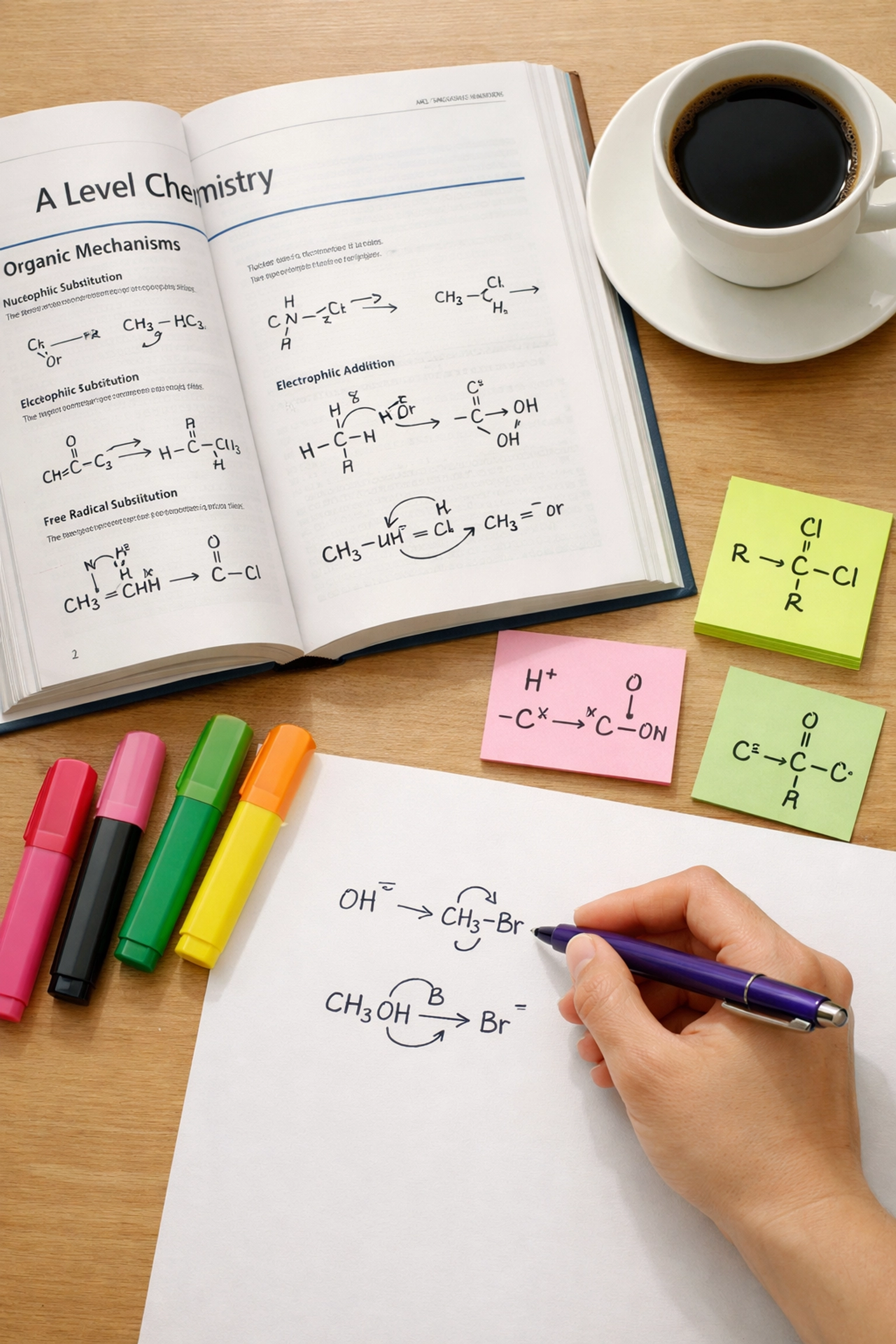
The 7 Deadly Sins of Curly Arrows (And How to Avoid Them)
Right, let’s get into the nitty-gritty. These are the seven most common mistakes I see students make with curly arrows: and the good news is, once you know what they are, they’re actually really easy to fix.
1. Starting Your Arrow From a Positive Charge
This is the number one killer mistake. I see it all the time, and it’s a dead giveaway that you don’t understand what curly arrows represent.
The mistake: You draw an arrow starting from a carbocation (C⁺) or any positively charged species.
Why it’s wrong: Curly arrows show electron flow, and electrons are negatively charged. A positive charge means there’s a lack of electrons, so how can electrons possibly flow from there? It’s like trying to pour water from an empty glass. 🚫
The fix: Always start your curly arrows from either a bond (which contains a pair of electrons) or a lone pair on an atom. If you see a positive charge, that’s usually where electrons are going, not where they’re coming from.
2. Pointing to ‘Empty Space’ Instead of a Specific Atom or Bond
The mistake: Your arrow kind of waves in the general direction of a molecule, landing somewhere vaguely near an atom.
Why it’s wrong: Examiners need to see exactly where those electrons are ending up. Are they forming a new bond with a specific atom? Are they becoming a lone pair? Vague arrows = lost marks.
The fix: Make your arrowhead land precisely on the atom you’re targeting or on the bond you’re breaking. Think of it like darts: you need to hit the bullseye, not just throw it in the general direction of the board. 🎯
3. Forgetting the Lone Pairs (The ‘Invisible’ Starting Points)
The mistake: You draw a mechanism showing an attack by a nucleophile, but you haven’t drawn the lone pair that’s doing the attacking.
Why it’s wrong: Every curly arrow must have a visible starting point. If you’re showing a nucleophile attacking an electrophile, that nucleophile has electrons to donate: and those electrons need to be drawn as a lone pair before you draw the arrow.
The fix: Get into the habit of always drawing lone pairs on oxygen, nitrogen, and halogen atoms, especially in the starting materials. These “invisible” electrons are often the stars of the show in mechanisms.

4. Losing Track of Charges (If It Starts Neutral and a Negative Leaves, What Happens?)
The mistake: You push electrons around beautifully, but then you forget to update the charges on your atoms. Or worse, you end up with an atom that has 10 electrons around it (which, unless you’re working with Period 3 elements in specific circumstances, is a big no-no).
Why it’s wrong: Chemistry is all about electron accounting. If an atom loses a pair of electrons, it gains a positive charge. If it gains a pair, it gains a negative charge. The maths has to add up.
The fix: After each step of your mechanism, check your charges. Think of it like balancing a budget: every electron you move changes the “account balance” of that atom. If an oxygen atom starts neutral and you push a lone pair away to form a bond elsewhere, that oxygen is now positively charged (O⁺).
5. Mixing Up Nucleophiles and Electrophiles (The ‘Lovers’ and ‘Haters’ of Electrons)
The mistake: You’ve got a nucleophile attacking another nucleophile, or an electrophile attacking an electrophile. Chaos ensues.
Why it’s wrong: Nucleophiles are electron-rich (they love to donate electrons: think of the “nucleo” as meaning “nucleus-loving,” and the nucleus is positive, so they’re attracted to positive charges). Electrophiles are electron-poor (they love to accept electrons). Opposites attract. Two electron-rich species aren’t going to react with each other: they’ll repel like the same poles of a magnet. 🧲
The fix: Before you draw your mechanism, identify the key players. Label your nucleophile (usually has a lone pair or a negative charge) and your electrophile (usually has a partial positive charge, δ⁺, or a full positive charge). The nucleophile always attacks the electrophile, never the other way round.
6. Drawing Arrows That Are Too ‘Lazy’ or ‘Vague’
The mistake: Your curly arrow is really short, or it curves in a weird way, or it’s just… not quite right.
Why it’s wrong: Examiners are looking for clear, confident arrows that show you understand the electron flow. A lazy arrow suggests lazy thinking (even if that’s not true!).
The fix: Draw your curly arrows with purpose and precision. Start from the exact location of the electrons (bond or lone pair), curve them in a smooth arc, and land them exactly where they’re going. Think of it like archery: smooth draw, clear aim, direct hit. 🏹
7. Trying to Memorise 50+ Mechanisms Instead of Learning the 3 Core Patterns
This is the big one. This is the mistake that causes students to spend hours making flashcards and still bomb the mechanism questions in the exam.
The mistake: You’re trying to memorise every single mechanism you’ve ever been taught as a separate, unique entity.
Why it’s wrong: Your brain isn’t a hard drive. You can’t just upload 50+ mechanisms and expect to recall them perfectly under exam pressure. Plus, if the exam throws you a mechanism you haven’t seen before (which they love to do), you’re stuck.
The fix: Stop memorising. Start understanding the patterns. There are really only about three core patterns in A Level organic chemistry:
- Nucleophilic substitution (nucleophile replaces a leaving group)
- Nucleophilic addition (nucleophile adds to a C=O bond)
- Electrophilic addition (electrophile adds to a C=C bond)
Everything else is just a variation on these themes. Once you understand how and why these patterns work, you can apply them to any molecule the exam throws at you. 🌟
The Simple Fix: Focus on the “Electron Flow” Story
Here’s the golden rule that changed everything for my students: treat mechanisms like a story where the electrons are looking for a more stable home.
Electrons want to be in stable, low-energy environments. They’re attracted to positive charges. They’ll leave atoms that can stabilise a negative charge. They’ll form bonds with electron-deficient areas.
When you’re drawing a mechanism, ask yourself:
- Where are the electrons now? (Starting point: bond or lone pair)
- Where do they want to go? (Ending point: usually somewhere positive or electron-deficient)
- What happens to the atoms as a result? (Charge changes, new bonds, broken bonds)
That’s it. That’s the whole game. 🎮
You’re Not Alone (And It’s Usually Not Your Fault)
If you’re a bright, hardworking student in Dubai, the UK, or anywhere else, and mechanisms “just won’t click,” let me tell you something: you aren’t alone. I work with top-tier students every week who are getting A*s in everything else but struggling with organic chemistry.
And here’s the secret: it’s usually not a lack of ability. It’s an exam technique issue. It’s the way mechanisms are often taught: as lists to memorise rather than patterns to understand. It’s the fact that your teacher has 30 students in a class and can’t give you the one-to-one time you need to really nail this.
The students who “get it” aren’t necessarily smarter than you. They’ve just had someone explain it in a way that finally makes sense. ✨
Ready to Finally Master Mechanisms?
If you’re serious about turning mechanisms from your worst topic into one of your strongest, I’d love to help. Whether you’re preparing for your mocks, gearing up for the real thing, or just trying to build a solid foundation early on, 1-to-1 tuition is the fastest way to fix those curly arrow mistakes for good.
I also run small group sessions where you can work through practice questions with other students who are in exactly the same boat (and trust me, there’s something really reassuring about realising you’re not the only one who’s struggled with this!).
And if you’re more of a self-study person, I’ve got revision resources that break down every mechanism you need to know into clear, manageable steps: no fluff, no overwhelm, just the good stuff.
👉 Get in touch via my contact page and let’s have a chat about where you’re at and how I can help you get to where you want to be.
Because here’s the truth: you’re capable of this. You just need the right approach. And once it clicks? You’ll wonder why you ever found it difficult in the first place. 🚀

Oxford-Educated Chemistry Specialist
With over 20 years of teaching experience at some of the UK’s top independent schools, I help ambitious students bridge the gap between hard work and top-tier results. I specialise in GCSE, A Level, and IB Chemistry tuition for students targeting Grade 9s and A*s. Based in the UK but working globally, I provide 1-1 online support for families in South and West London, Dubai, and Hong Kong, ensuring students are perfectly prepared for competitive medical applications and Oxbridge entries.
I’ve helped students achieve top grades from schools such as Alleyn’s, Dulwich College, Tonbridge, Sevenoaks, Brighton College, Wycombe Abbey, Caterham, St Paul’s, Dubai College, Dubai British School and Harrow International School Hong Kong.
Contact me archardchloe@gmail.com to discuss how I can help your child excel in Chemistry.