

Blog
The 1% Margin: How to Master 6-Mark A Level Chemistry Synthesis Questions


You know the content. You’ve memorized the functional groups, practiced the mechanisms, and can recite oxidation states in your sleep. But every time you hit a 6-mark synthesis question, you lose 2 or 3 marks on what your teacher calls “minor details.”
Let me be blunt: in the race for an A*, these small leaks are the difference between a top-tier university offer and a backup plan.
If you’re sitting at a B or an A right now, you’re not missing fundamental knowledge. You’re missing the 1% margin: the tiny technical nuances that separate students who know chemistry from students who can execute chemistry in examiner-speak. And that’s exactly what we’re fixing today.
The “Year 13 Wall”: Why Your Grades Have Plateaued
Here’s what happens to high-achieving students around November of Year 13:
You cruised through GCSE. Year 12 felt manageable. Then suddenly, organic synthesis gets complex, and your previously reliable A grades start slipping to B+ or A-.
This isn’t about intelligence. It’s about specificity.
In Year 12, you could get away with writing “add sodium hydroxide” or “heat under reflux.” But in Year 13, examiners expect you to distinguish between concentrated NaOH in ethanol (elimination) versus dilute aqueous NaOH (substitution). They want you to specify excess ammonia in a sealed tube rather than just “react with ammonia.”
The Year 13 wall exists because the margin for vagueness disappears. Every word matters. Every condition matters. And most classroom teaching: constrained by time and large class sizes: simply doesn’t have the bandwidth to drill this level of precision into every student.
Deconstructing the 6-Marker: Reading the Hidden Requirements
Let’s get tactical. When you see a 6-mark synthesis question, you’re not just being asked to “plan a route.” You’re being asked to provide:
✅ Correct reagents for each step
✅ Specific conditions (temperature, concentration, catalyst)
✅ Structures of key intermediates
✅ Type of reaction at each step (oxidation, substitution, addition, etc.)
✅ Balanced equations where appropriate
✅ Logical sequencing that shows clear chemical reasoning
Most students write half of this. They’ll give reagents but forget conditions. They’ll draw the final product but skip the intermediates. They’ll name the reaction type but use the wrong structural notation.
Here’s a real example from an OCR past paper:
“Plan a synthesis of propanoic acid from propan-1-ol. Show all reagents, conditions, and intermediate structures.” (6 marks)
A B-grade answer might say:
“Oxidize propan-1-ol to propanoic acid using acidified potassium dichromate.”
That’s worth 2 marks. Maybe.
An A*-grade answer says:
“Step 1: Oxidize propan-1-ol to propanal using acidified potassium dichromate(VI), K₂Cr₂O₇/H₂SO₄, with distillation to prevent over-oxidation.
Step 2: Further oxidize propanal to propanoic acid using acidified potassium dichromate(VI) under reflux.”
See the difference? The A* student has shown:
- Two-step reasoning (aldehyde intermediate)
- Specific conditions (distillation vs. reflux)
- Full reagent names (not just “dichromate”)
- Clear intermediate structure
That’s 6 marks.
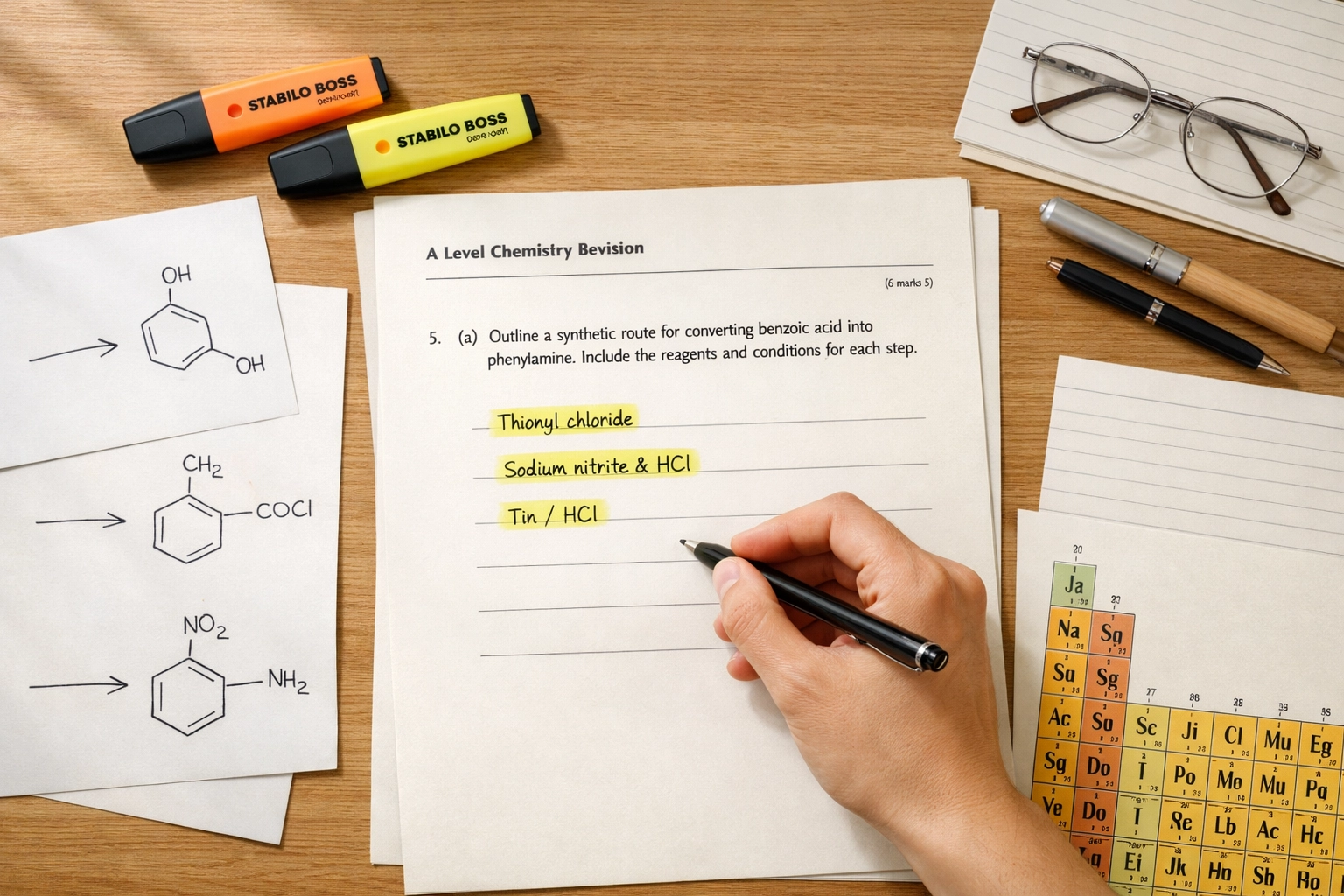
The Power of “Examiner-Speak”: Keywords That Unlock Marks
Let’s talk about the words that physically unlock marks on mark schemes. I’ve spent hundreds of hours analyzing examiner reports, and here’s what I’ve learned:
Examiners are looking for these specific terms:
🔹 Reflux (not “heat”)
🔹 Excess (when one reagent needs to be in surplus)
🔹 Acidified (when using oxidizing agents)
🔹 Dilute vs. concentrated (matters hugely for NaOH, HCl, H₂SO₄)
🔹 Sealed tube (for reactions with ammonia or high-pressure conditions)
🔹 Room temperature (when explicitly avoiding heat)
🔹 Anhydrous conditions (for Grignard or Friedel-Crafts)
🔹 Distillation (to isolate aldehydes and prevent over-oxidation)
Here’s the truth: you can know the chemistry perfectly and still lose marks if you don’t use these exact words.
A student writes: “Heat the mixture.”
Examiner thinks: Does the student mean reflux or distillation? Unclear. Zero marks.
Another student writes: “Heat under reflux.”
Examiner thinks: Correct condition specified. One mark.
This is what I mean by examiner-speak. It’s not about being pedantic. It’s about removing ambiguity so the examiner has zero room to deny you marks.
Structuring for Clarity: The A* Framework
Here’s my step-by-step framework for laying out a synthesis route that is impossible for an examiner to misinterpret:
The Five-Part Formula:
1. State the starting material clearly
Write out the full structure or name. Don’t assume.
2. For each step, use this exact format:
- Reagent(s): Full chemical names (not abbreviations unless standard)
- Conditions: Temperature, concentration, special apparatus
- Reaction type: (e.g., “nucleophilic substitution” or “oxidation”)
- Intermediate structure: Draw it clearly with correct notation
3. Use skeletal formulae for organic structures
They’re faster, clearer, and what examiners prefer at A Level.
4. Show electron flow where mechanism matters
If the question asks “explain” or “show,” include curly arrows.
5. Label each step numerically
Step 1, Step 2, Step 3. This makes your logic trackable.
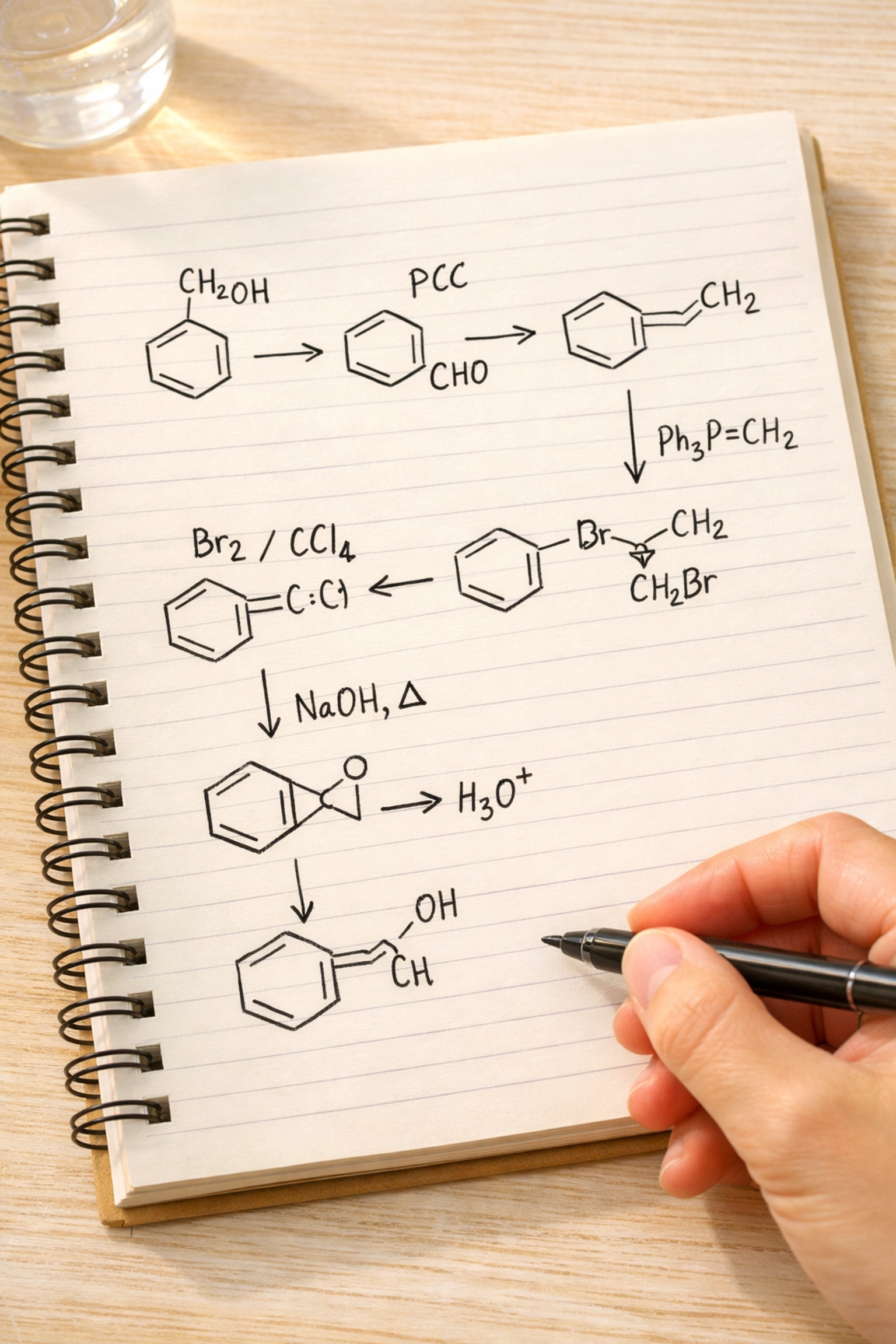
Let me show you this in action with a classic question:
“Convert benzene to phenylamine. Show all steps, reagents, and conditions.” (6 marks)
A* Answer:
Step 1: Nitration
- Reagents: Concentrated nitric acid (HNO₃) and concentrated sulfuric acid (H₂SO₄)
- Conditions: Heat to 50°C
- Reaction type: Electrophilic substitution
- Product: Nitrobenzene (C₆H₅NO₂)
Step 2: Reduction
- Reagents: Tin (Sn) and concentrated hydrochloric acid (HCl), or hydrogen gas (H₂) with Ni catalyst
- Conditions: Reflux
- Reaction type: Reduction
- Product: Phenylamine (C₆H₅NH₂)
That’s 6/6 marks. Every box is ticked.
Compare that to a vague answer like: “React benzene with nitric acid, then reduce with tin.” That’s maybe 2 marks if the examiner is feeling generous.
From B to A*: Why High-End Tuition Focuses on These Nuances
Here’s what most schools don’t have time to do:
❌ Mark your synthesis answers with examiner-level precision
❌ Teach you to anticipate ambiguity in your own answers
❌ Drill you on when excess reagents matter
❌ Show you how to structure multi-step syntheses for maximum clarity
This is where A Level Chemistry tutor support becomes genuinely valuable: not for re-teaching content you already know, but for refining your execution to examiner standard.
When I work with students at this level, we don’t spend time on “what is an aldehyde?” We spend time on:
✔️ “Why did you lose 2 marks on that synthesis question?”
✔️ “How could you have worded that condition more precisely?”
✔️ “What’s the difference between ‘add NaOH’ and ‘add aqueous NaOH’?”
These are the 1% margins. And at the A*/A boundary, they’re everything.
Because here’s the reality: the difference between an A and an A* in Chemistry is often 3-5 marks across the entire exam. That’s one synthesis question. One set of conditions. One missing keyword.
You don’t need to learn more chemistry. You need to execute the chemistry you know with surgical precision.
Your Next Step
If you’re a Year 13 student sitting at a B or A right now, and you’re serious about pushing to an A*, here’s what I’d recommend:
📌 Go back through your last three mock papers
Find every 6-mark synthesis question. Compare your answer to the mark scheme. Count how many marks you lost on “details” versus actual knowledge gaps.
📌 Rebuild those answers using the Five-Part Formula
Rewrite each synthesis answer with full reagents, conditions, and intermediate structures. Then get a teacher or online Chemistry tutor to mark it against the actual mark scheme.
📌 Create a “conditions bank”
Make a table of common reactions (oxidation, reduction, substitution, elimination) with the exact conditions examiners expect. Drill it until it’s automatic.
The students who get A* in Chemistry aren’t the ones who know the most obscure reactions. They’re the ones who never lose marks on the basics. They’re the ones who write “concentrated H₂SO₄ catalyst” instead of just “sulfuric acid.” They’re the ones who specify “heat under reflux” instead of “heat.”
That’s the 1% margin. And it’s yours to master.
If you need help refining your exam technique or want someone to mark your synthesis answers with examiner-level precision, you can explore A Level Chemistry revision support here. Sometimes all it takes is one session to see where those 2-3 marks are leaking: and how to plug them.
Now go get that A*. You’re closer than you think. 🧪✨


Oxford-Educated Chemistry Specialist
With over 20 years of teaching experience at some of the UK’s top independent schools, I help ambitious students bridge the gap between hard work and top-tier results. I specialise in GCSE, A Level, and IB Chemistry tuition for students targeting Grade 9s and A*s. Based in the UK but working globally, I provide 1-1 online support for families in South and West London, Dubai, and Hong Kong, ensuring students are perfectly prepared for competitive medical applications and Oxbridge entries.
I’ve helped students achieve top grades from schools such as Alleyn’s, Dulwich College, Tonbridge, Sevenoaks, Brighton College, Wycombe Abbey, Caterham, St Paul’s, Dubai College, Dubai British School and Harrow International School Hong Kong.
Contact me archardchloe@gmail.com to discuss how I can help your child excel in Chemistry.