

Blog
The A to A* Shift: Mastering the 6-Mark Question in A-Level Chemistry

You know that sinking feeling when your brilliant, hardworking teen opens their Chemistry mock results and sees an A staring back at them: not the A* they were banking on for their Oxbridge or Russell Group application?
Here’s what I see time and time again in my tutoring practice: students who absolutely nail the knowledge-based questions, who can recite reaction mechanisms in their sleep, who’ve memorized every periodic trend… and then they hit a wall with the 6-mark extended response questions.
That wall? It’s the difference between an A and an A*.
And here’s the thing: it’s not about how much Chemistry they know. It’s about how they communicate what they know. Let me show you exactly what examiners are looking for, and how we can train your child to deliver it consistently.
The Grading Gap: Why Facts Alone Won’t Cut It
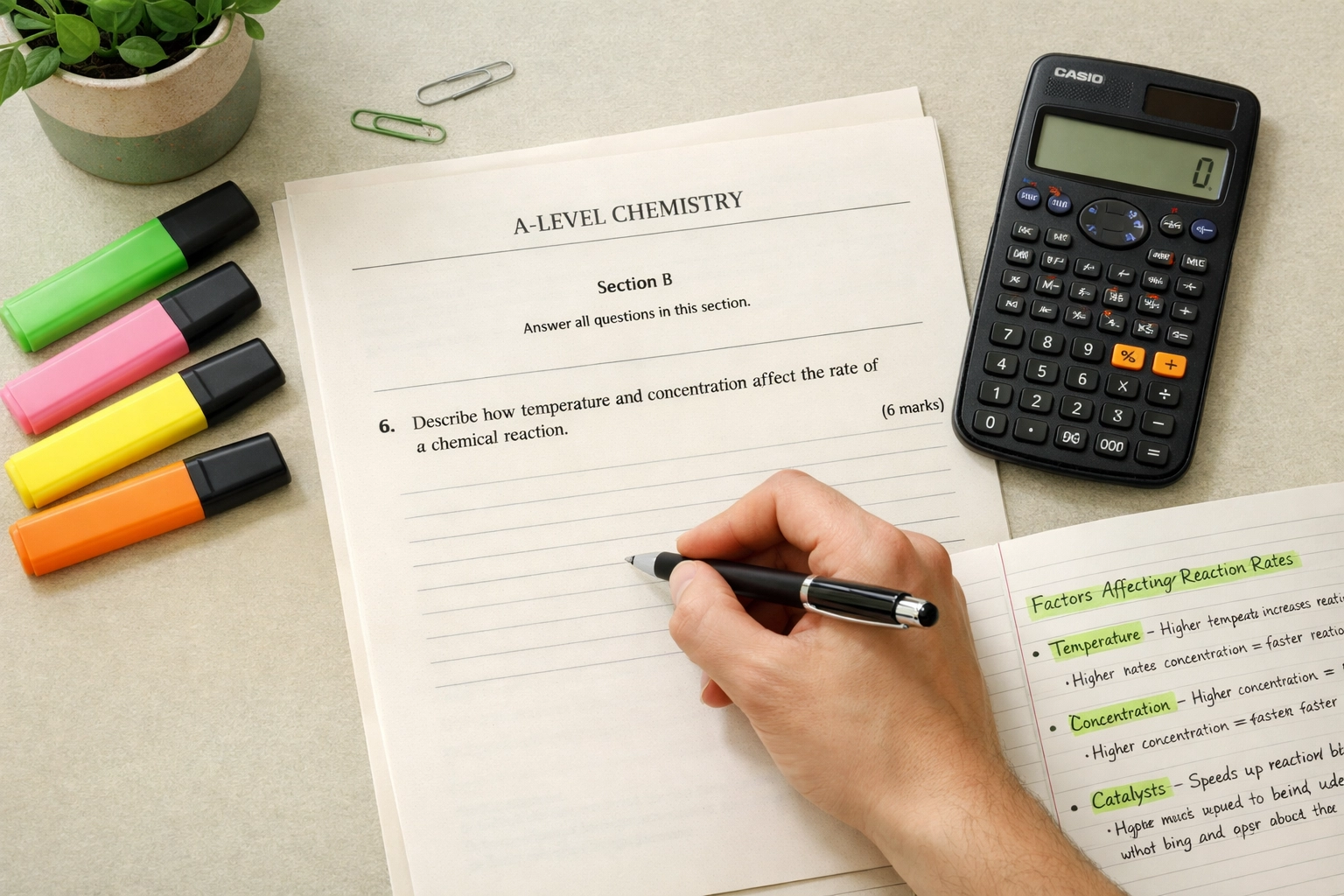
The 6-mark question is your examiner’s secret weapon for identifying A* candidates. While shorter questions test recall and application (that’s Assessment Objective 1 and 2), these extended response questions are designed to test AO3: Analysis and Evaluation.
Translation? They want to see your teen think like a chemist, not just remember like one.
A student could write down every single correct chemistry fact: transition metal complexes, ligand substitutions, entropy changes: and still land in the bottom marking level if they present it as a disjointed list. The examiners aren’t just marking what you say; they’re marking how you build the argument.
This is where most students lose those crucial marks. They’ve got the content. They just haven’t been taught the architecture of an A* answer.
Decoding the ‘Levels’ System (And Why It’s Not What You Think)
Here’s something that surprises most parents: 6-mark questions aren’t marked out of six in the traditional sense.
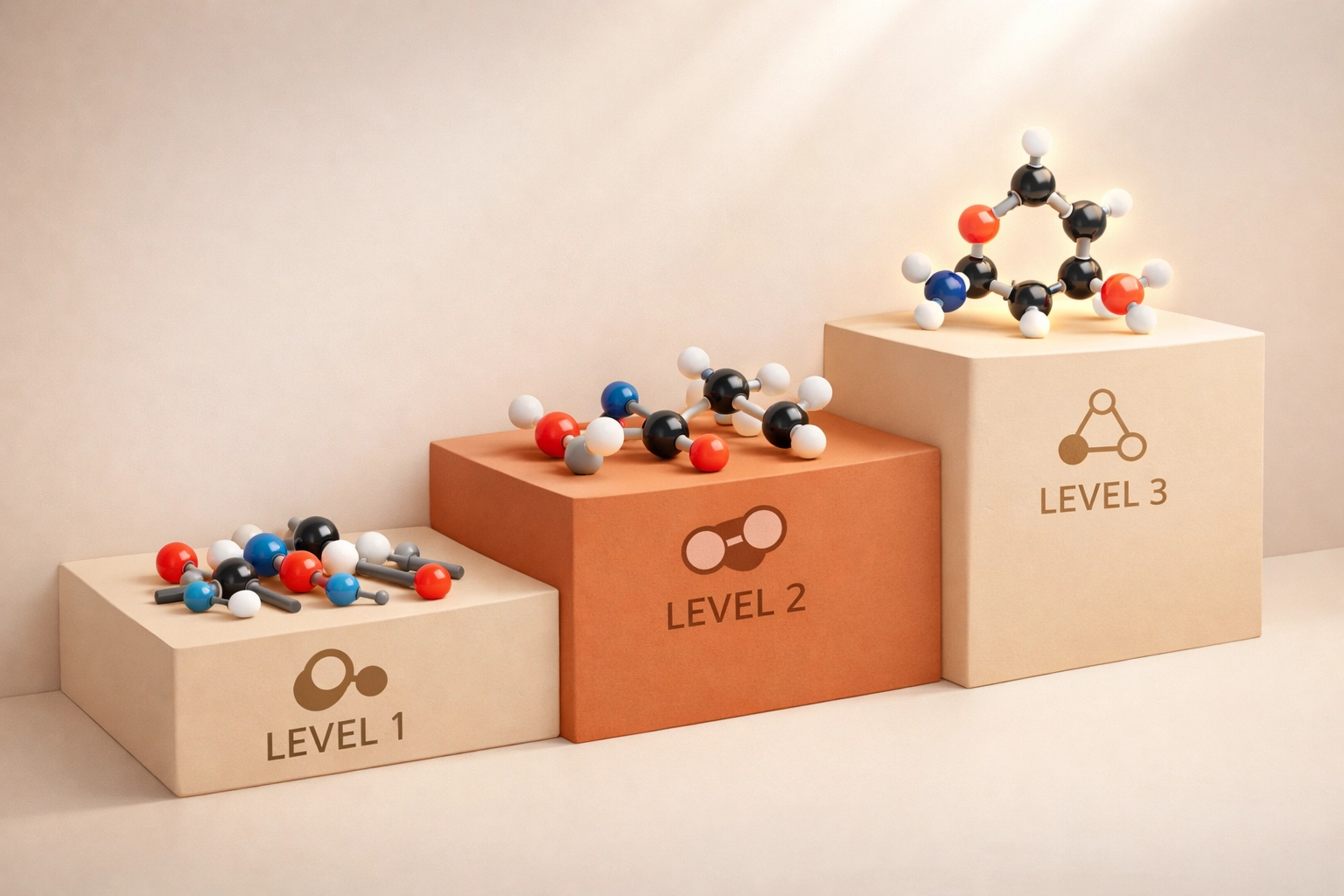
Instead, examiners use a Levels of Response marking system, typically with three bands:
- Level 1 (Basic): 1-2 marks : Isolated points with no logical connection
- Level 2 (Good): 3-4 marks : Relevant chemistry with some structure, but gaps in reasoning
- Level 3 (Excellent): 5-6 marks : Comprehensive chemistry content delivered in a coherent, logical sequence with specialist terminology
The key word here? Coherent.
Your teen could identify every chemistry concept the question demands and still get stuck at 3-4 marks if they don’t link those concepts logically. The examiner needs to see cause and effect. They need to see “this happens, therefore this occurs, leading to this outcome.”
Think of it like this: Level 1 is a pile of LEGO bricks. Level 3 is a completed structure where every brick has a purpose and fits precisely. Same bricks. Different outcome.
Strategic Mastery: The Four Pillars of A* Answers
So how do we train students to consistently hit Level 3? I teach what I call the “Four Pillars” approach to 6-markers. These are battle-tested techniques that work across every exam board: whether your child is sitting AQA, OCR, or Edexcel.
1. Annotate the Command Words First
Before your teen writes a single word of their answer, they should be dissecting the question itself.
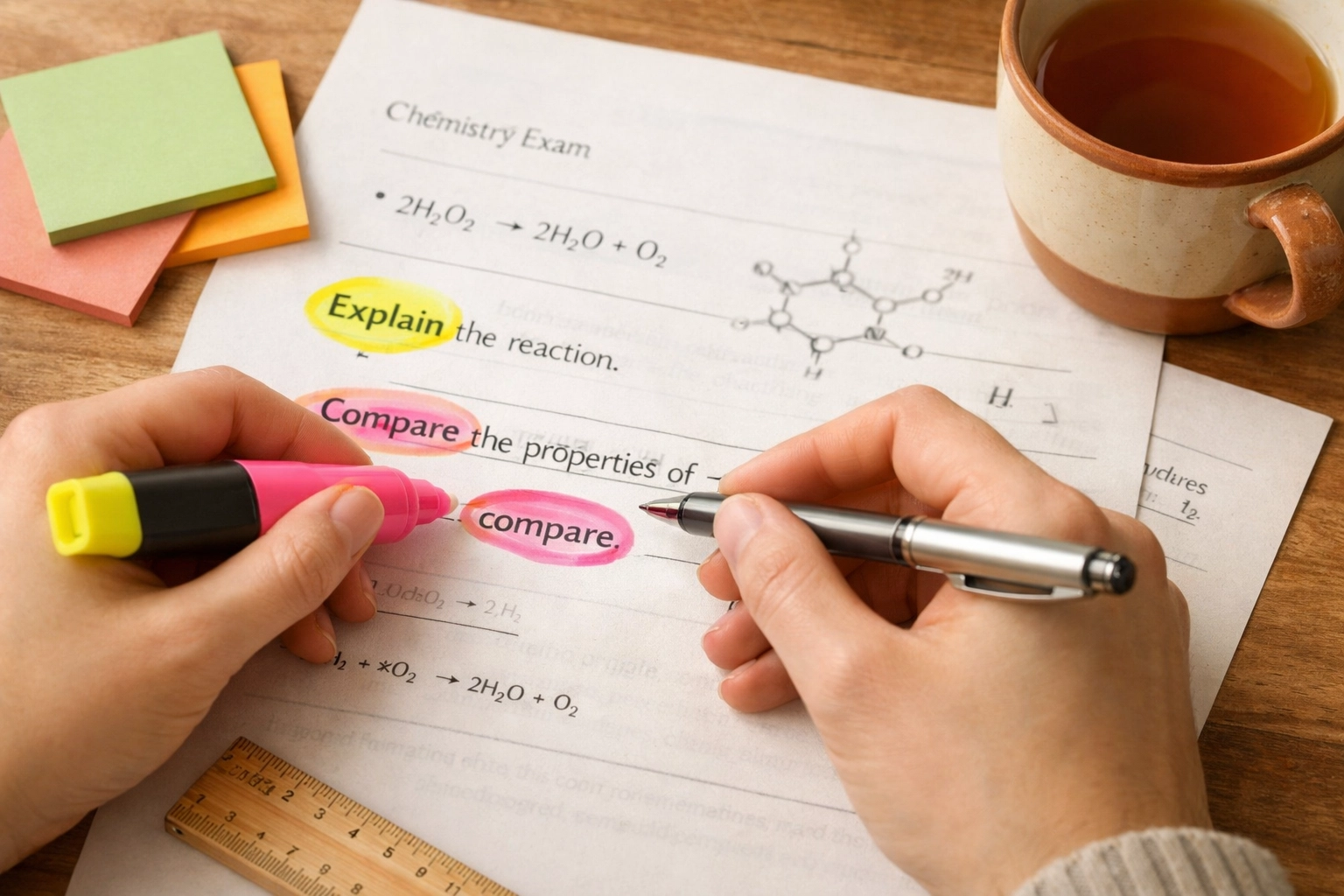
Is it asking them to “explain”? That means they need mechanisms and reasons. “Compare”? They’ll need clear distinctions between two substances or processes. “Suggest”? They’re being tested on application of knowledge to unfamiliar contexts.
I get my students to literally circle and underline the command words and any specific chemical contexts mentioned. This 15-second habit prevents the single biggest mistake: answering the question they think is being asked, rather than the one actually on the paper.
2. Keywords as Anchors
Start every major point with the specialist terminology the examiner is hunting for.
For example, if you’re explaining why a certain ligand substitution occurs, you’d open with “Ligand exchange occurs due to…” not “The things around the metal change because…”
Terminology signals to the examiner that you’re operating at A* level before they’ve even read your reasoning. It anchors your answer in credible chemistry from sentence one.
This isn’t about showing off: it’s about precision. Chemistry is a language, and A* students speak it fluently.
3. The Logical Flow: “Therefore” and “Leading To”
This is where the magic happens. Once you’ve laid down your chemistry concept, you must connect it to the next idea using explicit linking phrases:
- “Therefore…”
- “This leads to…”
- “As a result…”
- “Consequently…”
Let me show you the difference with a thermodynamics example:
Level 1 answer: “The reaction is exothermic. The surroundings get hotter. Entropy increases.”
Level 3 answer: “The reaction is exothermic, releasing energy to the surroundings. Therefore, the surroundings experience a temperature increase. This leads to an increase in entropy of the surroundings, which consequently makes the overall entropy change positive and the reaction feasible.”
See how the second answer guides the examiner through the reasoning? That’s the narrative structure that unlocks full marks.
For equilibrium questions, thermodynamics problems, or any multi-step analysis, this technique is absolutely non-negotiable.
4. Separate Substances Systematically
When a question asks you to compare two substances: say, the electrical conductivity of sodium chloride solid vs. molten: never jump back and forth between them.
Instead:
- Fully explain Substance A (all relevant points)
- Then fully explain Substance B (all relevant points)
- Optionally, add a summary comparison at the end
Alternating between substances creates confusion and often leads to contradictions. Examiners have specifically noted this in their reports as a common reason for students being capped at Level 2.
Think of it as giving each substance its own mini-essay within your answer. Clean. Logical. Distinction-worthy.
The Usual Suspects: Topics That Love 6-Markers
While any topic could appear as a 6-marker, certain areas show up with reliable frequency. If your teen is revising strategically, these should be priority zones:
🔬 Shapes of Molecules : Explaining electron pair repulsion, bond angles, and deviations from ideal geometry
🔬 Bonding and Structure : Comparing ionic vs. covalent vs. metallic bonding and relating this to physical properties
🔬 Colorimetry and Beer-Lambert Law : A favorite for practical endorsement-style questions
🔬 Transition Metal Chemistry : Ligand substitutions, color changes, variable oxidation states
🔬 Organic Reaction Mechanisms : Especially distinguishing between compounds using chemical tests
🔬 Periodicity and Trends : Ionization energy patterns, atomic radius changes across periods/groups
🔬 Thermodynamics : Feasibility of reactions, entropy, Gibbs free energy
🔬 Equilibria : Le Chatelier’s principle applied to industrial processes or complex systems
The key is practicing these topics in the 6-mark format specifically. It’s not enough to “know” colorimetry: you need to have practiced writing a coherent, Level 3 response about it under timed conditions.
The 1% Margin: Where Tutoring Makes the Difference
Here’s the truth that exam boards won’t advertise: the gap between an A and an A* can come down to 3-4 marks across an entire paper.
That’s one 6-marker. Sometimes less.
This is why I call personalized A Level Chemistry tutoring the “finishing school” for top-tier students. Your teen doesn’t need to learn more Chemistry (they probably know plenty). They need to learn how to package and present it in the high-stakes moment of an exam.
In my 1-1 sessions, we do something most classroom teachers simply don’t have time for: we dissect real 6-mark questions from past papers, compare student answers at each level, and practice building that Level 3 structure until it becomes second nature.
We look at actual mark schemes. We decode what “indicative scientific points” really means. We train the muscle memory of writing logically connected responses.
It’s like having a personal coach for a specific athletic skill. You might be fit, strong, and fast: but if you want to master the high jump technique that wins medals, you need someone analyzing your form and correcting the details.
That’s what we do with 6-markers. We make A* technique a habit, not a hope.
Timing: The 6-8 Minute Sweet Spot
One final piece of the puzzle: time management.
In a typical A-Level Chemistry exam (90 marks in 2 hours), you’re working at roughly 1 mark per minute, with a small buffer for checking. That means a 6-marker should take 6-8 minutes maximum.
Students who haven’t practiced this pacing often fall into two traps:
- Rushing and writing a scattered, Level 1 answer in 3 minutes
- Over-elaborating and spending 12 minutes on one question, leaving themselves short later
We practice hitting that sweet spot: enough time to plan, write, and link your points coherently, but not so much that you’re sacrificing marks elsewhere.
Again, this is a skill, not just knowledge. And skills improve with deliberate practice and expert feedback.
Your Next Step: Bridging the Gap
If your child is consistently hitting A grades but struggling to break into A* territory: or if Chemistry Olympiad preparation is on your radar for that ultimate UCAS stand-out: then mastering 6-mark questions is your strategic priority right now.
This isn’t about cramming more facts. It’s about refining technique. And the fastest, most effective way to do that is through personalized coaching where we can analyze your teen’s actual written responses and correct the structure in real-time.
Whether you’re in London, Dubai, or anywhere else in the world, my online Chemistry tutoring provides that targeted, expert feedback that transforms good students into exceptional ones.
The A* isn’t out of reach. It’s just hidden behind better exam technique. Let’s unlock it together. 🌟
Reach out today, and let’s talk about where your child is now and exactly what they need to consistently hit Level 3 on those crucial 6-markers. Because in the competitive world of university admissions, that difference between an A and an A*? It matters more than ever.


Oxford-Educated Chemistry Specialist
With over 20 years of teaching experience at some of the UK’s top independent schools, I help ambitious students bridge the gap between hard work and top-tier results. I specialise in GCSE, A Level, and IB Chemistry tuition for students targeting Grade 9s and A*s. Based in the UK but working globally, I provide 1-1 online support for families in South and West London, Dubai, and Hong Kong, ensuring students are perfectly prepared for competitive medical applications and Oxbridge entries.
I’ve helped students achieve top grades from schools such as Alleyn’s, Dulwich College, Tonbridge, Sevenoaks, Brighton College, Wycombe Abbey, Caterham, St Paul’s, Dubai College, Dubai British School and Harrow International School Hong Kong.
Contact me archardchloe@gmail.com to discuss how I can help your child excel in Chemistry.