

Blog
The Easter Revision Trap: Why Reading Your Notes Won’t Get You an A* in A Level Chemistry


Easter break is just around the corner, and I can already picture what’s about to happen in thousands of households across the UK and Dubai: Year 12 and 13 students are going to sit down with their chemistry notes, a fresh set of highlighters, and the very best of intentions. 🌟
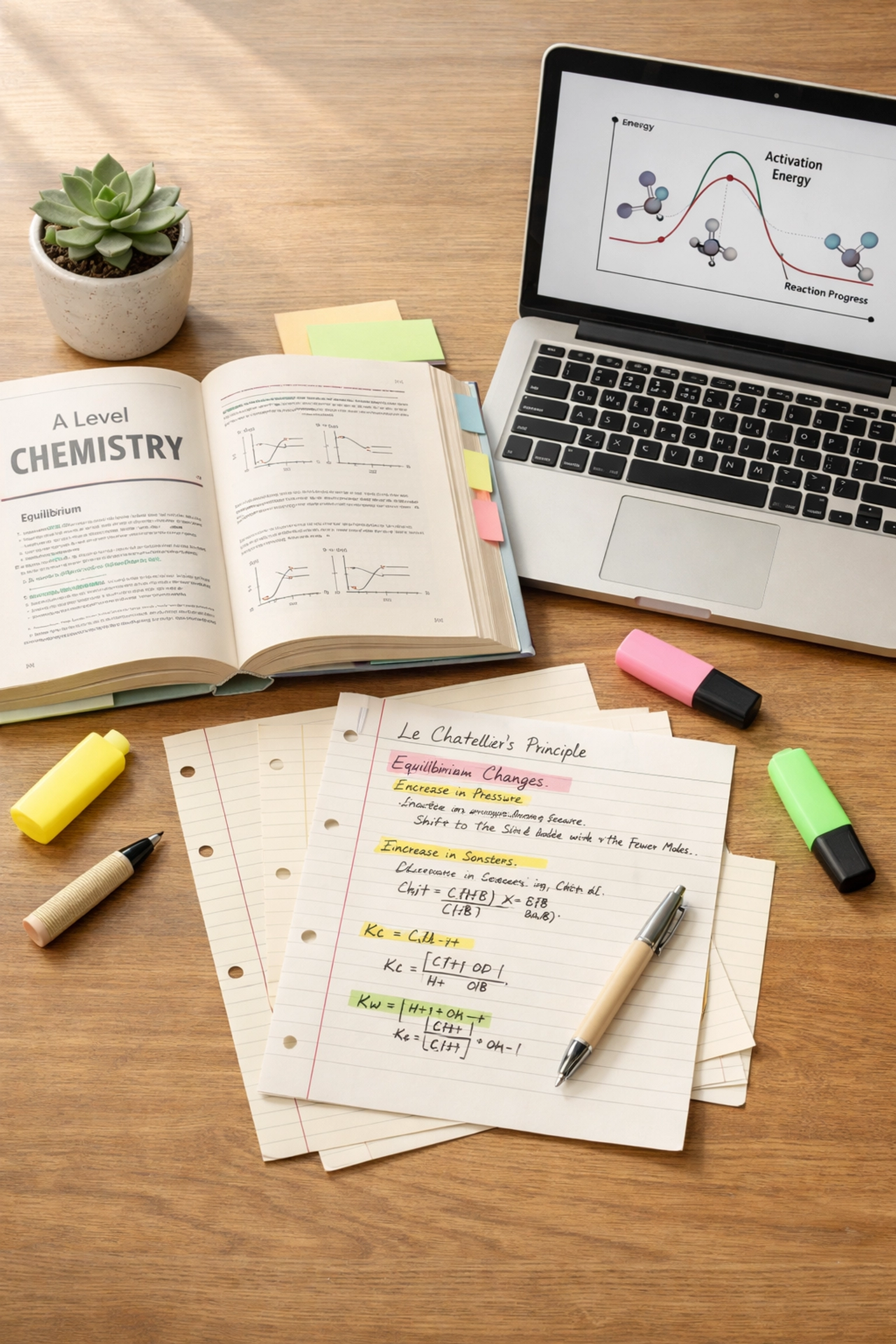
They’ll read through their notes on Organic Chemistry. They’ll highlight key reactions in neon yellow. They might even rewrite their notes on flashcards. And by the end of Easter, they’ll feel like they’ve done “so much revision.”
But here’s the hard truth: reading your notes won’t get you an A* in A Level Chemistry. In fact, it’s one of the biggest revision traps students fall into, and it’s costing them marks they could easily gain with smarter strategies.
Let me explain why passive revision doesn’t work, and what you should be doing instead this Easter to actually improve your exam performance and boost your confidence before those all-important summer exams.
Why Reading Your Chemistry Notes Feels Like Revision (But Isn’t)
There’s something deeply satisfying about reading through your chemistry notes. It feels productive. It feels safe. You recognize the content, you nod along, and you think, “Yes, I know this.”
But recognition is not the same as recall. And exams don’t test recognition, they test your ability to retrieve information from memory, apply it to unfamiliar contexts, and communicate it clearly under time pressure.
When you read your notes, you’re engaging in what educational psychologists call passive revision, you’re absorbing information without actively testing yourself on it. It creates what’s known as the “fluency illusion”: the material feels familiar, so your brain tricks you into thinking you’ve mastered it. But when you sit down in the exam hall and face a 6-mark question on electrode potentials, that fluency evaporates. 😰
The research backs this up. Studies show that students who rely on passive revision techniques (reading, highlighting, rewriting notes) perform significantly worse in exams than those who use active recall methods. Quality matters far more than quantity when it comes to A Level Chemistry revision.
What Actually Works: Active Retrieval and Spaced Repetition
So if reading your notes isn’t the answer, what is? The two most powerful revision techniques are Active Retrieval and Spaced Repetition, and the good news is, they’re not complicated. Let me break them down for you in simple terms.
Active Retrieval
Active Retrieval means forcing your brain to pull information out of your memory without looking at your notes. Instead of reading “The Haber Process uses an iron catalyst at 450°C and 200 atm,” you ask yourself: “What are the conditions for the Haber Process?” and try to answer from memory.
This feels harder than reading your notes, and that’s exactly why it works. The effort of retrieving information strengthens the neural pathways in your brain, making it easier to recall that information in the future (like in an exam). It’s like training a muscle: the harder you work it, the stronger it gets. 💪
Spaced Repetition
Spaced Repetition means revisiting information at increasing intervals over time, rather than cramming it all in one marathon session. For example, you might test yourself on electrode potentials today, then again in three days, then again in a week.
This technique leverages the “spacing effect”, the fact that your brain retains information much better when you revisit it multiple times over a longer period, rather than repeatedly in a short burst. It’s why cramming the night before an exam might get you through, but you’ll forget everything a week later.
Together, Active Retrieval and Spaced Repetition transform your Easter revision from a passive reading exercise into a powerful, exam-focused training session. And the best part? You can implement them starting this Easter with a simple 3-step action plan.
Your 3-Step Easter Action Plan for Chemistry Success
If you want to make the most of your Easter break and walk into your summer exams feeling confident and prepared, follow this plan. It’s designed specifically for A Level Chemistry students who want to target their weakest areas and build rock-solid exam skills.
Step 1: Identify Your Weak Topics (Don’t Start with What You Know)
Here’s the biggest mistake students make at the start of Easter revision: they revise what they already know. It feels comfortable, it’s low-stress, and it gives them a quick confidence boost. But it’s a waste of precious revision time.
Instead, you need to start with your weakest topics, the ones that make you feel a bit queasy when they come up in class. For most students, this includes:
- Equilibria (Le Chatelier’s Principle, Kc and Kp calculations)
- Organic Chemistry mechanisms (especially electrophilic addition and nucleophilic substitution)
- Electrode potentials and electrochemical cells
- Kinetics (rate equations, orders of reaction)
Here’s how to identify your weak spots:
- Look at your last few mock exams or class tests. Which topics did you lose the most marks on?
- Go through your specification (Edexcel, AQA, OCR) and rate each topic on a scale of 1-5, where 1 = “I have no idea what this is” and 5 = “I could teach this to someone else.”
- Prioritize anything you rated 1-3. These are your Easter targets.
Don’t fall into the trap of revising what you already know just because it feels easier. Your exam grade will be determined by how well you perform on the difficult topics, not the easy ones. 🎯

Step 2: Use the ‘Blurting’ Method
Once you’ve identified your weak topics, it’s time to use one of the most effective (and underrated) active recall techniques: Blurting.
Here’s how it works:
- Choose a topic (e.g., “Born-Haber cycles”).
- Set a timer for 5 minutes.
- Write down everything you can remember about that topic from memory, no notes, no textbook, no peeking. Just brain-dump everything onto a blank page.
- After 5 minutes, stop. Now open your notes or textbook and compare what you wrote with the actual content.
- Identify the gaps. What did you miss? What did you get wrong? What was incomplete?
The Blurting method is powerful because it immediately reveals what you don’t know. You can’t fake it. If you can’t write it down from memory, you don’t really know it, and that’s exactly the information you need to focus on.
Do this for each of your weak topics over the Easter break, and you’ll see dramatic improvements in your recall. Plus, it’s much faster than reading through pages of notes for hours. ⏱️
Step 3: Timed Exam Questions (and Mark Them Like an Examiner)
Here’s where the magic happens. Once you’ve used the Blurting method to fill in your knowledge gaps, it’s time to practice exam questions under timed conditions.
This is non-negotiable if you want an A*. You could know every single fact in your specification, but if you can’t communicate that knowledge clearly, concisely, and within the time limit, you won’t get the marks.
Here’s your Easter exam question strategy:
- Download past papers from your exam board (Edexcel, AQA, OCR, they’re all free online).
- Choose questions on your weak topics (not random questions, targeted practice is key).
- Set a timer and give yourself the exact amount of time you’d have in the real exam (roughly 1.5 minutes per mark).
- Answer the question as if it’s the real exam, no pausing, no checking your notes.
- Mark your answer using the mark scheme.
Now, here’s the secret: mark your own work like an examiner, not like a teacher. Don’t give yourself half-marks for “kind of” getting it right. Be brutal. Did you include the exact keywords the mark scheme asks for? Did you explain the mechanism step-by-step, or did you jump ahead? Did you balance the equation?
This self-marking process is where the real learning happens. You’ll start to notice patterns: “Oh, I always forget to mention the curly arrow showing lone pair donation,” or “I keep losing marks because I don’t write ‘oxidation state’ explicitly.” These insights are gold: they’re the difference between an A and an A*. ⭐

Why This Plan Works (and How an A Level Chemistry Tutor Can Help)
The beauty of this 3-step plan is that it’s active, targeted, and exam-focused. You’re not wasting time re-reading notes or highlighting things you already know. You’re identifying your weak spots, drilling them with active recall, and practicing the exact skills you need to succeed in the exam.
But here’s the reality: doing this alone can be tough. It’s hard to stay disciplined, it’s hard to know if you’re marking yourself correctly, and it’s hard to know which topics to prioritize when everything feels overwhelming.
That’s where working with an Online Chemistry Tutor can make all the difference. A good A Level Chemistry tutor doesn’t just explain concepts: they teach you how to revise effectively, how to approach exam questions strategically, and how to mark your own work like an examiner. They hold you accountable, guide you through your weak topics, and give you personalized feedback that you simply can’t get from a textbook or YouTube video.
If you’re based in Dubai or anywhere else in the world, an Online Chemistry Tutor gives you access to UK-qualified, subject-specialist support that fits around your schedule. No commuting, no stress: just focused, results-driven tuition that helps you bridge the gap between where you are now and where you want to be.
Make This Easter Count 🌟
Easter revision doesn’t have to be stressful, and it definitely shouldn’t be wasted on passive note-reading. With the right strategies: Active Retrieval, Spaced Repetition, targeted practice, and expert guidance: you can transform your understanding of chemistry and walk into your exams feeling confident and prepared.
So this Easter, put down the highlighters, close your notebook, and start testing yourself. Your future self (and your A Level results) will thank you. 💚
If you’d like support implementing this plan or need expert guidance on your weak topics, I’d love to help. Let’s make this Easter the turning point in your chemistry journey.

Oxford-Educated Chemistry Specialist
With over 20 years of teaching experience at some of the UK’s top independent schools, I help ambitious students bridge the gap between hard work and top-tier results. I specialise in GCSE, A Level, and IB Chemistry tuition for students targeting Grade 9s and A*s. Based in the UK but working globally, I provide 1-1 online support for families in South and West London, Dubai, and Hong Kong, ensuring students are perfectly prepared for competitive medical applications and Oxbridge entries.
I’ve helped students achieve top grades from schools such as Alleyn’s, Dulwich College, Tonbridge, Sevenoaks, Brighton College, Wycombe Abbey, Caterham, St Paul’s, Dubai College, Dubai British School and Harrow International School Hong Kong.
Contact me archardchloe@gmail.com to discuss how I can help your child excel in Chemistry.