

Blog
The GCSE to A Level Chemistry Jump: Why It Feels So Hard (and How to Bridge the Gap)


If you’ve just finished your GCSEs and are gearing up for A Level Chemistry, you’ve probably heard the warnings. “A-Levels are way harder.” “It’s a massive jump.” “Get ready to study all the time.”
And honestly? They’re not wrong.
But here’s the thing: the A Level Chemistry jump isn’t just about harder questions or more content. It’s about a fundamental shift in how you need to think, learn, and apply chemistry. And that’s exactly why so many students feel blindsided in those first few months.
Whether you’re a student in the UK or an expat family in Dubai navigating the British curriculum, understanding what makes this transition so challenging, and how to prepare for it, can make all the difference between struggling to keep up and actually thriving.
Let’s break down why the GCSE Chemistry vs A Level gap feels like a chasm, and more importantly, what you can do about it.
It’s Not Just “GCSE Plus a Bit More”
Here’s the first reality check: A-Level Chemistry isn’t an extension of GCSE. It’s a different subject entirely.
At GCSE, you learn chemistry in broad strokes. Energy changes are straightforward. Reaction rates follow predictable patterns. Your teacher guides you step-by-step through each topic, and exams reward you for remembering key facts and applying simple formulas.
At A-Level? Everything changes.
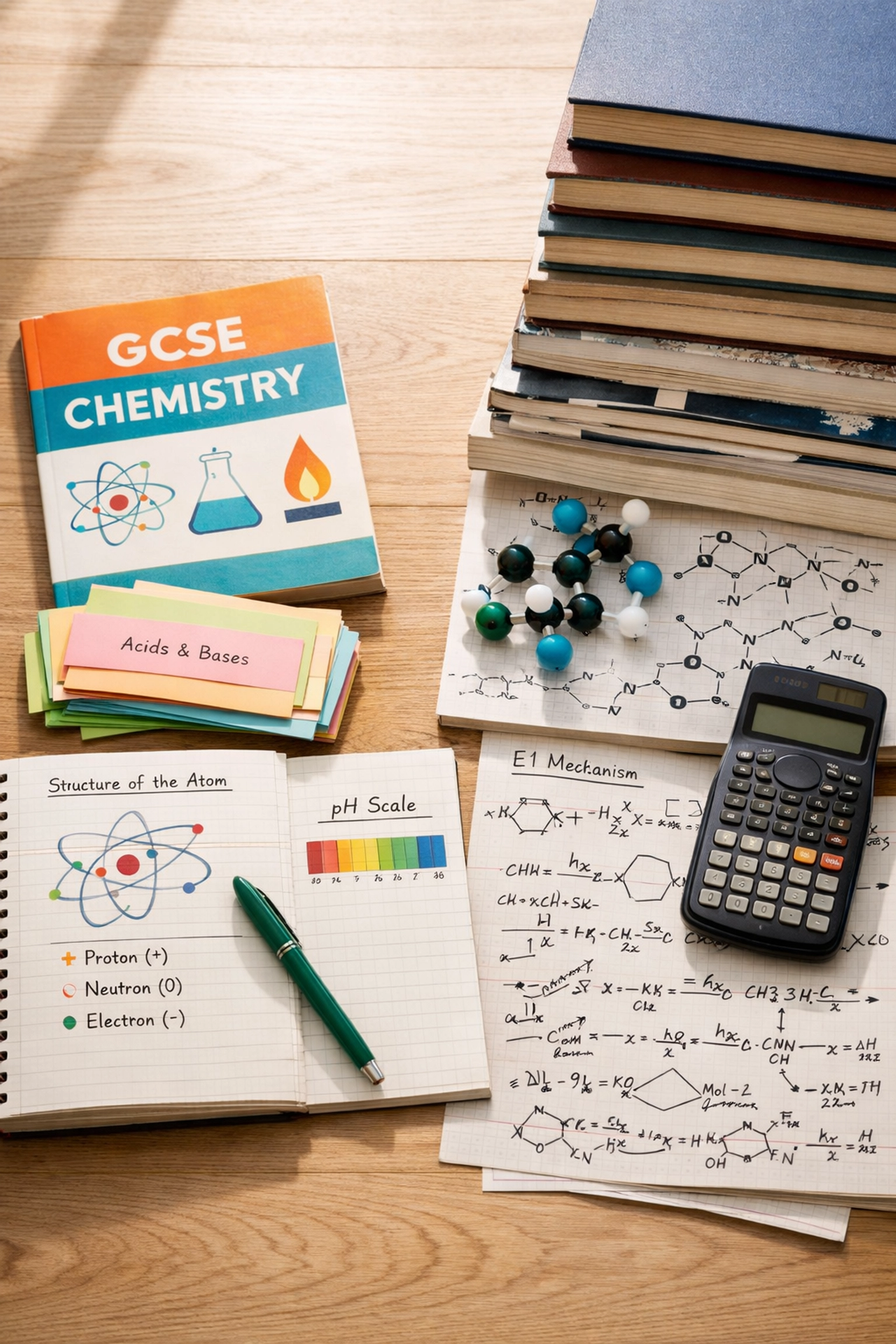
You’re suddenly expected to:
- Use logarithms and exponential functions confidently in Physical Chemistry
- Understand electron movement and complex reaction mechanisms in Organic Chemistry
- Grapple with abstract concepts like redox potentials and transition metal chemistry
- Apply mathematical skills in completely new contexts
- Study independently with far less hand-holding
The mathematical demand alone is a shock for many students. While the maths itself rarely goes beyond GCSE level (rearranging formulas, using standard form), it’s relentless. Quantitative chemistry and mole calculations make up roughly a quarter of your A-Level content, compared to just one small topic at GCSE.
And here’s the kicker: A-Level mark schemes are far stricter. At GCSE, you might get away with a vague definition. At A-Level, examiners want precise scientific vocabulary. Every word matters.
The Four Core Challenges (and Why They Hit Simultaneously)
Let’s talk about why this transition feels overwhelming. It’s rarely just one thing, it’s several interconnected challenges all hitting you at once.
1. More Content, Less Time ⏰
GCSE science is already dense with new ideas. But A-Level covers significantly more material with reduced teaching time per topic. You’ll have more free periods, which sounds great until you realize you’re expected to use them for independent review and practice.
This is a massive adjustment. At GCSE, your teacher likely covered everything you needed in class. At A-Level, you must take ownership of your learning. Free periods aren’t for scrolling TikTok, they’re for consolidating what you learned that morning and preparing for what’s coming next.
2. Scientific Vocabulary Overload 📚
The sheer volume of technical terms at A-Level is staggering. And the mark schemes don’t mess around.
At GCSE, you might describe a covalent bond as “atoms sharing electrons” and get full marks. At A-Level, you need to specify “a shared pair of electrons” or you’ll lose points. The precision required takes getting used to, and building this vocabulary is a gradual process.
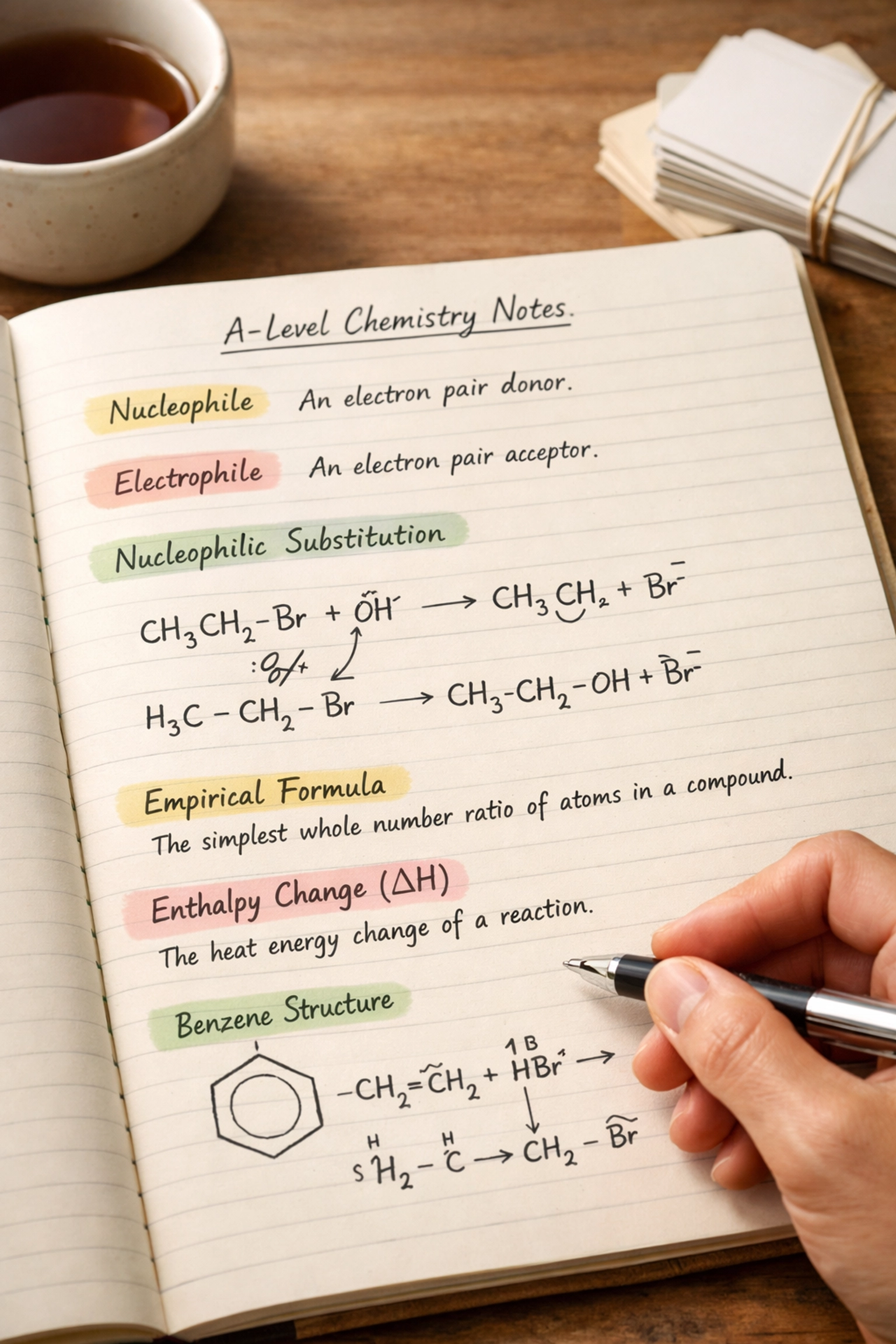
3. Calculations Everywhere 🔢
Remember how calculations were just one topic at GCSE? Well, at A-Level, quantitative chemistry is woven throughout the entire course.
You’ll be doing mole calculations in your sleep. Titrations. Enthalpy calculations. Equilibrium constants. Rate equations. The mathematics itself isn’t necessarily harder, but the application is constant and unforgiving.
Many students who excelled at GCSE Chemistry find themselves struggling simply because they’re not confident with mathematical problem-solving in chemical contexts.
4. The Confidence Crisis 😰
This one’s psychological but incredibly real. When you were getting A’s and 9’s at GCSE, you felt capable. You felt smart.
Then you start A-Level and suddenly everyone seems to understand things faster than you. You’re getting marks you’ve never seen before. You might be at a new sixth form or college where you don’t know anyone. And that voice in your head starts whispering, “Maybe I’m not good enough for this.”
This is what educators call “compare and despair,” and it’s one of the biggest hidden barriers to A-Level success. You’re not alone in struggling, you’re just more aware of your struggles than you are of everyone else’s.
How to Bridge the Gap (Before You Fall Into It)
Okay, so the A Level Chemistry jump is real. But it’s not insurmountable. Here’s how to set yourself up for success.
Start Before You Start 🚀
The best time to prepare for A-Level Chemistry? Before term begins.
Spend time over the summer reviewing critical GCSE foundations. The most important topics to solidify are:
- Calculations and quantitative chemistry (this will save you so much stress)
- Atomic structure (everything builds on this)
- Bonding and structure (crucial for understanding A-Level concepts)
- Redox reactions (these get complex quickly at A-Level)
Getting these foundations rock-solid means you can hit the ground running instead of playing catch-up while new content is being introduced.
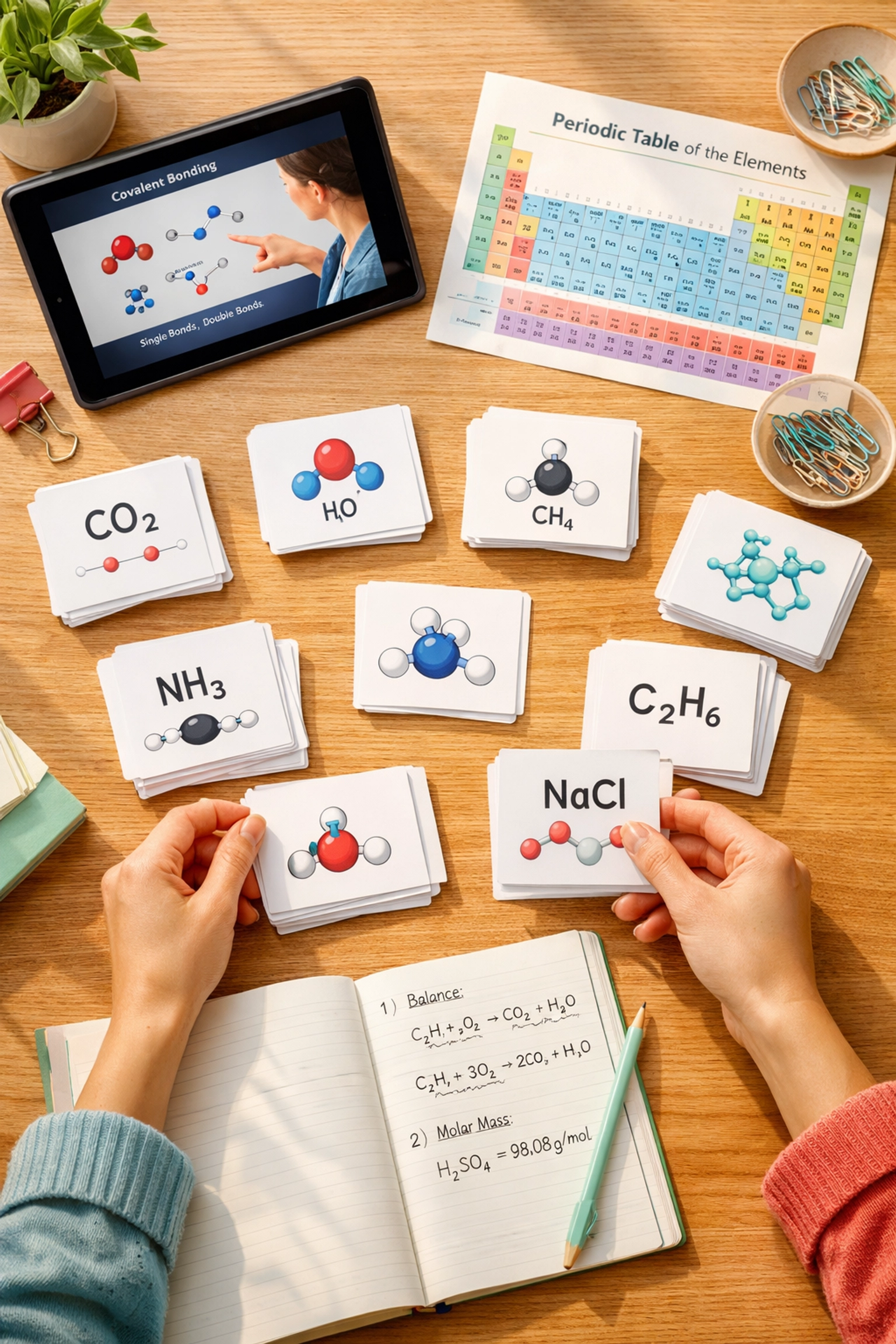
Master Active Learning (Not Passive Re-Reading) 💪
Here’s a hard truth: the study methods that worked at GCSE won’t cut it at A-Level.
Reading through your notes multiple times? Not effective. Highlighting entire textbook pages? Waste of time.
What actually works:
- Flashcards and retrieval practice to embed definitions and concepts
- Teaching the content to someone else (even if it’s your confused pet)
- Regular retrieval practice: revisiting past content before exams embeds knowledge far more effectively than cramming
- Practicing past papers with strict attention to timing
The key word here is active. Your brain needs to actively work with the material, not just passively review it.
Build Consistent Study Routines Early 📅
Unlike GCSE with its tightly structured lessons and guided homework, A-Level success depends on consistent, independent study throughout the year.
This means:
- Working steadily rather than only before mocks and finals
- Using free periods effectively (seriously, this matters)
- Reviewing content from previous weeks regularly, not just cramming before tests
Establish these habits in September, not in March when you’re panicking before exams.
Get Comfortable With Command Words and Exam Technique 📝
At least 15% of A-Level Chemistry assessment relates to practical work, and exam questions use specific command words that require different types of responses.
“Describe” needs a different answer than “explain.” “Calculate” requires showing your working. “Suggest” means you need to apply knowledge to unfamiliar contexts.
Practicing past papers is non-negotiable. It helps you sharpen your exam technique, manage your time, and approach unfamiliar questions calmly and logically.
When to Seek Support (Spoiler: Probably Sooner Than You Think)
Here’s something that families in Dubai and across the UK often overlook: asking for help isn’t a sign of weakness: it’s a sign of smart strategy.
The transition to A-Level is genuinely difficult. Many students benefit from targeted support, whether that’s speaking up more in class or working with an Online Chemistry Tutor who can provide personalized guidance.
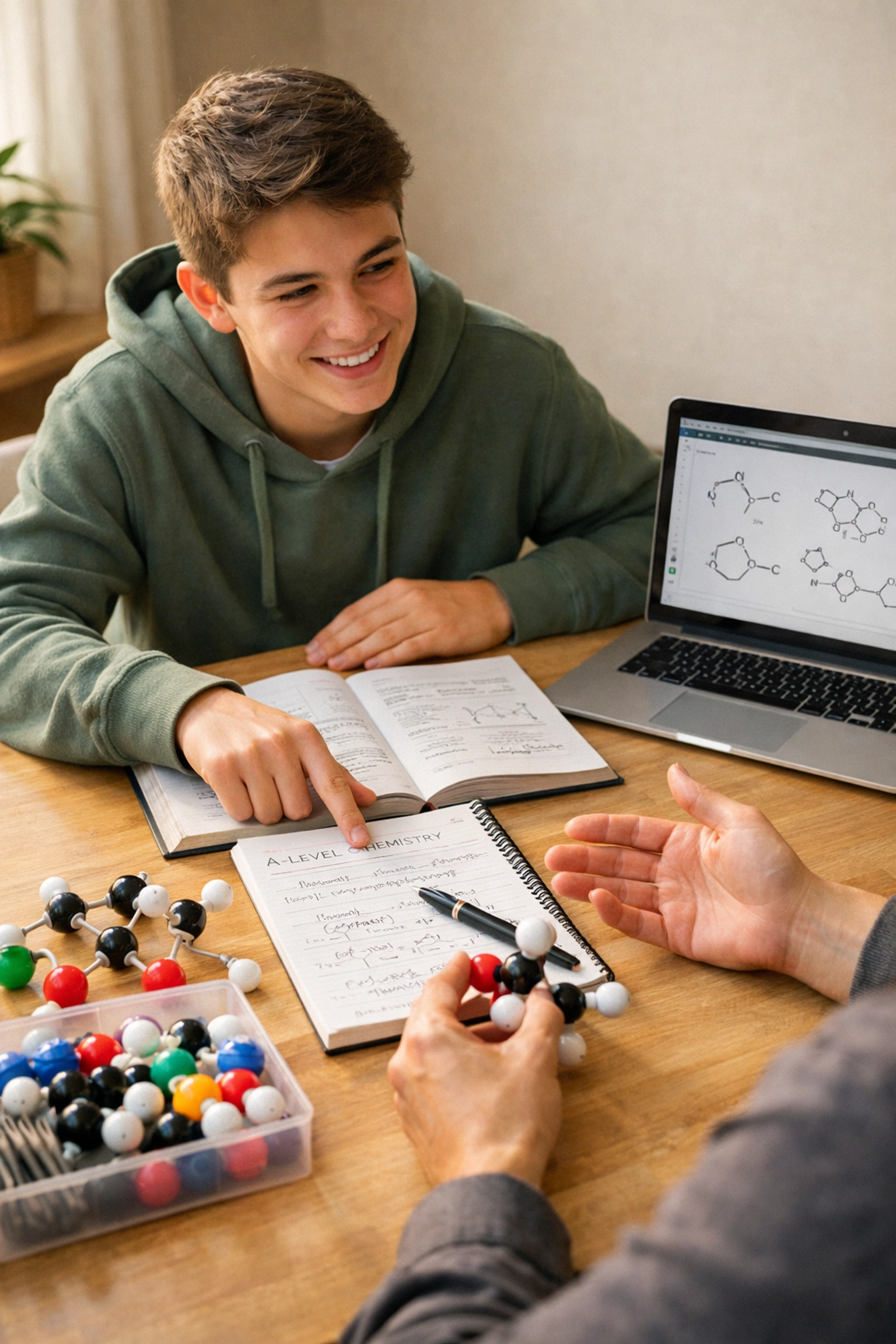
One-to-one or small group tuition can be a game-changer during this transition because it allows you to:
- Identify and fill specific knowledge gaps from GCSE that are holding you back
- Build confidence in applying concepts rather than just memorizing them
- Develop problem-solving strategies tailored to your learning style
- Practice exam technique with someone who knows exactly what examiners are looking for
For expat families in Dubai specifically, finding a Chemistry Tutor Dubai who understands the British curriculum and can work around time zone differences for online sessions can provide crucial support during this challenging year. The right tutor doesn’t just teach content: they teach you how to learn at A-Level standard.
You’ve Got This 🌟
Look, the GCSE to A-Level Chemistry jump is real, and it’s challenging. But thousands of students successfully make this transition every year, and with the right preparation and support, you absolutely can too.
The key is understanding that it’s not about working harder: it’s about working differently. It’s about shifting from passive memorization to active application. From teacher-led learning to independent study. From getting the gist to mastering the details.
Start preparing now. Build solid foundations. Develop active learning habits. Practice consistently. And don’t hesitate to seek support when you need it.
You’ve got this. And if you need a hand bridging that gap? That’s exactly what we’re here for.
Whether you’re navigating A-Levels in London, Manchester, or Dubai, the right support and strategies can transform this daunting jump into an achievable: and even exciting (challenge.) 🔬✨

Oxford-Educated Chemistry Specialist
With over 20 years of teaching experience at some of the UK’s top independent schools, I help ambitious students bridge the gap between hard work and top-tier results. I specialise in GCSE, A Level, and IB Chemistry tuition for students targeting Grade 9s and A*s. Based in the UK but working globally, I provide 1-1 online support for families in South and West London, Dubai, and Hong Kong, ensuring students are perfectly prepared for competitive medical applications and Oxbridge entries.
I’ve helped students achieve top grades from schools such as Alleyn’s, Dulwich College, Tonbridge, Sevenoaks, Brighton College, Wycombe Abbey, Caterham, St Paul’s, Dubai College, Dubai British School and Harrow International School Hong Kong.
Contact me archardchloe@gmail.com to discuss how I can help your child excel in Chemistry.