

Blog
The ‘Invisible’ Mark-Loss: Why Knowing Chemistry Isn’t Enough to Get an A* at A Level


If your child can explain Le Chatelier’s principle over dinner, ace practice questions at the kitchen table, and recite organic mechanisms in their sleep: but their mock exam results keep landing at a B or C: you’re not alone. And more importantly, it’s not because they don’t know their A Level chemistry.
There’s a frustrating gap between understanding the content and securing the marks. It’s what I call “invisible” mark-loss, and it’s the reason why hardworking students plateau despite putting in hours of revision.
Let me explain what’s really happening: and how to fix it.
The Problem: Chemistry Knowledge ≠ Exam Performance
Here’s the truth that nobody tells you: A-Level Chemistry exams don’t just test chemistry knowledge: they test your ability to perform under pressure, communicate precisely, and apply logic in unfamiliar contexts.
Your child might know the chemistry inside-out, but if they’re not using the exact language examiners are looking for, applying knowledge to novel situations, or managing their time strategically, they’re bleeding marks without even realizing it.
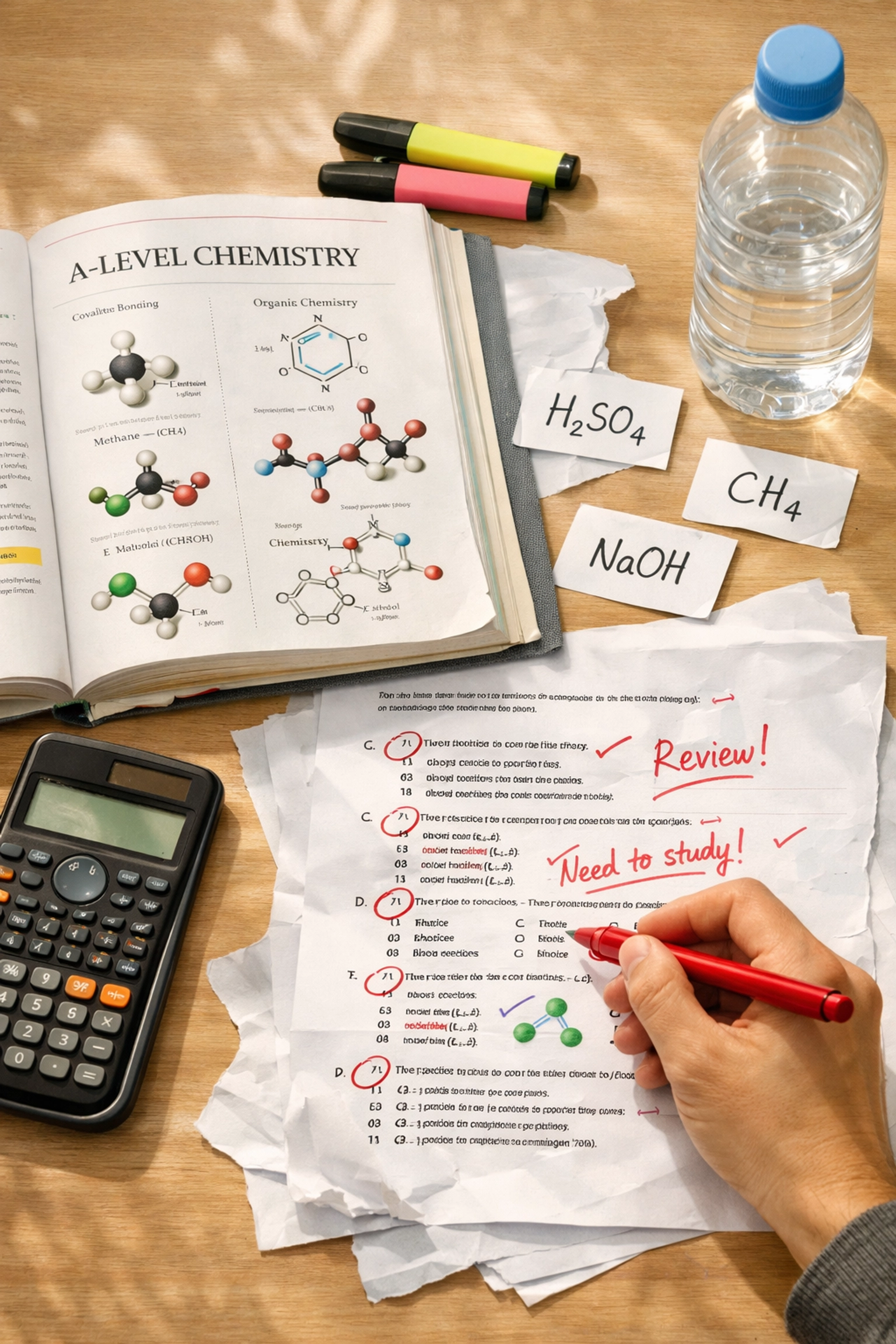
According to recent examiner reports from AQA and OCR, the most common errors aren’t about misunderstanding chemistry: they’re about execution. Students lose marks for:
- Missing state symbols in equations
- Forgetting to identify limiting reactants correctly
- Writing lengthy explanations instead of precise, factual statements
- Panicking when they see an unfamiliar reaction type (even when they have all the knowledge to solve it)
- Running out of time on questions they could absolutely answer
These aren’t knowledge gaps. They’re technique gaps. And the difference is enormous.
Why Hard Work Isn’t Translating to Higher Grades
Let’s paint a picture. Your child revises for hours. They rewrite notes, do practice questions, watch videos. They genuinely understand equilibria, kinetics, organic mechanisms: all of it.
Then exam day arrives. They read a question about a reaction they’ve never seen before. Panic sets in. Instead of applying their understanding of electron movement or reactivity principles, they default to a memorized mechanism that doesn’t fit. Zero marks.
Or they spend 15 minutes perfecting a 6-mark calculation, leaving just 5 minutes for a 12-mark extended response at the end. They know the answer: they just didn’t have time to write it down.
This is invisible mark-loss. It’s not showing up in revision sessions at home because those are low-pressure, self-paced environments. But in the exam hall? It’s costing your child an entire grade boundary.
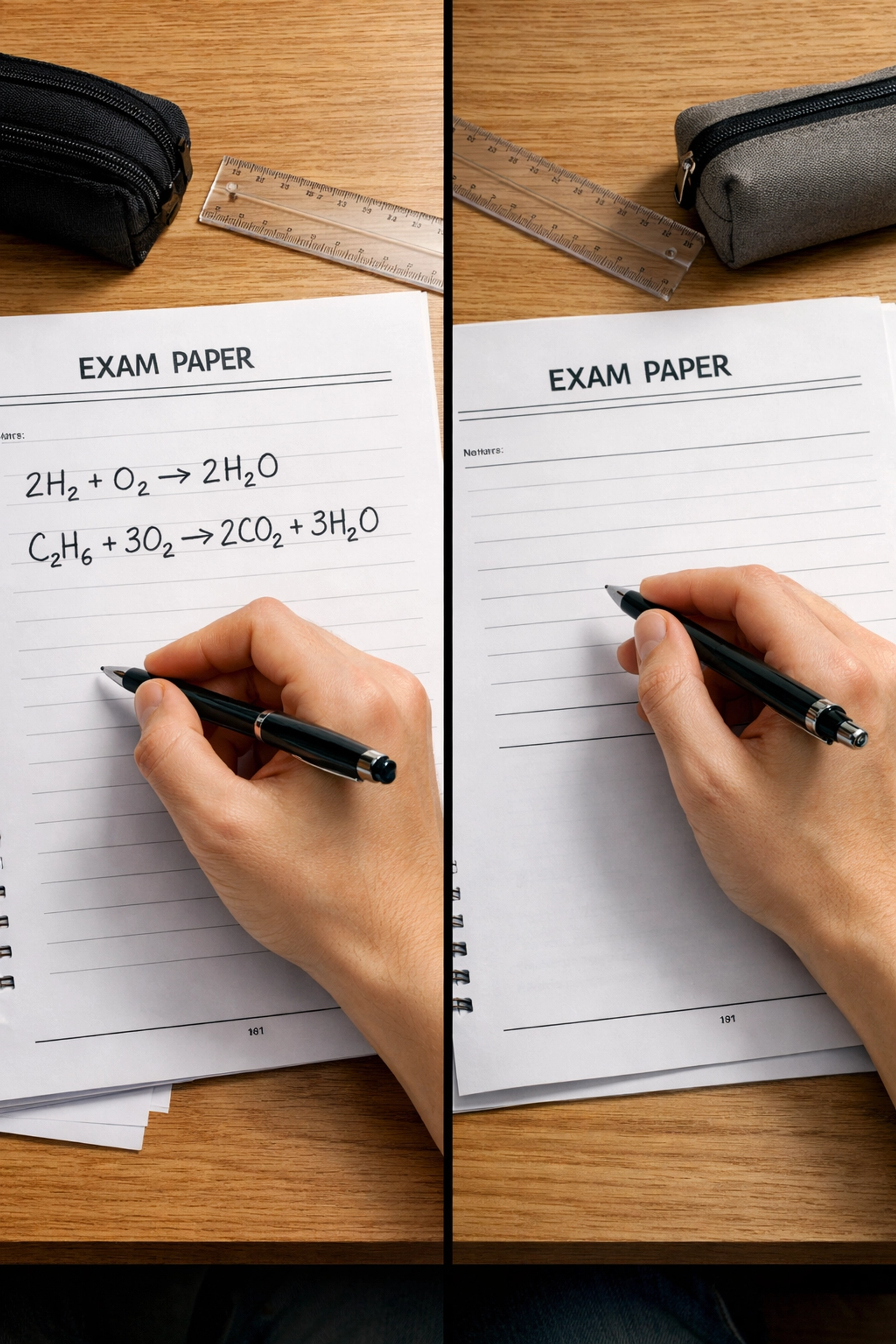
The Three Hidden Skills Examiners Are Actually Testing
Here’s what separates a B-grade student from an A* student: and it has very little to do with who knows more chemistry.
1. Speaking the Mark Scheme Language
Every A-Level Chemistry mark scheme has specific buzzwords and phrases that examiners are trained to look for. If your answer doesn’t include them, you don’t get the mark: even if your explanation is technically correct.
For example, in a question about bond enthalpy:
❌ “The reaction needs energy to happen” = 0 marks
✅ “Energy is required to break bonds” = 1 mark
It’s subtle, but it’s everything. Examiners aren’t looking for explanations: they’re looking for specific factual statements that match their mark scheme criteria.
Students who consistently hit A* grades have learned to think like an examiner. They know which words carry marks. They structure their answers in clear, numbered points. They don’t waffle: they deliver precision.
This is a skill you can learn. It’s not about being “naturally good at exams.” It’s about training your brain to communicate in mark-scheme language.
2. Mastering Application Questions
The 2023 OCR Examiner Report highlighted a massive problem: students were reflexively applying memorized mechanisms to questions that required a different approach. They knew the chemistry: but they panicked and fell back on what they’d memorized, rather than applying logical thinking.
Application questions are designed to be unfamiliar. That’s the point. Examiners want to see if you can take core principles (like “electron-rich species attack electron-poor sites”) and apply them to a brand-new context.

The students who excel at these questions aren’t necessarily the ones who’ve memorized the most: they’re the ones who’ve practiced thinking flexibly under exam conditions. They can spot patterns, make connections, and adapt their knowledge on the spot.
This is where working with an A Level Chemistry tutor makes a tangible difference. A good tutor doesn’t just teach you chemistry: they teach you how to think in an exam. They show you how to break down unfamiliar scenarios, identify what the question is really asking, and apply your knowledge logically rather than mechanically.
3. Strategic Revision, Not Just ‘More’ Revision
Here’s a hard truth: more revision doesn’t equal better results if you’re revising the wrong way.
If your child is spending hours rewriting notes, passively reading textbooks, or doing endless practice questions without analyzing their mistakes: they’re working hard, but not smart.
The students who jump from a B to an A* don’t necessarily revise more: they revise strategically. They:
- Practice under timed conditions to build exam stamina and pacing
- Analyze every mistake to identify whether it was a knowledge gap or a technique gap
- Focus on weak spots rather than endlessly rehearsing what they already know
- Use mark schemes actively to train their brains to think like an examiner
Time management is critical here. With 105+ marks to cover in 2 hours, you have roughly one minute per mark. If your child is spending 10 minutes on a 3-mark question because they want to “get it perfect,” they’re sabotaging themselves.
Strategic revision means knowing when to move on, when to guess intelligently, and how to maximize marks in the time available.
What Parents Can Actually Do About This
If you’re reading this and thinking, “This sounds exactly like my child,” here’s what you need to know:
The problem is fixable. But it requires a shift in approach.
Instead of more hours at the desk doing the same kind of revision, your child needs:
✅ Targeted exam technique training to learn mark-scheme language
✅ Timed practice under realistic exam pressure
✅ Expert feedback that identifies invisible mark-loss patterns
✅ Strategic guidance on how to approach unfamiliar application questions
This is where an Online Chemistry Tutor becomes invaluable: not just for explaining chemistry concepts, but for training exam performance. A tutor who understands the mark schemes, the examiner mindset, and the common pitfalls can help your child close that gap between knowledge and grades.

If you’re based overseas, finding a qualified Chemistry Tutor Dubai or other international locations who understands UK exam boards (AQA, OCR, Edexcel) is crucial. The chemistry might be universal, but the exam technique is very specific to A-Level standards.
The Bottom Line
Your child isn’t failing because they don’t work hard enough or don’t understand chemistry. They’re losing marks invisibly: through missed buzzwords, poor time management, panic under pressure, and a lack of strategic exam technique.
The good news? These are skills that can be taught, practiced, and mastered. With the right guidance, that frustrating plateau at a B or C can absolutely become an A or A*.
Because knowing the chemistry is only half the battle. Knowing how to show it in an exam is what gets you the A*.
If you’d like to explore how targeted tutoring can help your child unlock those invisible marks and finally see their hard work reflected in their grades, I’d love to chat. Sometimes all it takes is someone showing you where the marks are hiding.

Oxford-Educated Chemistry Specialist
With over 20 years of teaching experience at some of the UK’s top independent schools, I help ambitious students bridge the gap between hard work and top-tier results. I specialise in GCSE, A Level, and IB Chemistry tuition for students targeting Grade 9s and A*s. Based in the UK but working globally, I provide 1-1 online support for families in South and West London, Dubai, and Hong Kong, ensuring students are perfectly prepared for competitive medical applications and Oxbridge entries.
I’ve helped students achieve top grades from schools such as Alleyn’s, Dulwich College, Tonbridge, Sevenoaks, Brighton College, Wycombe Abbey, Caterham, St Paul’s, Dubai College, Dubai British School and Harrow International School Hong Kong.
Contact me archardchloe@gmail.com to discuss how I can help your child excel in Chemistry.