

Blog
The Secret Code: Decoding A Level Chemistry Command Words for Exam Success


You’ve spent weeks memorising the Born-Haber cycle. You can draw the mechanism for nucleophilic substitution in your sleep. You walk into the exam hall, see a question about the trend in first ionisation energy, and you pour your heart onto the page.
Then the results come back. You got 1 mark out of 3.
What happened? You knew the chemistry! The problem wasn’t your brain; it was your “translation.” In A Level Chemistry, the examiners don’t just want to see what you know; they want you to follow a very specific set of instructions called command words.
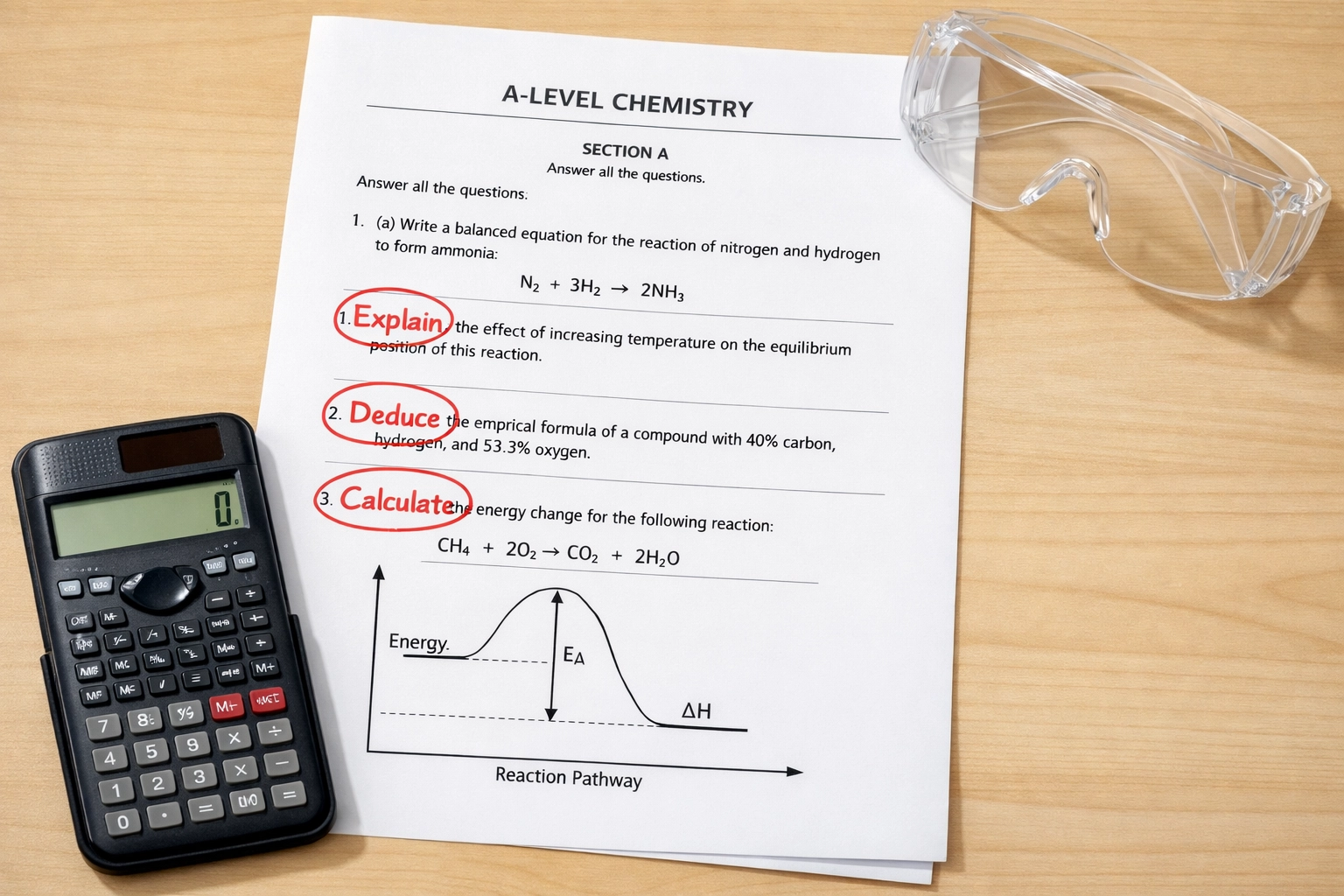
Think of command words as a secret code. If the examiner says “Describe” and you “Explain,” you’re answering a question they didn’t ask. It’s like someone asking for the time and you telling them how a watch is made.
Let’s crack the code and turn those “near misses” into full marks.
The Ultimate Rivalry: Describe vs. Explain
If there is one mistake that costs A Level students more marks than anything else, it’s mixing up Describe and Explain. They sound similar in everyday English, but in a chemistry paper, they are worlds apart.
Describe: The “What”
When you see “Describe,” the examiner wants a play-by-play of what is happening. You are the commentator, not the scientist.
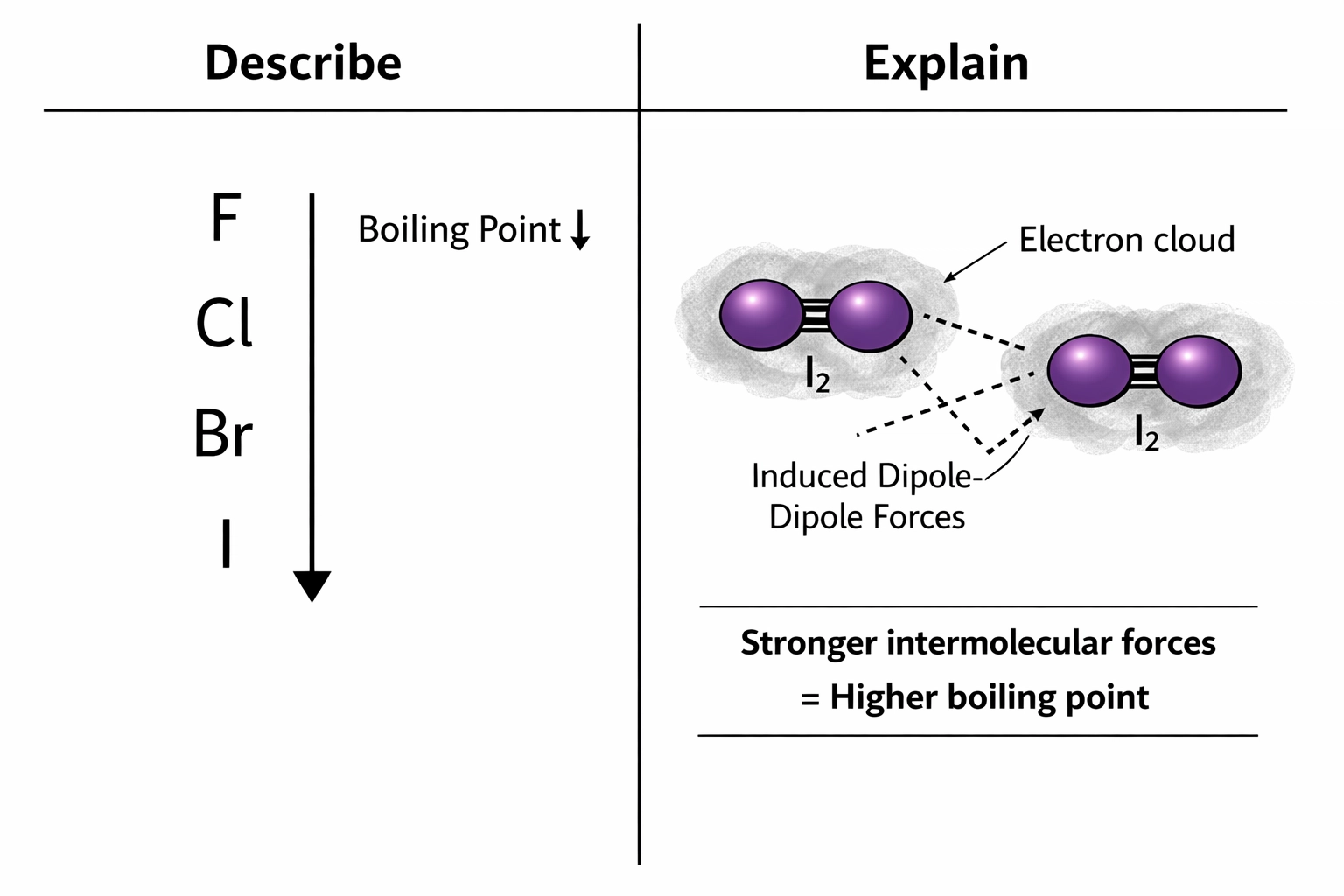
- Example: “Describe the trend in boiling points of the halogens.”
- The Answer: “As you go down the group, the boiling point increases.”
- What NOT to do: Don’t start talking about London forces or induced dipole-dipole interactions yet. You haven’t been asked why it happens, just what happens.
Explain: The “Why”
“Explain” is where you show off your big chemistry brain. You must give a reason or a justification. If you see “Explain,” you should almost always be using the word “because” in your head.
- Example: “Explain the trend in boiling points of the halogens.”
- The Answer: “The boiling point increases because the number of electrons increases, leading to stronger London forces which require more energy to overcome.”
The Golden Rule: If you “Explain” when asked to “Describe,” you might get the marks if you happened to mention the trend. But if you “Describe” when asked to “Explain,” you will almost certainly walk away with zero.
The Comparison Trap: Compare and Contrast
This command word is a classic “gotcha.” When a question asks you to Compare and contrast, students often just list everything they know about Substance A, then everything they know about Substance B.
The Edexcel examiners are very specific about this: your answer must relate to both things mentioned, and it must include at least one similarity and at least one difference.
- Pro Tip: Use “linking” words. Phrases like “In contrast to,” “Similarly,” or “Whereas” show the examiner you are actually comparing them, not just listing facts in isolation.
- Example: “Compare and contrast the bonding in magnesium and magnesium chloride.”
- The Similarity: Both involve strong electrostatic forces of attraction.
- The Difference: Magnesium has metallic bonding between positive ions and delocalised electrons, whereas magnesium chloride has ionic bonding between Mg²⁺ and Cl⁻ ions.
The Judgment Calls: Evaluate, Assess, and Criticise
These are the “heavy hitters.” You usually find these in 6-mark levelled response questions. They require you to step back and look at the bigger picture.
Evaluate
To Evaluate, you need to look at the evidence provided (usually data or an experimental method) and weigh it up. You need to mention the strengths, the weaknesses, and, crucially, come to a conclusion. An evaluation without a final judgment is just a list.
Assess
Assess is similar to evaluate but focuses more on the importance of different factors. You need to identify what’s relevant and decide which factor is the most important.
Criticise
This sounds mean, doesn’t it? When you Criticise, you are looking for the flaws. You might be given an experimental plan or a student’s statement. You need to look at the merits and the faults, but focus on giving evidence for why something is wrong.
The Math Monsters: Calculate, Determine, and Show That
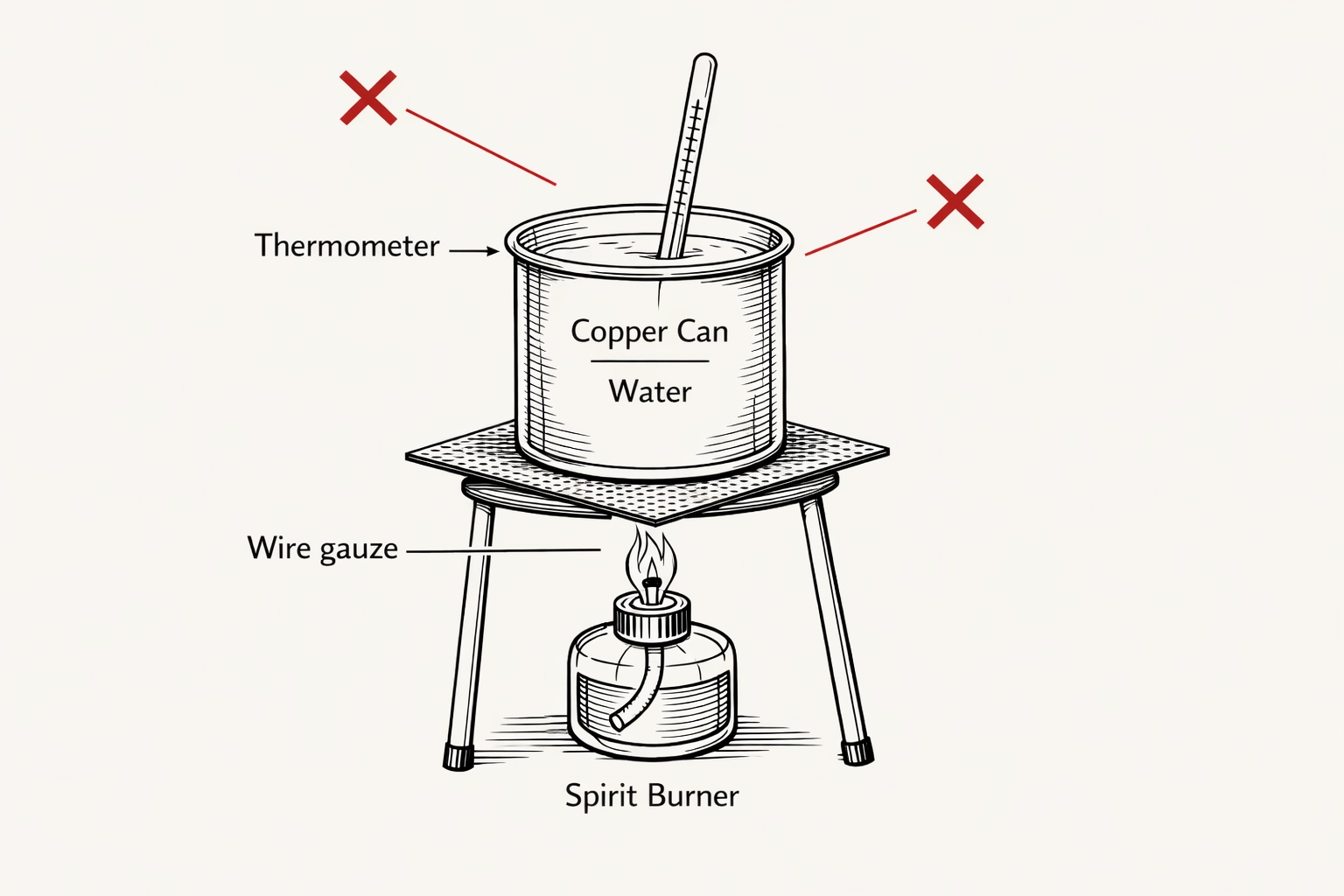
A Level Chemistry is about 20% math, and the command words tell you exactly how much work you need to show.
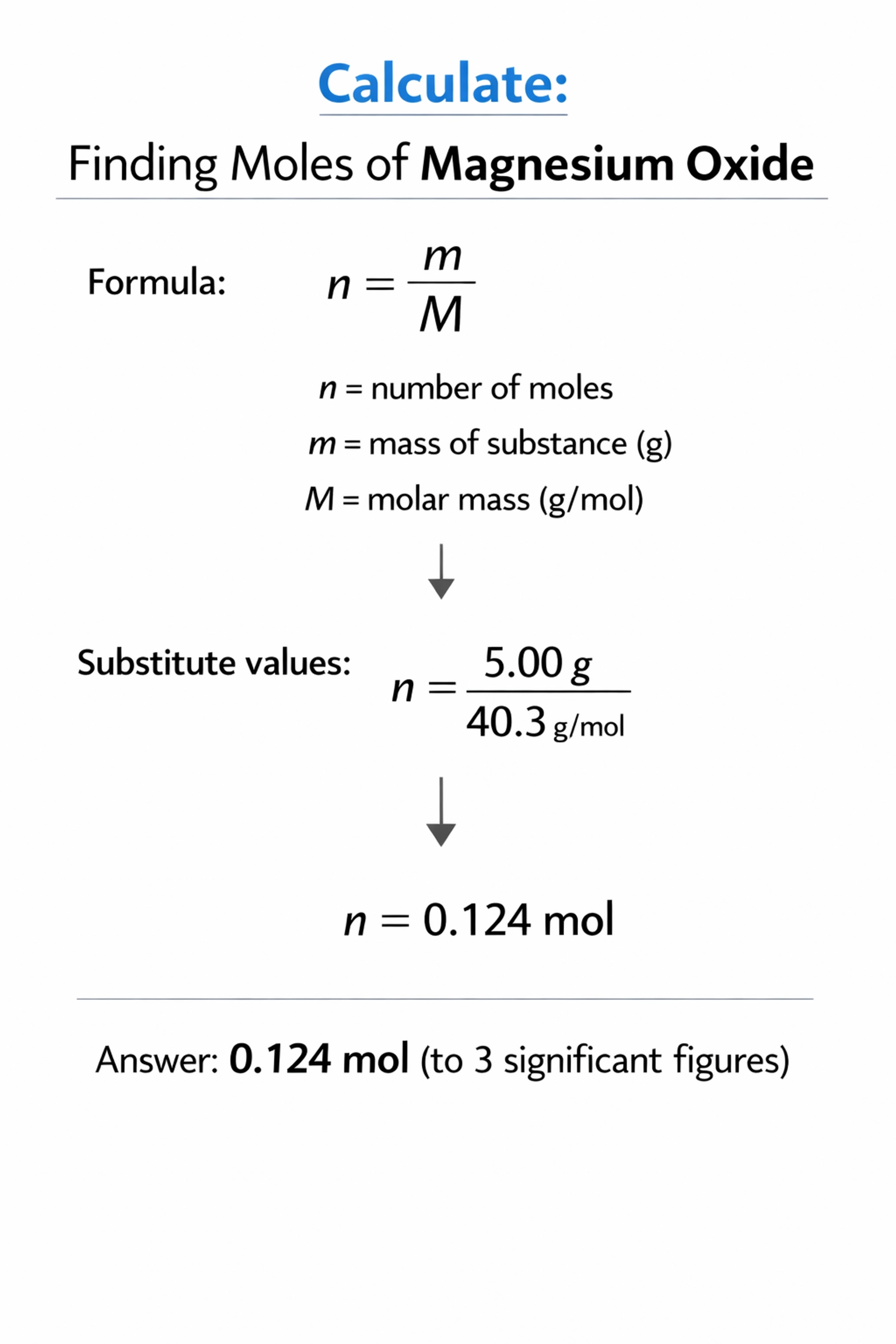
Calculate
This is straightforward: get a numerical answer. However, the secret code here is “showing relevant working.” Even if your final answer is wrong, a clear trail of moles, ratios, and molar masses can bag you 3 out of 4 marks. Also, always check the units! If the question asks for kJ mol⁻¹ and you give J mol⁻¹, you’ve just donated a mark to the exam board.
Determine
This often pops up when you need to use a graph or a specific set of data to reach an answer. It implies there might be a bit of “detective work” involved before you get to the final calculation. If the question involves a graph, “Determine” usually means “go find the gradient or the intercept.”
Show That
This is the examiner being kind. They give you the answer (e.g., “Show that the enthalpy change is -57.3 kJ mol⁻¹”). Your job is to prove it.
- Warning: Do not just write down the answer they gave you at the bottom. You must show every single step of the calculation. If you skip a step, the examiner can’t be sure you didn’t just “fudge” the numbers to match their answer.
The Art of Chemistry: Plot, Draw, and Sketch
Yes, you need your inner artist for Paper 3, but there’s a big difference between a “Sketch” and a “Plot.”
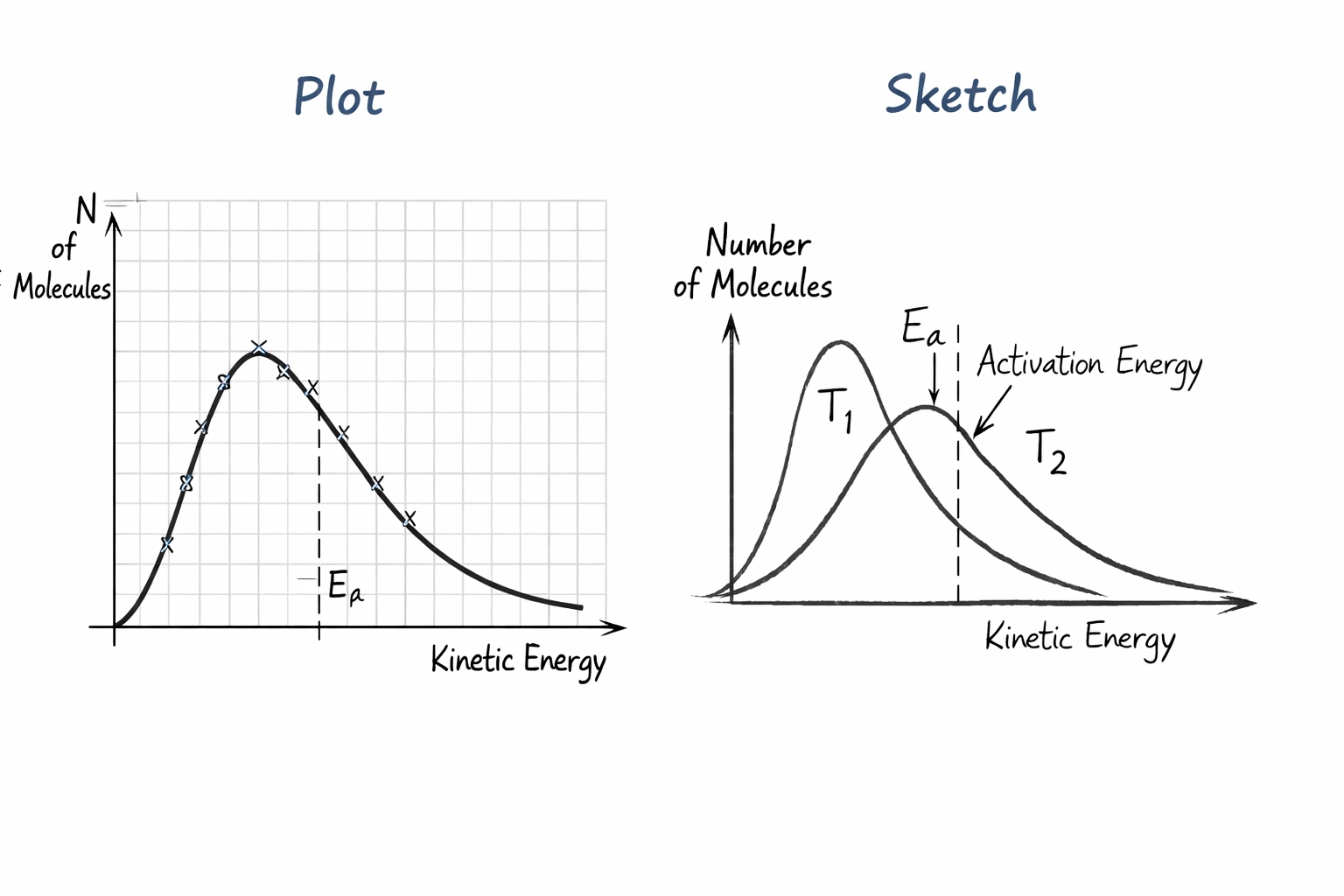
Plot
This is all about precision. You need a sharp pencil, a ruler, and a steady hand.
- The Code: Mark points accurately with a small ‘x’ or a dot in a circle. Draw a line of best fit (which could be a curve or a straight line).
- Don’t forget: You must include a suitable scale and label your axes with units (time / s, not just time).
Draw
Usually refers to a diagram: like a piece of glassware or a skeletal formula. If it’s a diagram, use a ruler for straight lines (like the surface of a liquid). If it’s a mechanism, your curly arrows must start at a lone pair or a bond and point directly to an atom.
Sketch
This is the only time you can be a bit “freehand.” A Sketch of a graph doesn’t need a scale or plotted points, but it does need labelled axes and the correct shape. If you’re sketching a Maxwell-Boltzmann distribution, it must start at the origin, and the tail must never touch the x-axis.
The Quick Hits: Deduce, Predict, and State
Deduce
This means “be a detective.” Use the information provided to reach a conclusion. You don’t need to recall a fact from your textbook; you need to look at the data in the question and figure it out.
Predict
What do you think will happen next? This is usually based on a pattern you’ve already identified. If Group 1 metals get more reactive as you go down, and you know about Rubidium, you can predict that Caesium will be even more explosive.
State / Give / Name
These are the “low-hanging fruit.” They require simple recall. Don’t overthink them. If it asks you to “State the catalyst,” just write “Iron” or “V2O5.” You don’t get extra marks for writing a paragraph about how the catalyst works.
Summary Cheat Sheet
| Command Word | What the Examiner Actually Wants |
|---|---|
| Describe | What is happening? (The “what”) |
| Explain | Why is it happening? (The “because”) |
| Compare | Give at least one similarity AND one difference. |
| Evaluate | Pros, cons, and a final “I reckon…” conclusion. |
| Show That | Prove the answer we gave you. No skipping steps! |
| Deduce | Use the data provided to solve the puzzle. |
| Plot | Ruler, scale, ‘x’ marks the spot. |
| Sketch | No scale needed, but get the shape right. |
Final Thoughts
Mastering command words is like learning the rules of a game. You can be the most talented player in the world, but if you keep picking up the ball with your hands in a game of football, you’re going to get a red card.
Next time you do a practice paper, don’t just dive into the chemistry. Circle the command word first. Ask yourself: “Am I describing or explaining? Do I need a conclusion here? Did I show my working?”
Cracking the code is the fastest way to jump an entire grade boundary without learning a single new chemical reaction. Good luck, and happy decoding!

Oxford-Educated Chemistry Specialist
With over 20 years of teaching experience at some of the UK’s top independent schools, I help ambitious students bridge the gap between hard work and top-tier results. I specialise in GCSE, A Level, and IB Chemistry tuition for students targeting Grade 9s and A*s. Based in the UK but working globally, I provide 1-1 online support for families in South and West London, Dubai, and Hong Kong, ensuring students are perfectly prepared for competitive medical applications and Oxbridge entries.
I’ve helped students achieve top grades from schools such as Alleyn’s, Dulwich College, Tonbridge, Sevenoaks, Brighton College, Wycombe Abbey, Caterham, St Paul’s, Dubai College, Dubai British School and Harrow International School Hong Kong.
Contact me archardchloe@gmail.com to discuss how I can help your child excel in Chemistry.