

Blog
The Secret to Competitive University Applications: Why Chemistry Mastery Matters for Future Leaders


When parents think about their teenager’s university prospects, conversations often centre around predicted grades and personal statements. But there’s a quieter, more strategic element that admissions tutors at competitive institutions notice immediately: subject choice and the depth of understanding a student demonstrates in rigorous academic disciplines.
Chemistry, in particular, holds a unique position in this landscape. It’s a subject that signals something important to university admissions teams: not just scientific knowledge, but a capacity for analytical thinking, precision, and the kind of intellectual resilience that translates across disciplines and careers.
Why Chemistry Carries Weight in University Admissions
Universities, particularly those with competitive entry requirements, look for evidence that a student can handle demanding academic work. Chemistry provides exactly this kind of signal.
The subject requires students to hold multiple concepts in mind simultaneously: balancing equations while considering atomic structure, understanding reaction mechanisms while predicting outcomes. This cognitive complexity is precisely what admissions tutors value. It demonstrates that a student has developed the mental agility to tackle challenging material and the discipline to work through problems methodically.
For courses like Medicine, Engineering, Biochemistry, and Environmental Science, strong Chemistry qualifications are often mandatory. Medical schools, for instance, place significant emphasis on GCSE and A-level Chemistry performance because the subject underpins pharmacology, biochemistry, and clinical reasoning. Engineering programmes rely on Chemistry foundations for material science and chemical engineering concepts.
But the value extends beyond these obvious pathways. Even for students considering Law, Economics, or Business, a strong Chemistry background signals analytical capability: something that selective institutions and, later, competitive employers recognise.
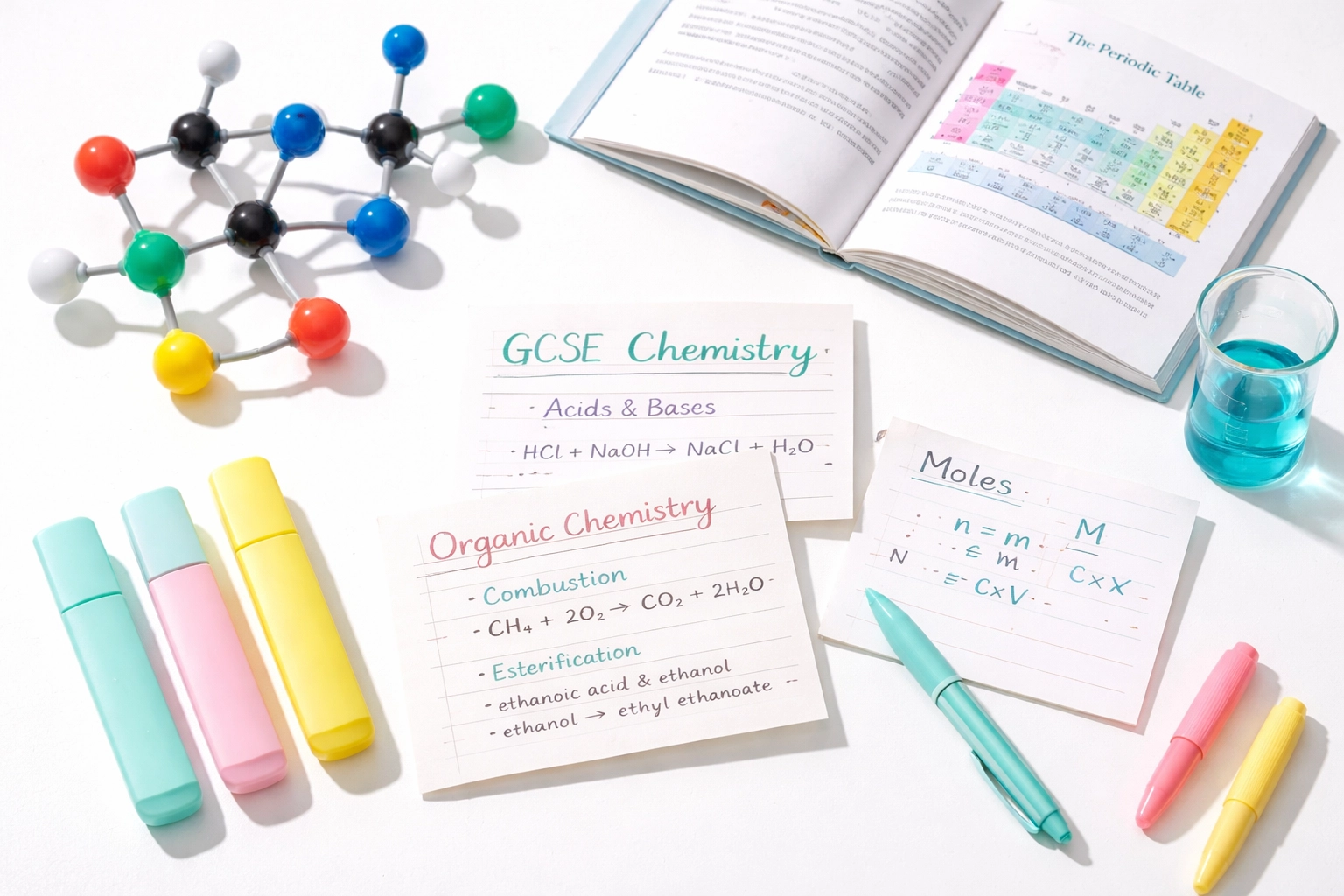
The “Gold Standard” Subject
There’s a reason Chemistry is sometimes called a “facilitating subject” by university admissions experts. It opens doors rather than closing them.
A student with strong Chemistry grades isn’t pigeonholed into a single career path. Instead, they’ve demonstrated competence in a subject that requires:
- Analytical precision : the ability to break down complex problems into manageable steps
- Quantitative reasoning : comfort with calculations, data interpretation, and mathematical modelling
- Experimental rigour : practical skills in measurement, documentation, and hypothesis testing
- Abstract thinking : understanding concepts that can’t always be seen, like electron behaviour or thermodynamic principles
These aren’t just “Chemistry skills.” They’re the foundations of clear thinking across virtually every demanding profession.
Building Future Leaders: From Molecules to Boardrooms
Here’s something we find ourselves explaining to parents quite often: the skills developed through Chemistry study translate remarkably well into leadership and innovation roles: even in fields that seem far removed from the laboratory.
Consider what solving a complex Chemistry problem actually involves. A student must gather information, identify relevant principles, consider multiple variables, test hypotheses, and refine their approach based on results. This is precisely the cognitive process that effective leaders use when tackling business challenges, policy decisions, or strategic planning.
The analytical frameworks learned in Chemistry: systematic investigation, evidence-based reasoning, comfort with uncertainty: are the same frameworks that drive innovation in technology, sustainability, finance, and healthcare. When we hear about “future-proof skills,” these are exactly what educators and employers mean.

The Economic Reality: Why Chemistry Matters for Career Outcomes
Beyond the intellectual development, there’s a practical dimension worth considering.
According to data from the Royal Society of Chemistry, the chemical sciences sector contributes approximately £83 billion to the UK’s GDP. This isn’t a niche industry: it’s a substantial part of the national economy, spanning pharmaceuticals, materials science, energy, environmental technology, and advanced manufacturing.
The workforce in this sector is growing 30% faster than the UK average, creating sustained demand for graduates with strong Chemistry foundations. And the financial premium is significant: Chemistry graduates earn a median salary approximately £7,500 higher than the UK average.
These figures matter because they reflect genuine market value. Employers across multiple sectors actively seek the analytical and problem-solving capabilities that Chemistry education develops. Whether a student ultimately pursues a traditional Chemistry career or applies their skills elsewhere, this foundation creates options.
For families thinking strategically about their teenager’s future, Chemistry represents both intellectual development and practical positioning in a competitive landscape.
The Transferable Advantage
What makes Chemistry particularly valuable for ambitious students is its versatility. The subject doesn’t just prepare students for Chemistry careers: it prepares them for roles where complex problem-solving and analytical rigour are essential.
We see this play out in interesting ways:
In Law, the logical structure of building arguments mirrors the systematic approach to solving Chemistry problems. Many top law firms actively recruit STEM graduates for precisely this reason.
In Finance, quantitative analysis and comfort with complex models translate directly from Chemistry training. Investment banks and consulting firms value the precision and mathematical confidence that Chemistry develops.
In Technology and Innovation, understanding how things work at a fundamental level: from materials to energy systems: provides an edge in product development, sustainability initiatives, and strategic planning.
In Healthcare and Policy, the evidence-based reasoning central to Chemistry education supports better decision-making in clinical, research, and administrative contexts.
The Royal Society of Chemistry provides an excellent overview of career pathways available to Chemistry students, which can be helpful for families exploring these options with their teenagers.

Starting with Strong Foundations
All of this brings us to an important practical point: these advantages begin with solid GCSE foundations.
University admissions, A-level success, and ultimately career outcomes all build on the understanding developed at GCSE level. When students genuinely grasp core concepts: atomic structure, chemical bonding, reaction types, and quantitative Chemistry: they’re not just preparing for one exam. They’re building the foundation for everything that follows.
This is why we believe thoughtful preparation matters so much. Not cramming or last-minute panic, but structured, supported learning that builds genuine understanding and confidence.
Students who arrive at A-level Chemistry with solid GCSE foundations find the transition manageable. Those with gaps often struggle: not because they lack ability, but because the building blocks weren’t firmly in place.
How We Support This at Success in STEM
For families in South London looking to ensure their teenager has the strongest possible foundation, we offer a focused opportunity this spring.
Our Easter GCSE Science Revision Course runs from 7th to 10th April 2026 at Harris Boys Academy in East Dulwich. Over four days, students work through Chemistry, Biology, and Physics with our experienced teaching team: Chloe, Ruth, and Kate: all former independent school educators with deep expertise in GCSE Science.
The course is designed to consolidate understanding, build exam technique, and develop the kind of confident, systematic approach that serves students well beyond their summer exams.
We keep groups small deliberately, so every student receives individual attention and support. The atmosphere is focused but encouraging: we find students work best when they feel challenged and supported in equal measure.
A Thoughtful Investment in Your Child’s Future
Chemistry mastery isn’t about creating the next Nobel laureate (though that would be lovely). It’s about developing the analytical capabilities, intellectual confidence, and problem-solving frameworks that open doors: whether that’s to competitive university courses, demanding careers, or simply the satisfaction of understanding how the world works at a fundamental level.
For parents weighing up revision support options, we’d encourage you to think about it in these terms: a strong Chemistry foundation is an investment that compounds over time, creating advantages that extend well beyond any single exam result.
If this approach resonates with how you think about your teenager’s education, we’d be glad to welcome them to our Easter course.
You can find full details and booking information on our Easter GCSE Science Revision Course page, or browse our full range of courses to find the right fit for your child’s needs.

Chloe Archard | Oxford-Educated Chemistry Specialist
With over 20 years of teaching experience at some of the UK’s top independent schools, I help ambitious students bridge the gap between hard work and top-tier results. I specialise in GCSE, A Level, and IB Chemistry tuition for students targeting Grade 9s and A*s. Based in the UK but working globally, I provide 1-1 online support for families in South and West London, Dubai, and Hong Kong, ensuring students are perfectly prepared for competitive medical applications and Oxbridge entries. Contact me archardchloe@gmail.com to discuss how I can help your child excel in Chemistry.