

Blog
Beyond A-Level: Two Chemistry Olympiad Topics You Need to Master

If you’ve decided to take on the UK Chemistry Olympiad, you already know it’s not your average exam. It’s a thrilling step up that requires you to think in 3D and visualise complex molecular transformations that go far beyond what your A-Level textbook covers. 🧪
After years of coaching students for the Olympiad, I’ve noticed two “hidden” topics that come up almost every single year but aren’t always covered in depth at A-Level: Unit Cells and Advanced Organic Synthesis.
Here’s the beautiful thing, mastering these won’t just help you in the competition. They’ll give you a massive head start for your first year at university and make your UCAS application stand out to admissions tutors at Oxford, Cambridge, and beyond.
Let me walk you through exactly what you need to know.
The 3D Puzzle: Mastering Unit Cells 🔷
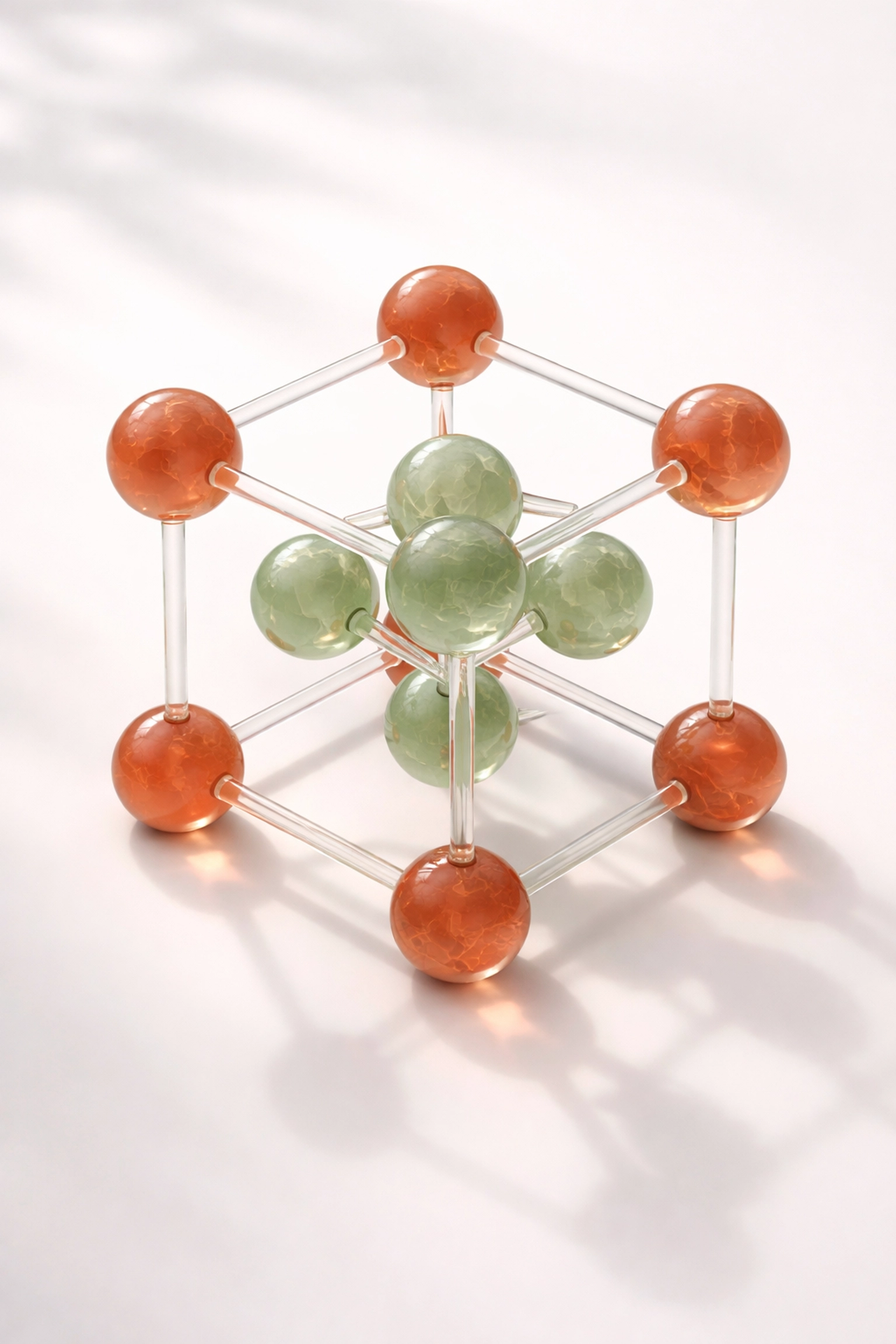
In your standard A-Level course, you talk about giant ionic lattices and maybe draw a few diagrams of sodium chloride structures. But the Olympiad wants you to go much deeper into the “unit cell”, the smallest repeating block of a crystal that, when stacked in all directions, creates the entire lattice structure.
This is where your spatial reasoning skills really get tested. Can you visualise a 3D box and count exactly how many atoms are inside it? It sounds simple, but trust me, it trips up even the brightest students!
The Secret Rule of Fractions
The trickiest part of unit cell questions is remembering that a whole atom isn’t always inside the box. Atoms sit on corners, edges, and faces, meaning they’re shared between multiple unit cells. You have to count them as fractions based on where they sit:
| Position | How Many Cells Share It? | Count As |
|---|---|---|
| Corner | Shared by 8 boxes | 1/8 |
| Edge | Shared by 4 boxes | 1/4 |
| Face | Shared by 2 boxes | 1/2 |
| Body (centre) | Completely inside | 1 |
Once you’ve internalised this table, you can tackle almost any unit cell problem the Olympiad throws at you. 🙌
Putting It Into Practice: The NaCl Unit Cell
Let’s take sodium chloride (NaCl) as an example. If you can calculate that an NaCl unit cell actually contains 4 formula units (that’s 4 Na⁺ ions and 4 Cl⁻ ions), you’re already halfway to a Bronze award!
Here’s how it works:
- Chloride ions sit at the corners (8 × 1/8 = 1) and on the faces (6 × 1/2 = 3). Total: 4 Cl⁻
- Sodium ions sit on the edges (12 × 1/4 = 3) and one in the body centre (1 × 1 = 1). Total: 4 Na⁺
See? It’s not magic, it’s just methodical counting. And once you’ve practised this with a few different structures (face-centred cubic, body-centred cubic, caesium chloride), you’ll find these questions become almost enjoyable!
The King of Functional Groups: Carbonyl Chemistry & Organic Synthesis 👑
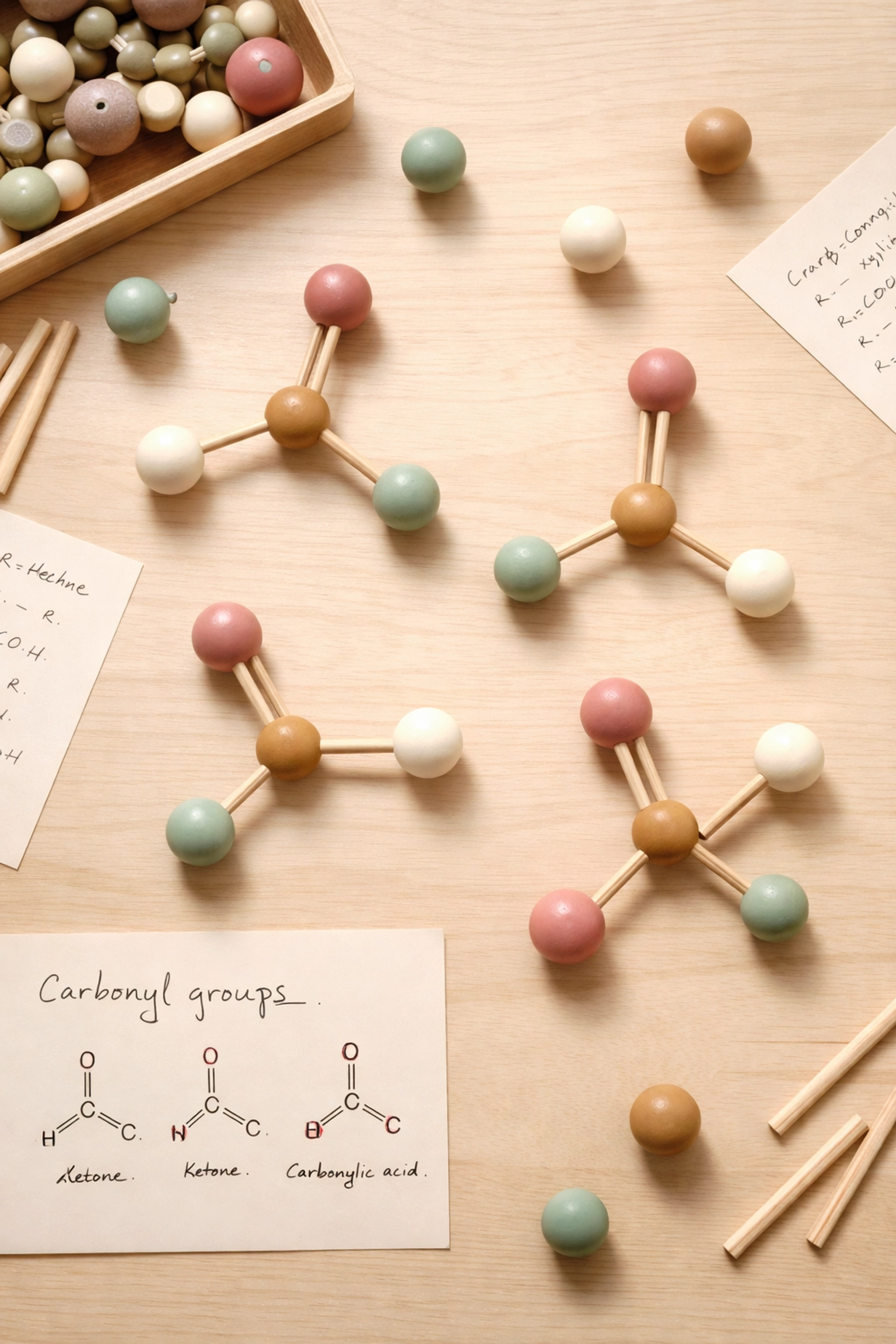
Now let’s talk about the heart of the Olympiad: organic synthesis. While you know your basics: alcohols, aldehydes, carboxylic acids: the Olympiad focuses heavily on the Carbonyl (C=O) group because it’s the ultimate “intermediate” in synthetic chemistry.
Why? Because the carbonyl carbon is incredibly electrophilic (thanks to that greedy, electronegative oxygen pulling electron density away), making it a perfect target for nucleophilic attack. Understanding this reactivity is absolutely essential.
Nucleophilic Addition-Elimination: The Reaction You Must Know
At A-Level, you learn about nucleophilic addition to aldehydes and ketones. But the Olympiad takes this further with addition-elimination reactions, especially with acyl chlorides.
Here’s the key mechanism to understand:
- A nucleophile attacks the electrophilic carbonyl carbon
- The C=O bond partially breaks, forming a tetrahedral intermediate
- The leaving group departs (in acyl chlorides, this is Cl⁻)
- The C=O bond reforms, giving you a new carbonyl compound
This mechanism is the foundation for creating esters, amides, anhydrides, and so much more. Once you truly understand why it works, you can apply it to reactions you’ve never seen before: which is exactly what the Olympiad examiners want!
Acyl Chlorides: The Swiss Army Knife of Synthesis 🔧
If there’s one class of compounds I’d love to invite you to fall in love with, it’s acyl chlorides. They’re like the Swiss Army Knife of organic synthesis: versatile, reactive, and incredibly useful.
Using reagents like SOCl₂ (thionyl chloride) to convert a carboxylic acid into an acyl chloride opens up a world of possibilities:
- React with an alcohol → Ester
- React with an amine → Amide
- React with water → Back to carboxylic acid (hydrolysis)
- React with a benzene ring (with AlCl₃ catalyst) → Aromatic ketone via Friedel-Crafts acylation
That last one: Friedel-Crafts acylation: is a classic Olympiad reaction that rarely appears at A-Level. It’s how pharmaceutical chemists build complex aromatic molecules, including drugs like Tamiflu and sildenafil!
Retrosynthesis: Working Backwards Like a Pro
The real skill in Olympiad organic chemistry isn’t just knowing reactions: it’s planning a synthesis pathway. This is called retrosynthesis, and it involves working backwards from your target molecule to simple starting materials.
Ask yourself:
- What functional group transformations would give me this product?
- What bonds could I form in the final step?
- What intermediates would I need?
This logical, puzzle-solving approach is exactly what top universities are looking for during interviews. It demonstrates that you can think like a real chemist, not just memorise textbook reactions. ✨
Why These Two Topics Matter So Much
You might be wondering: why focus on unit cells and carbonyl chemistry specifically?
The answer is simple: they test different but equally important skills.
Unit cells test your spatial reasoning: your ability to visualise 3D structures, count systematically, and apply mathematical thinking to chemistry. These questions often feel more like puzzles than traditional chemistry, which is exactly why many students find them challenging (and rewarding!).
Organic synthesis tests your logical pathway thinking: your ability to see connections between reactions, plan multi-step transformations, and apply mechanisms to unfamiliar molecules. This is the heart of real-world chemistry research.
Together, these skills demonstrate exactly what admissions tutors at Oxford, Cambridge, Imperial, and other top universities are looking for. They want students who can think creatively, reason systematically, and tackle problems they’ve never seen before.
If you’re considering applying to competitive university programmes, mastering these Olympiad topics is one of the best ways to stand out.
Your Path from Confused to Olympiad-Ready 🏅
Don’t let these advanced topics intimidate you. They are just new puzzles to solve: and honestly, they’re some of the most satisfying puzzles in all of chemistry!
Here’s my advice for getting started:
- Practice unit cell calculations with simple structures first (NaCl, CsCl, metals)
- Master carbonyl mechanisms by drawing them out repeatedly until they feel automatic
- Try past Olympiad papers and don’t worry if you can’t finish them: even partial attempts build your skills
- Seek guidance when you get stuck (that’s where a tutor can make all the difference!)
With a bit of dedicated practice and the right support, you can move from “confused” to “Olympiad-ready” faster than you might think. I’ve seen it happen with so many of my students, and I’d love to see it happen for you too. ❤️
Ready to Go Beyond the Textbook?
Whether you’re an ambitious student in the UK or looking for a Chemistry Tutor in Dubai, I specialise in bridging the gap between school exams and elite competitions like the Chemistry Olympiad.
Together, we can tackle these advanced topics in focused 1-1 sessions designed around your specific goals: whether that’s securing a Gold award, acing your university interviews, or simply developing a deeper love for chemistry.
Let’s make it happen. Get in touch and let’s start your Olympiad journey today! 🌟

Chloe Archard | Oxford-Educated Chemistry Specialist
With over 20 years of teaching experience at some of the UK’s top independent schools, I help ambitious students bridge the gap between hard work and top-tier results. I specialise in GCSE, A Level, and IB Chemistry tuition for students targeting Grade 9s and A*s. Based in the UK but working globally, I provide 1-1 online support for families in South and West London, Dubai, and Hong Kong, ensuring students are perfectly prepared for competitive medical applications and Oxbridge entries. Contact me archardchloe@gmail.com to discuss how I can help your child excel in Chemistry.