

Blog
The New IB Chemistry Syllabus: 5 Critical Changes Every Parent Should Know for 2026

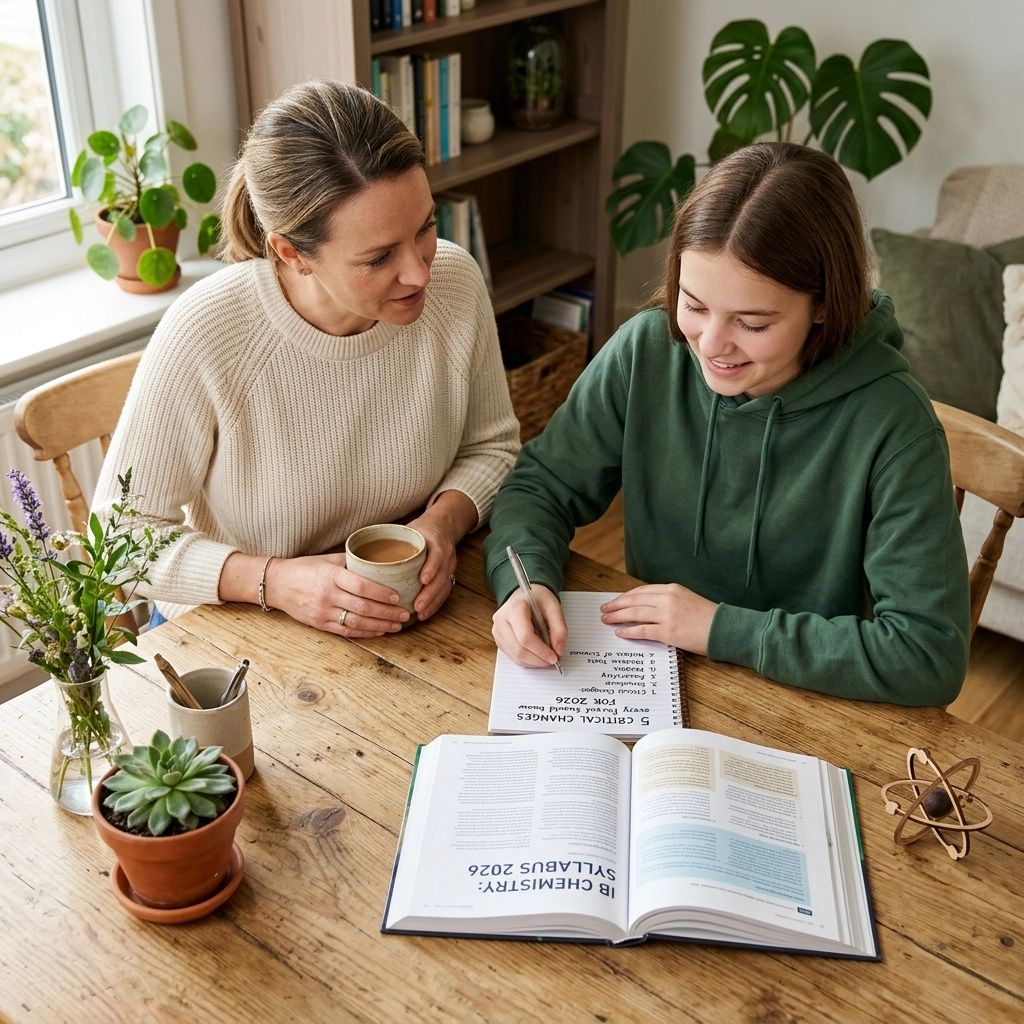
If you are a parent of a student in the International Baccalaureate (IB) program, you already know that "Chemistry" is often the word that strikes the most fear into households from Dubai to Hong Kong. It is famously rigorous, deeply technical, and requires a level of dedication that can feel overwhelming.
But there is a new challenge on the horizon. The IB Chemistry Syllabus 2026 represents one of the most significant overhauls the subject has seen in over a decade. As an Oxford-educated specialist and a former IB examiner, I have spent years deconstructing mark schemes and helping students navigate the complexities of the periodic table. I’ve seen how these curriculum shifts can leave even the most capable students feeling adrift if they aren’t prepared for the change in "how" they are expected to think.
The old days of purely memorizing "Definitions" and "Trends" are fading. The IB is moving toward a conceptual, inquiry-based model that demands a much deeper level of scientific fluency.
If your child is heading toward their exams in 2026, here are the 5 critical changes you need to know to ensure they stay ahead of the curve. ??
1. The Shift from "Topics" to "Concepts": Structure and Reactivity
For years, IB Chemistry was taught in a somewhat linear fashion: Atomic Structure, then Bonding, then Energetics, and so on. In the new IB Chemistry Syllabus 2026, the IB has moved to a thematic framework built around two core pillars: Structure and Reactivity.
The idea is that "structure determines reactivity, which in turn transforms structure." ? This means students are no longer just learning facts in isolation. They are expected to understand the beautiful interconnectedness of the subject.
Why this matters for your child:
In the past, a student could be "good at Organic" but "bad at Energetics." Now, the exam questions are designed to weave these together. If your child struggles with conceptual thinking, they might find the new format confusing. As an Online Chemistry Tutor, I focus on building these "mental bridges" early so that the syllabus feels like one cohesive story rather than a pile of random facts.

2. The Death of the "Options" (and the Integration of Content)
This is a big one. Previously, students and teachers chose one "Option" topic to study in-depth (like Medicinal Chemistry or Astrophysics). In the new syllabus, the Options have been removed entirely.
However, don't let that fool you into thinking there is less to learn! The IB has taken the most transformative and relevant parts of those options: such as chromatography, fuels, and medicinal chemistry: and baked them directly into the core syllabus.
What this means for the exams:
Paper 3, which used to house the Option questions, is gone. But the level of detail required for these "integrated" topics remains high. Your child will need to be a "Generalist Expert," capable of discussing everything from ocean acidification to polymer formation within the standard papers.
3. A Brand-New Exam Format: Say Hello to Paper 1B
The exam structure has been completely redesigned to test skills over memory.
- Paper 1A: The classic multiple-choice questions we all know (and sometimes loathe!).
- Paper 1B: A new data-based and experimental question paper.
For the first time, calculators are now allowed in all of Paper 1. While this sounds like a relief, it actually means the questions will likely involve more complex data processing and less "mental math."
As an IB Chemistry Tutor with examiner insight, I can tell you that Paper 1B is where many students will struggle. It requires a high level of scientific literacy: the ability to look at a graph or a table of raw data from a Dubai laboratory or a Hong Kong research study and immediately extract the chemistry behind it.

4. The 3,000-Word "Scientific Investigation" (The New IA)
The Internal Assessment (IA) has been rebranded as the "Scientific Investigation." The most notable change here is a strict 3,000-word limit.
In the old system, we saw students submitting 40-page lab reports that were often repetitive. The new limit forces students to be concise, precise, and highly analytical. They have to prove they can conduct a vibrant scientific inquiry without wasting a single word.
How I help my students:
Writing a 3,000-word report that covers the required "Personal Engagement," "Analysis," and "Evaluation" is an art form. I’ve helped hundreds of students refine their IA topics to ensure they are high-scoring. If you want to see how other students have felt supported through this process, feel free to check out my testimonials.
5. From "Rote Learning" to "Nature of Science" (NOS)
The IB is placing a much heavier emphasis on the Nature of Science (NOS). This isn't just about the "what" of chemistry, but the "how" and "why."
- Why do we use models?
- How does the scientific community reach a consensus?
- What are the ethical implications of chemical advancements?
Students in high-pressure environments like Hong Kong or Dubai are often trained to find "the one right answer." But the new syllabus requires them to engage with ambiguity and scientific inquiry. They need to be able to discuss the transformative power of science in a broader social context.
Why This Change is Actually a Good Thing (With the Right Support)
I know this sounds like a lot. As a parent, you want to see your child succeed and reach those top universities, but you also don't want them drowning in stress.
The good news? This new syllabus is designed to create better scientists. It’s more real-world, more logical, and frankly, more interesting! When a student finally "clicks" with the conceptual model of chemistry, their confidence skyrockets. It is truly life-changing to see a student move from "I hate this" to "I actually understand how the world works." ??
But here is the reality: Most school classrooms are still catching up. Teachers are learning these new requirements at the same time as the students.
This is where having an Online Chemistry Tutor who specifically understands the IB Chemistry Syllabus 2026 becomes a game-changer. I don't just teach the content; I teach the skills that the new mark schemes are looking for.

How We Can Support Your Child’s Journey
I’ve lived and breathed chemistry since my days at Oxford, and I’ve dedicated my career to making this "difficult" subject accessible and even enjoyable. My approach is educational, encouraging, and results-driven.
Whether your child is struggling to grasp the new Structure and Reactivity framework or they are staring at a blank page for their Scientific Investigation, I’d love to invite you to see how specialized support can transform their experience.
Here is how we can embark on this journey together:
- Expert Guidance: Direct access to an Oxford-educated chemist who knows the "ins and outs" of the IB.
- Strategic Exam Prep: We focus on the new Paper 1B and Paper 2 structures so there are no surprises on exam day.
- IA Mentorship: Navigating the 3,000-word limit with ease and precision.
If you’re ready to take the pressure off your child (and yourself!), let's chat. You can reach out directly via my contact page to discuss how we can build a plan for their success. ?
Final Thoughts for Parents
The IB is a marathon, not a sprint. The 2026 changes are significant, but they are manageable with the right roadmap. Your child is capable of change and capable of mastering this subject. By focusing on conceptual understanding rather than just "cramming," they will develop skills that serve them long after they’ve left the chemistry lab.
Let’s help them find the joy in the science. Let's make 2026 the year they truly shine! ?
Ready to get started?
- Explore my shop for resources.
- Book a consultation on my contact page.
- Learn more about the IB journey here.
You’ve got this, and I’m here to help every step of the way! ??

Oxford-Educated Chemistry Specialist
With over 20 years of teaching experience at some of the UK’s top independent schools, I help ambitious students bridge the gap between hard work and top-tier results. I specialise in GCSE, A Level, and IB Chemistry tuition for students targeting Grade 9s and A*s. Based in the UK but working globally, I provide 1-1 online support for families in South and West London, Dubai, and Hong Kong, ensuring students are perfectly prepared for competitive medical applications and Oxbridge entries.
I’ve helped students achieve top grades from schools such as Alleyn’s, Dulwich College, Tonbridge, Sevenoaks, Brighton College, Wycombe Abbey, Caterham, St Paul’s, Dubai College, Dubai British School and Harrow International School Hong Kong.
Contact me archardchloe@gmail.com to discuss how I can help your child excel in Chemistry.