

Blog
The Year 11 ‘Pre-Med’ Checklist: What to Do This Summer Before Starting A Level Chemistry


Your child has just finished their GCSEs. They’re dreaming of white coats, stethoscopes, and maybe even a cosy GP practice in South London or a consultant’s office at King’s College Hospital. The medicine dream is alive and well.
But here’s the thing: the summer between Year 11 and Year 12 isn’t just about Netflix marathons and sleeping until noon. It’s the secret weapon that separates the students who hit A Level Chemistry running from the ones who spend September drowning in moles, equilibrium, and memorising the entire periodic table.
I’m not saying they need to sacrifice their entire summer holiday. What I am saying is that a few strategic moves now will make the next two years (and the terrifying UCAS application process) infinitely smoother. Think of it as building a medical-ready CV while everyone else is still figuring out what Medicine actually involves.
Let’s talk about what your future medic should actually be doing this summer, and why it matters more than you think. 🩺✨
The “Summer of Freedom” vs. the “Competitive Edge”
I get it. Your child has worked incredibly hard for their GCSEs. They deserve a break. And they should absolutely take one! But here’s what nobody tells parents of aspiring medics: the jump from GCSE to A Level Chemistry is famously steep, and medical schools are looking for students who’ve been building their application from Year 12 onwards, not scrambling in Year 13.
The students who use their summer wisely? They start Year 12 feeling confident, prepared, and already miles ahead. The ones who don’t? They spend the first term playing catch-up while simultaneously trying to balance three A Levels, UCAT prep, and figuring out what a “personal statement” even is.
So yes, let them sleep in. Let them see their friends. But also encourage them to chip away at a few key areas that’ll make September feel like a breeze instead of a sprint. 🏃♀️
The ‘Pre-Med’ Summer Checklist
1. Volunteering & Work Experience: It Doesn’t Have to Be a Hospital
Let’s address the elephant in the room: getting formal work experience in a hospital is nearly impossible for a 16-year-old. Especially post-pandemic, NHS trusts have tightened their policies, and most hospital placements require you to be 18+.
But here’s the good news, medical schools aren’t expecting your Year 11 student to have scrubbed in on a triple bypass surgery. What they are looking for is genuine evidence of empathy, commitment, and an understanding of patient care.
So where can they actually volunteer this summer?
- Care homes: Many are desperate for young volunteers to chat with residents, help with activities, or assist at mealtimes. This teaches patience, communication, and the reality of working with vulnerable people.
- Pharmacies: Some independent pharmacies offer shadowing opportunities. Your child will see the healthcare system from a different angle and understand the role of pharmacists in patient care.
- Youth clubs or disability charities: Volunteering with children or adults with additional needs demonstrates compassion and resilience, qualities every medical school values.
- St John Ambulance or Red Cross: First aid training and volunteer shifts at public events look fantastic on a CV and give practical healthcare exposure.
The key here? Start now. Even a few hours a week throughout the summer builds a narrative. When they’re writing their personal statement in Year 13, they’ll have months of reflective experience to draw from, not a frantic week of shadowing cobbled together at the last minute. 📋

2. Wider Reading: Move Beyond the Textbook
If your child thinks Medicine is all about memorising bones and scribbling notes in a lab coat, they’re in for a shock. Medical schools want students who understand the human side of healthcare, the ethics, the communication challenges, the emotional toll, and the privilege of the profession.
This summer is the perfect time to dip into some books that’ll spark those dinner table discussions (and give them killer material for interviews). Here are my top picks:
- “The Man Who Mistook His Wife for a Hat” by Oliver Sacks: Fascinating neurological case studies that show the complexity of the human brain. It’s gripping, accessible, and makes you think differently about patient care.
- “This is Going to Hurt” by Adam Kay: Hilarious, heartbreaking, and brutally honest about life as a junior doctor. It’s a reality check, but it’s also compelling reading.
- “Being Mortal” by Atul Gawande: A beautiful exploration of end-of-life care and what it means to age with dignity. Perfect for understanding the balance between medical intervention and quality of life.
- Medical ethics podcasts or TED Talks: Short, digestible, and brilliant for understanding current debates (e.g., assisted dying, healthcare inequality, AI in medicine).
Here’s the trick: encourage your child to keep a “Reflective Diary.” Just a few bullet points after each chapter or episode. What surprised them? What challenged their assumptions? What would they do in that situation?
Trust me, when they’re staring at a blank personal statement screen in Year 13, they’ll thank you for this. 📚
3. The Chemistry Head-Start: Master the ‘Big Three’ Before September
Right, let’s talk Chemistry. Because this is where the summer can really pay off.
The jump from GCSE to A Level is no joke. GCSE Chemistry is formulaic. You learn a few key concepts, apply them to familiar scenarios, and you’re golden. A Level Chemistry? It’s abstract, it’s fast-paced, and it assumes you’ve retained everything from GCSE while simultaneously layering on complex new material.
And here’s the kicker: Medicine applicants need an A* in Chemistry. Not an A. An A*. So there’s zero room for a shaky start.
The good news? If your child spends just an hour or two a week this summer getting ahead, they’ll stride into Year 12 with confidence while everyone else is drowning in the deep end.
Here’s what they should focus on: the Big Three topics that underpin the entire A Level course:
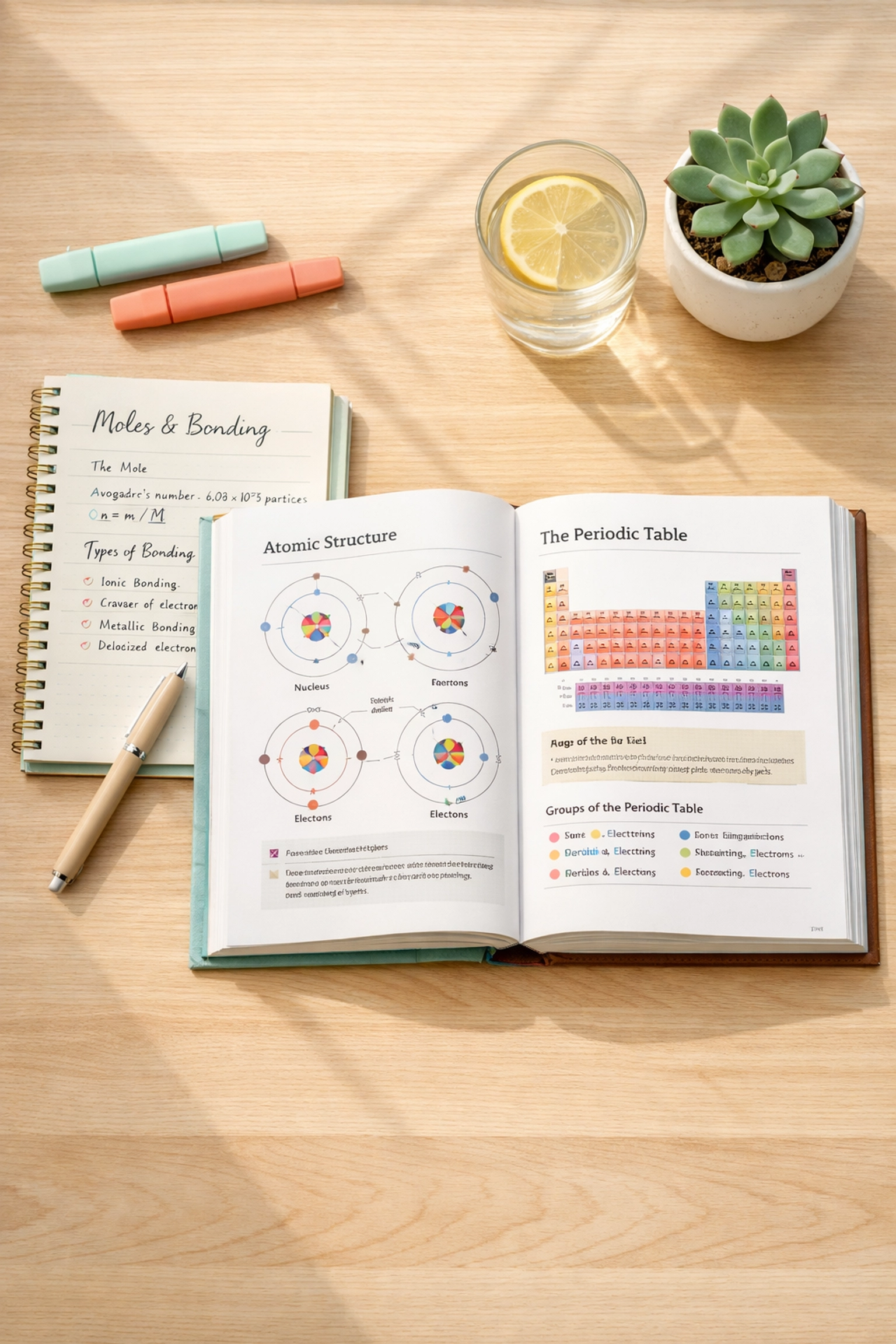
- Moles and Amounts of Substance: This is the backbone of A Level Chemistry. If they don’t nail this early, they’ll struggle with calculations for the next two years. I’m talking moles, molar mass, empirical formulae, and the Avogadro constant. Check out my guide on formulae and amounts of substance here: it’s a lifesaver.
- Atomic Structure and Bonding: Understanding electron configuration, ionisation energy, and the different types of bonding (ionic, covalent, metallic) is essential. This stuff comes up everywhere: organic chemistry, inorganic trends, you name it.
- The Periodic Table and Group Trends: Year 12 kicks off with Group 2 and Group 7 chemistry. If they’re already familiar with periodic trends (e.g., atomic radius, electronegativity), they’ll find it far easier to predict reactions and understand why certain elements behave the way they do.
Why does this matter so much? Because when September rolls around and everyone else is frantically scribbling notes and trying to keep up, your child will already get it. They’ll have mental space to focus on exam technique, ask deeper questions, and actually enjoy the subject: instead of just surviving it. 🧪
Why a “Low-Stress” Start is Better
Here’s the thing parents often misunderstand: pre-learning content isn’t about working harder: it’s about working smarter.
Think of it like this. Imagine trying to learn a new language while simultaneously learning the grammar, vocabulary, and cultural nuances all at once. It’s overwhelming, right? But if you spend a few weeks beforehand learning basic vocabulary and sentence structure, suddenly the full course feels manageable.
That’s exactly what’s happening here. When your child starts Year 12 already comfortable with moles, bonding, and the periodic table, they’re not playing catch-up. They’re building on a solid foundation. This reduces cognitive load, which means they have more mental energy for:
- Balancing three A Levels
- Preparing for the UCAT or BMAT (which, by the way, has Chemistry content)
- Volunteering and building that all-important CV
- Actually having a social life and decent sleep 😴
A relaxed, confident student is a successful student. And in a competitive field like Medicine, that edge matters.
Building the CV Early: Why September 2026 Matters
I know, I know. UCAS feels forever away. Your child hasn’t even started Year 12 yet, and I’m already banging on about university applications.
But here’s the truth: medical school applications are submitted in October of Year 13. That’s just over a year away once they start Sixth Form. And the personal statement? It needs to showcase two years of meaningful experience, reflection, and passion for Medicine.
If they start building that CV now: volunteering, reading, reflecting, and mastering Chemistry: they’ll have a rich, authentic narrative to draw from. They won’t be one of those students who frantically Googles “what to write in a medical school personal statement” in September 2027 and realises they’ve got… nothing.
Start a Reflective Diary this summer. A simple Google Doc or notebook where they jot down:
- What they did (e.g., volunteered at a care home, read “This is Going to Hurt”)
- What they learned
- How it challenged or changed their perspective
- Why it reinforced their desire to study Medicine
When it’s time to write that personal statement, they’ll have pages of material to choose from. Need help with the new UCAS format? I wrote a guide on nailing the 2027 medical school application here.
The Bottom Line: A Relaxed Student is a Successful Student
Look, I’m not here to steal your child’s summer. Let them have fun. Let them decompress. But I am here to tell you that a few strategic moves now: volunteering, reading, and getting ahead in Chemistry: will make the next two years infinitely less stressful.
Medicine is one of the most competitive degree courses in the UK. The students who get in aren’t necessarily the ones who work the hardest: they’re the ones who work the smartest. And starting early? That’s the smartest move of all.
Use this summer to build a foundation that supports both their grades and their wellbeing. Because when September rolls around and the A Level pressure kicks in, you’ll both be grateful you did. 🌟
Don’t let the A Level jump catch them off guard. If your child needs support making that transition from GCSE to A Level Chemistry (or you just want some peace of mind that they’re on the right track), I offer summer booster sessions designed specifically for future medics. Let’s make sure they hit the ground running in September.
Get in touch here to book your session. 🚀


Oxford-Educated Chemistry Specialist
With over 20 years of teaching experience at some of the UK’s top independent schools, I help ambitious students bridge the gap between hard work and top-tier results. I specialise in GCSE, A Level, and IB Chemistry tuition for students targeting Grade 9s and A*s. Based in the UK but working globally, I provide 1-1 online support for families in South and West London, Dubai, and Hong Kong, ensuring students are perfectly prepared for competitive medical applications and Oxbridge entries.
I’ve helped students achieve top grades from schools such as Alleyn’s, Dulwich College, Tonbridge, Sevenoaks, Brighton College, Wycombe Abbey, Caterham, St Paul’s, Dubai College, Dubai British School and Harrow International School Hong Kong.
Contact me archardchloe@gmail.com to discuss how I can help your child excel in Chemistry.