

Blog
Ants, Acid, and Ambition: How to Tackle “Impossible” Chemistry Olympiad Questions


Let’s be honest: when you first look at a UK Chemistry Olympiad Round 1 paper, your initial reaction is probably somewhere between “What on earth?” and “Absolutely not.” 🫠
These questions are designed to look impossible at first glance. They’re not testing whether you’ve memorised Topic 5.3.2 of the specification, they’re testing whether you can think like a chemist when faced with something completely unfamiliar.
And here’s the thing: that’s exactly what makes them brilliant preparation for university, competitive careers, and basically any situation where you need to solve problems that don’t come with a textbook answer.
So let’s talk about how to tackle these “impossible” questions, using one of my favourite examples: the 2005 Round 1 question about distilling ants for methanoic acid. Yes, you read that correctly.
The Question That Starts With “Let’s Distill Some Ants”
Picture this: you’re sitting down to your Olympiad paper, feeling reasonably confident about your moles calculations and pH knowledge. Then you turn the page and see this:
“The ‘simplest’ carboxylic acid is called methanoic acid and has formula HCOOH. It occurs naturally in ants and used to be prepared by distilling them!”
Wait, what? 🐜
The question goes on to explain that when an ant bites you, it injects about 6.0 × 10⁻³ cm³ of a 50% methanoic acid solution. Then it asks you to calculate everything from how many ants you’d need to distill to produce a litre of pure methanoic acid, to working out the acid dissociation constant (Ka) for the solution in your skin.
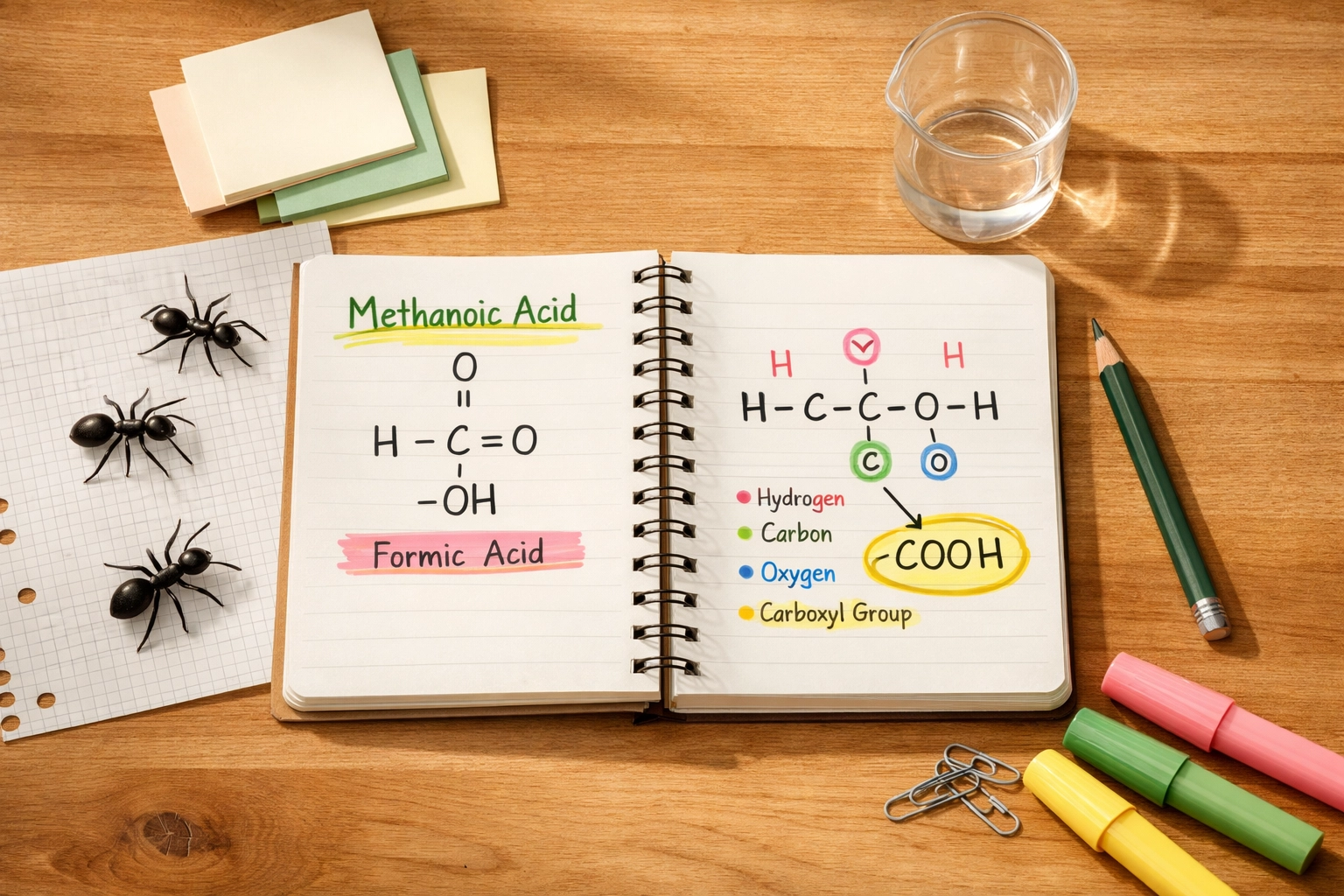
At first glance, this seems ridiculously niche and utterly unrelated to anything you’ve studied. But here’s where the magic happens: it’s actually just A Level chemistry dressed up in an unfamiliar context.
Let’s break it down.
Why “Impossible” Questions Are Actually Just Puzzles
The brilliance of the ants question is that it takes fundamental concepts you already know, moles calculations, concentration, stoichiometry, weak acid equilibria, and asks you to apply them in a scenario you’ve never encountered before.
Part (a) asks you to work out how much methanoic acid is in a “typical ant” if it only injects 80% when it bites. That’s just percentages and proportions, Year 9 maths, really.
Part (b) wants the equation for neutralising the sting with sodium hydrogencarbonate. You’ve written acid-base equations hundreds of times. This one’s exactly the same pattern, just with different chemicals.
Part (c) through (f)? Classic moles, concentration, pH, and Ka calculations. The kind you’ve done in every single mock exam and homework assignment since Year 12.
The only difference is that instead of “Calculate the pH of 0.1 mol dm⁻³ ethanoic acid,” the question is wrapped in a story about ant venom and Victorian chemists distilling insects. The chemistry hasn’t changed, just the packaging.
The Olympian Mindset: Getting Comfortable Being Uncomfortable
Here’s what the UK Chemistry Olympiad committee themselves say in their support materials:
“These questions are demanding: they do not rely on the relatively easy recall of information which students will have met before, but instead on thinking and trying to work out answers to unfamiliar questions, this is much more difficult. Success is often achieved by sheer determination and not giving up.”
That last bit is crucial. 🔥
In Round 1 of the UK Chemistry Olympiad, students can earn a bronze certificate with just 10 marks out of 82. That’s about 12%. The bar isn’t perfection, it’s persistence.
The “Olympian mindset” isn’t about being naturally brilliant or having memorised every reaction mechanism ever written. It’s about being willing to sit with discomfort, read the question three times, and methodically work through what you do know until the path forward becomes clearer.
Why Should You Even Bother?
Fair question. The Olympiad sounds terrifying, the questions are deliberately tricky, and you’re already drowning in A Level content. So why add another challenge to your plate?
1. It’s UCAS Gold 🏆
For competitive courses, Medicine, Natural Sciences at Cambridge, Chemistry at Oxford, Engineering at Imperial, the Chemistry Olympiad is the ultimate supercurricular credential. It screams “this student doesn’t just want good grades; they want to be challenged beyond the syllabus.”
Admissions tutors see hundreds of applicants with A*A*A* predictions. Far fewer have a Gold, Silver, or Bronze certificate from a nationally recognised academic competition. It makes you memorable.
2. It Trains You to Think Under Pressure
University interviews, PAT exams, BMAT questions, first-year problem sheets, they’re all designed to push you beyond rote learning. The Olympiad is practice for that kind of thinking in a lower-stakes environment.
If you can calmly work through a question about distilling ants, you can handle a Cambridge interviewer asking you to derive the Born-Haber cycle for a compound you’ve never heard of.
3. It’s Actually Fun (If You Like Chemistry)
Okay, hear me out. Yes, it’s hard. But if you genuinely enjoy chemistry, the why behind the reactions, the elegance of a well-balanced equation, the satisfaction of a calculation that clicks into place, then Olympiad questions are intellectually satisfying in a way that textbook exercises often aren’t.
They’re puzzles. And who doesn’t love solving a good puzzle? 🧩

How to Approach “Impossible” Questions (Without Losing Your Mind)
So you’ve decided to give the Olympiad a shot. Brilliant. Here’s how to tackle those intimidating questions without spiralling into panic.
Step 1: Don’t Panic. Seriously.
The first rule of Olympiad questions is that everyone finds them hard at first glance. The examiners want you to feel a bit lost initially, that’s the point. Take a breath, read the question carefully, and remind yourself that there’s a logical path through it.
Step 2: Break It Down Into Manageable Chunks
Most Olympiad questions are structured in parts (a), (b), (c), etc., for a reason. Each part builds on the last, and the early parts are usually more straightforward.
In the ants question, part (a) is just simple arithmetic. Part (b) is a standard equation and moles calculation. By the time you get to part (f), calculating Ka, you’ve already worked out the concentrations you need. The question guides you through the logic.
Don’t try to see the whole mountain at once. Just focus on the next step. 🪜
Step 3: Look for Familiar Patterns
Strip away the unfamiliar context and ask yourself: “What type of chemistry is this, really?”
- If they’re talking about reactions and equations, it’s probably stoichiometry.
- If they mention pH and weak acids, you’re heading toward equilibria and Ka.
- If there’s energy involved, think enthalpy, entropy, or Gibbs free energy.
Once you identify the underlying topic, you can apply your existing knowledge, even if the scenario is completely new.
Step 4: Show Your Working (Always)
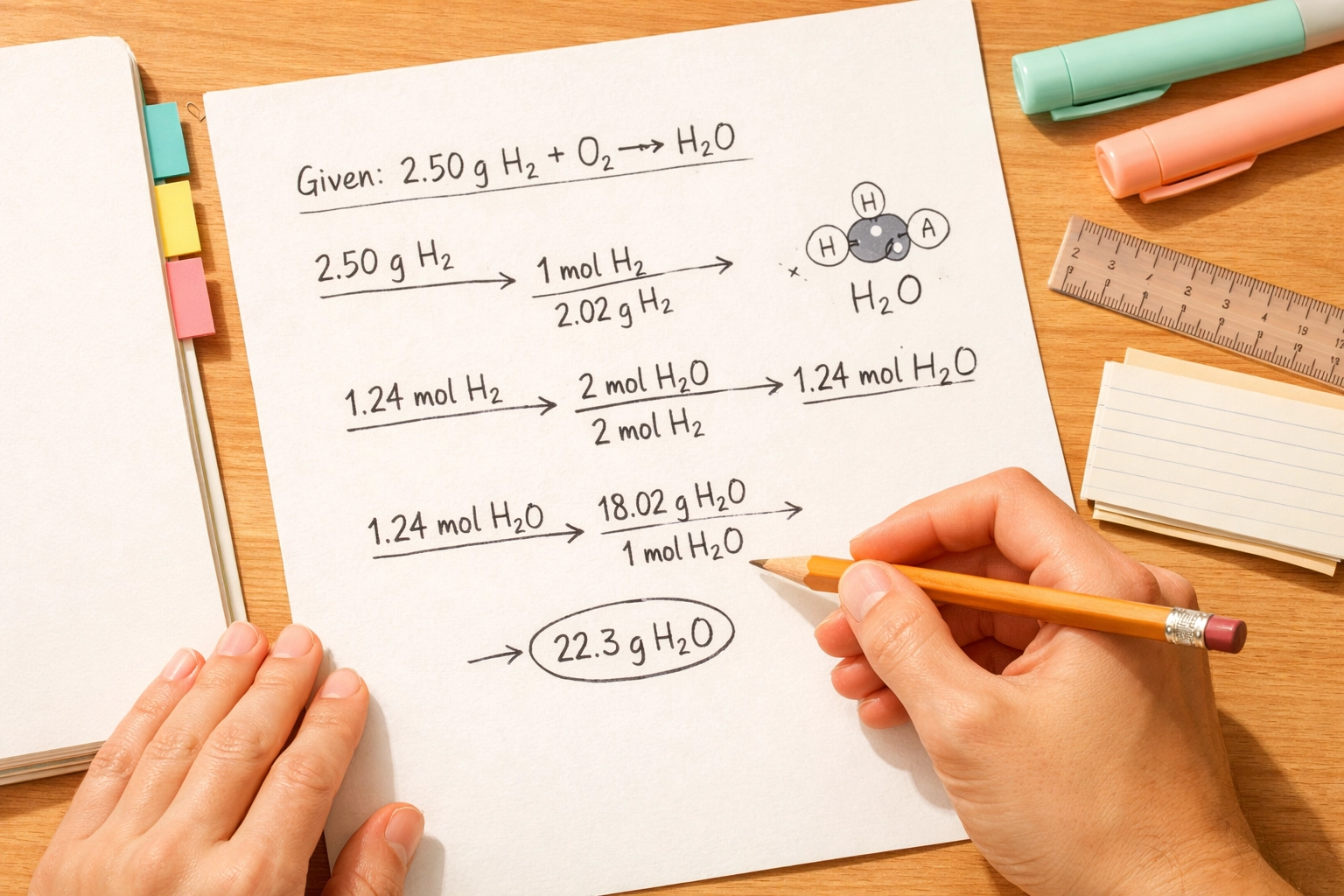
Olympiad marking schemes award substantial partial credit. Even if you don’t get the final answer, showing that you understood the method and made a sensible attempt can earn you half or more of the marks.
Write down your reasoning. Label your units. Explain your logic. The examiners are looking for evidence of chemical thinking, not just correct numbers.
Your Olympiad Action Plan
Ready to give it a go? Here’s your roadmap:
1. Master the Foundations
You can’t solve unfamiliar problems if your fundamentals are shaky. Make sure you’re rock-solid on:
- Moles and stoichiometry (seriously, this is 70% of Round 1)
- Equilibria and Ka/Kp calculations
- Energetics (enthalpy, entropy, Gibbs)
- Redox and electrode potentials
Check out Topic 5: Formulae, Equations, and Amounts of Substance if you need a refresher on the moles basics.
2. Practice Past Papers (Lots of Them)
The Royal Society of Chemistry has years of past Round 1 papers available on their website (www.rsc.org/olympiad). Start with older ones, work through them systematically, and then compare your approach to the worked solutions.
The key is to attempt the questions yourself first before looking at the answers. That initial struggle is where the learning happens.
3. Learn to Love Being Stuck
This is a mindset shift. Being stuck doesn’t mean you’re failing, it means you’re at the edge of your current understanding, which is exactly where growth happens.
When you hit a wall, don’t give up immediately. Sit with it. Reread the question. Look at what data you’ve been given and what you’re being asked to find. Draw a diagram. Try a different approach.
Sheer determination is half the battle.
4. Join the Community
Find other students at your school or online who are also preparing for the Olympiad. Discussing tricky questions with peers, arguing over approaches, explaining your reasoning, learning from each other’s mistakes, is incredibly valuable.
The Bottom Line
The UK Chemistry Olympiad isn’t about being naturally gifted or having some secret genius-level ability. It’s about curiosity, persistence, and the willingness to stretch yourself beyond the comfortable boundaries of the A Level syllabus.
Yes, the questions look impossible at first. But so did balancing your first redox equation, or calculating your first pH, or understanding why lattice enthalpy values are negative (check out this post for more on mastering tricky concepts).
You learned those. You can learn this too.
And honestly? If you can confidently explain how many ants you’d need to distill to produce a litre of pure methanoic acid, you’re going to absolutely smash your university interview. 🐜✨
Ready to stretch yourself beyond the textbook? Whether you’re aiming for Olympiad Gold or just want to master the trickiest A Level topics, let’s get to work. The best way to tackle “impossible” questions is with someone who’s seen them all before: and knows exactly how to break them down into manageable, conquerable steps.
Visit Chemistry with Chloe to book a session and start thinking like a chemist. Because the only truly impossible questions are the ones you never attempt. 🧪💪


Oxford-Educated Chemistry Specialist
With over 20 years of teaching experience at some of the UK’s top independent schools, I help ambitious students bridge the gap between hard work and top-tier results. I specialise in GCSE, A Level, and IB Chemistry tuition for students targeting Grade 9s and A*s. Based in the UK but working globally, I provide 1-1 online support for families in South and West London, Dubai, and Hong Kong, ensuring students are perfectly prepared for competitive medical applications and Oxbridge entries.
I’ve helped students achieve top grades from schools such as Alleyn’s, Dulwich College, Tonbridge, Sevenoaks, Brighton College, Wycombe Abbey, Caterham, St Paul’s, Dubai College, Dubai British School and Harrow International School Hong Kong.
Contact me archardchloe@gmail.com to discuss how I can help your child excel in Chemistry.