

Blog
Practical Endorsement Panic? 10 Things Every A Level Chemistry Student Needs to Know

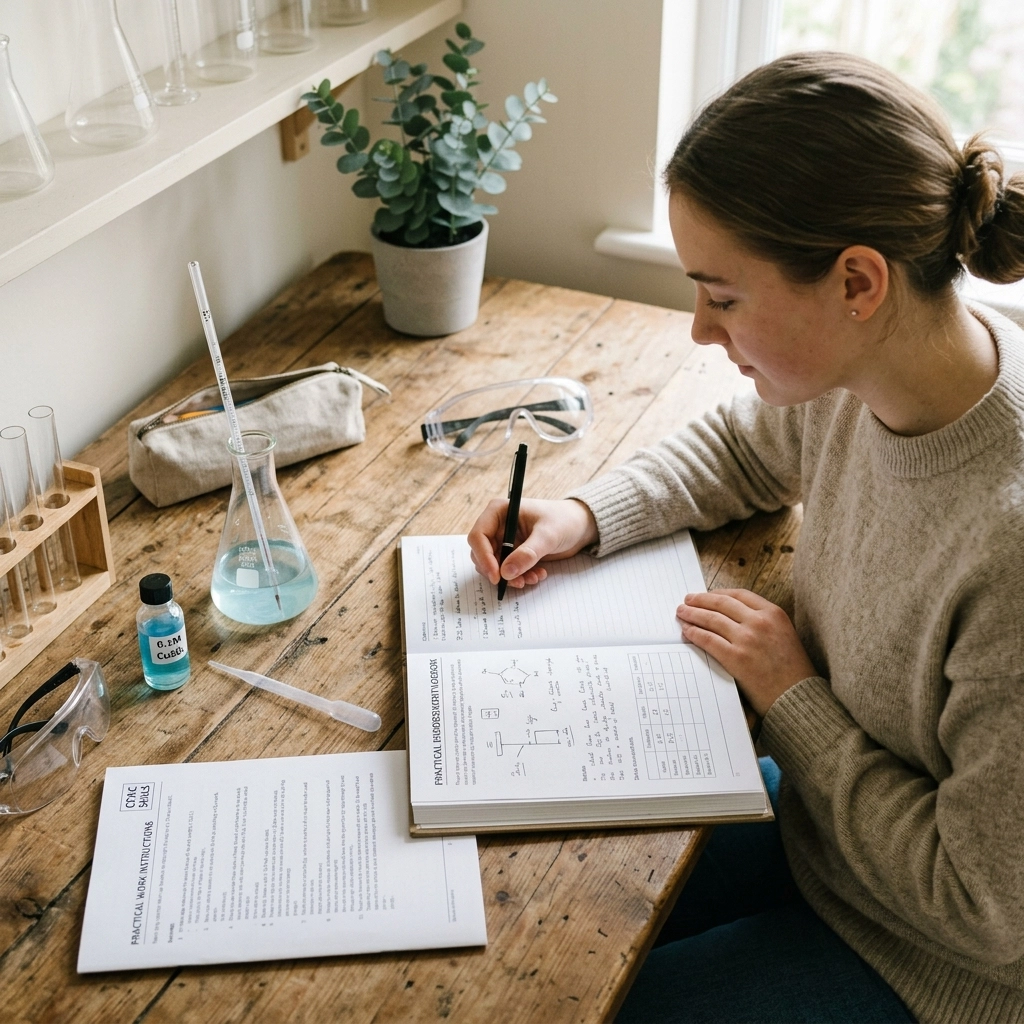
Does the sight of a titration flask make your heart race, and not in a good, "I love science" kind of way? If you are feeling the Practical Endorsement panic, I want you to take a deep breath. I have been exactly where you are. I remember standing in my Year 12 lab, staring at a burette, absolutely convinced that one wrong drop would ruin my entire A Level.
But here is the transformative secret: the Practical Endorsement is not about being a perfect robot in the lab. It is about demonstrating progress, safety, and scientific thought. Whether you are following the AQA, Edexcel, or OCR A Level Chemistry specification, the pressure to "pass" the practical component can feel overwhelming, especially when you are also trying to master complex organic mechanisms and calculate enthalpy changes.
As an Online Chemistry Tutor, I see students every week who are terrified that their lab book isn't "neat enough" or that their results are "wrong." Let’s clear the air. I’d love to invite you to look at the practical endorsement through a different lens, one where you feel empowered and confident.
Here are the 10 essential things every student needs to know to move from panic to practical mastery. ?
1. It is a "Pass" or "Not Reported," Not a Letter Grade
The first thing you must understand is that the Practical Endorsement is separate from your main A Level grade (the A* to E). It is a competency-based assessment. You are being judged on whether you can safely and competently carry out specific tasks over the two-year course.
If you meet the criteria, you get a 'Pass' endorsed on your certificate. While it doesn't change your UCAS points, most competitive university offers (especially for Medicine or Engineering) are conditional on you passing this element. If you’re feeling unsure, working with an A Level Chemistry Tutor can help you review the specific CPAC (Common Practical Assessment Criteria) so you know exactly what the examiners are looking for. ?
2. Your Lab Book is Evidence, Not a Scrapbook
Many students think their lab book needs to be a work of art. It doesn't! However, it does need to be a contemporaneous record. This means you should record your observations and data as they happen, not three days later from memory.
Pro tip: Use a pen for your results, and if you make a mistake, draw a single line through it. Transparency is key in science. I always tell my students that a messy but honest lab book is infinitely better than a "perfect" one that looks like it was written in a library rather than a lab. ?
3. Mistakes Are Actually "High-Level" Data
Did your titration go way past the endpoint? Did your recrystallization yield zero crystals? Don't panic! In the world of an Online Chemistry Tutor, we call these "learning opportunities."
The OCR A Level Chemistry and AQA specs actually reward students who can identify why an experiment went wrong. If you record a "failed" result but then write a brilliant paragraph on the sources of error and how to improve the method next time, you are demonstrating mastery of the highest order. This shows you are thinking like a real scientist!

4. You Must Master the "Why," Not Just the "How"
It is easy to follow a recipe. It is much harder to explain why you are adding 10cm³ of sulfuric acid instead of hydrochloric acid. To transform your practical skills, you need to link the lab work to your theory.
If you are struggling to see the connection between the Required Practicals and the exam papers, I highly recommend checking out our revision courses. We bridge the gap between the beaker and the book, ensuring you understand the chemical principles behind every reaction.
5. Terminology is Your Secret Weapon
Calling a volumetric flask a "large glass bottle" is a quick way to lose marks on your CPAC skills. You need to be precise.
- Aliquot
- Titre
- Standard Solution
- Concordant results (results within 0.10cm³ of each other)
Using this language consistently in your lab book and during your 1-to-1 sessions with an A Level Chemistry Tutor will make your competency clear to your teachers. It builds massive confidence when you can speak the language of the lab! ?
6. The "Pencil and Ruler" Rule is Non-Negotiable
When it comes to the Practical Endorsement, your drawing skills matter. Whether you are sketching a distillation setup or a titration curve, you must:
- Use a sharp pencil.
- Use a ruler for straight lines.
- Draw cross-sections of glassware (no "lids" on beakers!).
- Label clearly with straight lines.
This might seem trivial, but it is a core part of being a professional scientist. I’ve seen many students lose marks on Paper 3 simply because they didn't know how to draw a gas syringe correctly. Let’s get those basics perfected now!
7. Safety is More Than Just Goggles
Yes, you need to wear your safety glasses. But to pass the endorsement, you need to show you understand risk assessment. This means knowing the difference between a hazard (the chemical's inherent property, like being "corrosive") and a risk (how you might actually get hurt, like "splashing in the eyes").
When I work as an Online Chemistry Tutor, I always push my students to look up the MSDS (Material Safety Data Sheet) for the chemicals they use. Being able to explain why you’re using a fume cupboard for a specific reaction is a deliciously smart move that proves your competence. ?
8. Significant Figures Will Make or Break Your Data
This is the "malaise" of A Level Chemistry! If your burette reads to two decimal places (ending in .00 or .05), your lab book must reflect that. If you are calculating a mean, your answer should be to an appropriate number of significant figures based on your raw data.
Precision is where many students trip up, but it is a skill we can transform together. If you want to dive deeper into the math of chemistry, our Shop has resources specifically designed to tackle these tricky calculations.
9. Practical Skills are 15% of Your Written Exams
Here is the life-changing truth: the work you do for your Practical Endorsement isn't just "extra" work. At least 15% of the marks in your final A Level papers come from practical-based questions.
By taking your lab work seriously now, you are effectively revising for Paper 3. You’ll be asked about color changes, precipitate colors, and how to improve experimental methods. If you have lived it in the lab, you will master these questions in the exam hall. It is the secret weapon for securing that A or A*! ?

10. You Don’t Have to Do This Alone
If your school's science department feels like a "ghost town" or your teacher is too busy to explain the OCR A Level Chemistry core practicals, it is okay to ask for help.
I started Chemistry with Chloe because I wanted to provide the support and guidance that I wish I had in sixth form. I’d love to invite you to join our community. Whether you need an Online Chemistry Tutor to walk you through a specific practical write-up or you want to join our revision courses to nail your exam technique, we are here to help you thrive.
Let’s embark on this journey together. You are more than capable of passing your endorsement and smashing your exams. Let’s turn that "panic" into a confident, life-changing success story. ??
Ready to stop the overwhelm and start mastering your practicals? If you are looking for an Online Chemistry Tutor who understands the stress of the 2026 syllabus, check out our Services page or Contact us today. Let's make this year your most transformative one yet! ??
Want more tips? Read our guide on Navigating Practicals and Nailing the A or explore the Edexcel Core Practicals 1-16.
📄 Free AQA A Level Chemistry Revision Guides
📄 Free OCR A Level Chemistry A Revision Guides
⬇ Component 01: Periodic Table & Physical Chemistry ⬇ Component 02: Synthesis & Analysis

Oxford-Educated Chemistry Specialist
With over 20 years of teaching experience at some of the UK’s top independent schools, I help ambitious students bridge the gap between hard work and top-tier results. I specialise in GCSE, A Level, and IB Chemistry tuition for students targeting Grade 9s and A*s. Based in the UK but working globally, I provide 1-1 online support for families in South and West London, Dubai, and Hong Kong, ensuring students are perfectly prepared for competitive medical applications and Oxbridge entries.
I’ve helped students achieve top grades from schools such as Alleyn’s, Dulwich College, Tonbridge, Sevenoaks, Brighton College, Wycombe Abbey, Caterham, St Paul’s, Dubai College, Dubai British School and Harrow International School Hong Kong.
Contact me archardchloe@gmail.com to discuss how I can help your child excel in Chemistry.