

Blog
How to Perfect Your Edexcel IAL Chemistry Calculations: 5 Common Traps and How to Avoid Them

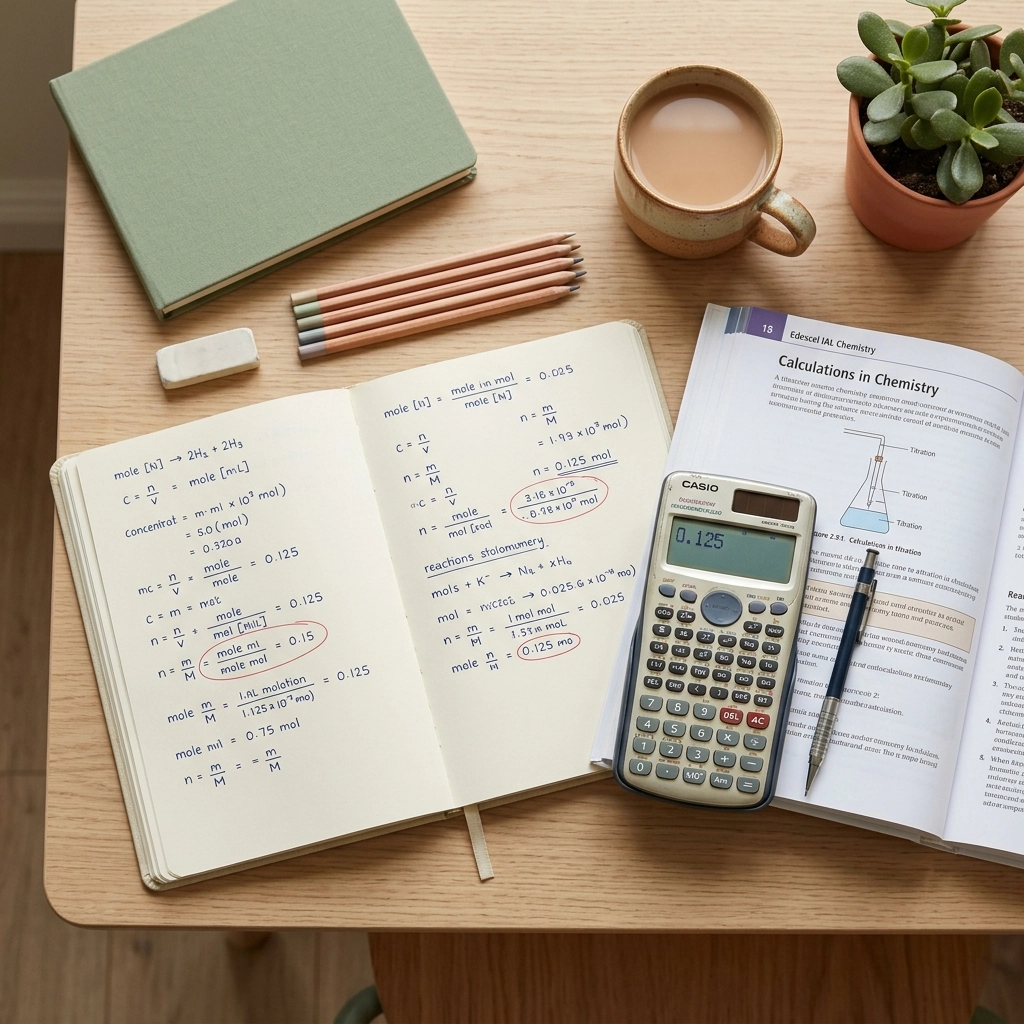
If you are currently studying Edexcel IAL Chemistry, whether you are in a classroom in Dubai, a study group in Hong Kong, or preparing at home in the UK, you already know one thing to be true: the calculations are where the magic (or the misery) happens.
In my years as an online chemistry tutor, I have seen incredibly bright students: the ones who can explain the intricacies of SN1 mechanisms and transition metal electronic configurations: suddenly freeze up when faced with a multi-step calculation in Unit 2 or Unit 4. It is heartbreaking to see someone lose marks not because they don't understand the chemistry, but because they fell into a "calculation trap."
These traps are exactly what separate an A grade from an A*. In the competitive world of A Level Chemistry, precision is your greatest asset. Today, I want to share the five most common calculation traps I see as a tutor and, more importantly, how you can master them to ensure you walk into your exams with total confidence. ?
1. The Unit Conversion Chaos (The pV=nRT Nightmare)
If there is one equation that causes more tears than any other in Edexcel IAL Chemistry, it is the Ideal Gas Equation: pV = nRT.
The concept is simple, but the units are a literal minefield. Most of your data in a question will be given in cm3, kPa, and °C. However, the gas constant (R = 8.31 J K^-1 mol^-1) demands that you use SI units.
The Trap: Students often remember to convert Celsius to Kelvin (adding 273), but they stumble on volume. Converting cm3 to dm3 is second nature by now (divide by 1,000), but for pV = nRT, you must use m3.
How to avoid it:
- cm3 to m3: Divide by 1,000,000 (1 x 10^-6).
- dm3 to m3: Divide by 1,000 (1 x 10^-3).
- kPa to Pa: Multiply by 1,000.
I always tell my students to write out their conversions on the side of the page before they even touch the formula. It prevents that "silly mistake" that costs 3 marks. If you want to dive deeper into the basics of these units, check out my guide on Topic 5: Formulae, Equations, and Amounts of Substance.

2. Forgetting the "Silent" Mole Ratios
You’ve done the hard work. You’ve calculated the moles of the reactant. You’re feeling great. You plug that number into the final step to find the mass or concentration… and you get the answer wrong. Why? Because you forgot the stoichiometric ratio from the balanced equation.
The Trap: In the heat of the exam, it is so easy to assume a 1:1 ratio. However, Edexcel IAL examiners love to give you equations involving sulfuric acid (H2SO4) reacting with sodium hydroxide (NaOH), which is a 1:2 ratio, or redox titrations involving manganate(VII) and iron(II) ions (1:5 ratio).
How to avoid it: Every time you finish a mole calculation for one substance, look back at the balanced equation. Literally draw an arrow from one substance to the other and write the ratio above it. I want you to make this a physical habit. Understand that the equation is your map; ignore it, and you’ll end up at the wrong destination.
If you struggle with balancing these complex equations, especially in redox, my resource on Redox I and Oxidation Numbers will be a lifesaver for you.
3. The Mean Titre: Don't Use Every Number You Have!
This trap is specific to the practical-based questions in Unit 3 and Unit 6, but it also pops up in Unit 2. When you are given a table of titration results, your first instinct is to find the average.
The Trap: Students often calculate the mean of all the titres provided, including the rough titration or results that are widely spread. Edexcel is very strict: you must only use concordant titres.
How to avoid it:
- Concordant means results within 0.10 cm3 of each other.
- Look at your table. If you have 25.10, 24.80, 24.85, and 24.90 cm3, you only use the last three. The 25.10 is an outlier.
- Clearly state which titres you are using. Write: "Mean titre = (24.80 + 24.85 + 24.90) / 3".
This shows the examiner you master the practical requirements of the course. For more help on practical techniques, I’ve mapped out all the Core Practicals 1-16 for you to review. ?
4. Incorrect Rinsing: The Practical Calculation Killer
This is a conceptual trap that ruins the "Calculation of Percentage Uncertainty" or "Analysis of Errors" questions. While it might seem like a small detail, the way you rinse your glassware determines the accuracy of your moles.
The Trap: When asked how to improve an experiment or why a titre was higher than expected, students often get confused about what to rinse with what.
How to avoid it:
- Burette and Pipette: Must be rinsed with the solution they will contain. If you rinse them with water, you dilute the solution, meaning you’ll need a larger volume to react (increasing your titre and ruining your calculation).
- Conical Flask: Must be rinsed with distilled water only. If you rinse it with the solution it’s going to hold, you are adding extra moles of reactant that shouldn't be there. Since you are calculating the moles based on the volume pipetted in, those extra "rinsed-in" moles will create a massive error.
Understanding these nuances is what makes you a confident chemist. Let’s embark on a journey where you don't just memorize steps, but you actually understand the 'why' behind the lab work. ?

5. The "Intermediate Rounding" Catastrophe
I see this daily in my work as an A Level Chemistry Tutor. A student is working through a 5-mark calculation. At each step, they round their answer to 2 significant figures. By the time they reach the final answer, the rounding errors have compounded so much that their final value is outside the allowed range on the mark scheme.
The Trap: Rounding too early or using the wrong number of significant figures in the final answer.
How to avoid it:
- Keep the full number in your calculator memory. Use the "ANS" button!
- If you must write down intermediate steps, keep at least 4 or 5 significant figures on paper.
- The Final Answer Rule: Look at the data provided in the question. Your final answer should usually be given to the same number of significant figures as the least precise piece of data provided (often 3 s.f. in Edexcel papers).
I’d love to invite you to start practicing this today. Even in your homework, treat every calculation as if it’s the final exam. This consistency is how you transform your grades.
Why These Marks Matter
In the Edexcel IAL system, the grade boundaries for an A* are often very tight. You might understand Atomic Structure or Organic Chemistry perfectly, but if you lose 2 marks on units and 2 marks on rounding in every paper, you are effectively dropping a whole grade.
Calculations are "guaranteed marks" once you learn the patterns. Unlike "suggest" or "explain" questions which can be subjective, math is either right or wrong. When you master these 5 traps, you turn the calculation section from a source of anxiety into a reliable bank of marks.
How Chemistry with Chloe Can Help
I know that A Level Chemistry can feel overwhelming. Whether you are struggling with Kinetics or find Energetics confusing, you don't have to do it alone.
As an Oxford-educated Chemistry Tutor, I specialize in helping students in Dubai, Hong Kong, and across the UK navigate the specific quirks of the Edexcel IAL specification. My goal is to help you feel confident, prepared, and actually excited about your exams!
If you’re looking for more personalized support, I offer a range of Revision Courses and one-on-one Services designed to target your specific pain points.
Don't let a few unit conversions stand between you and your dream university place. Let’s work together to make sure your hard work is reflected in your final results. ??
Ready to take the next step? Contact me here and let’s get started on your journey to an A*! ?

📄 Free AQA A Level Chemistry Revision Guides
⬇ Paper 1: Physical & Inorganic ⬇ Paper 2: Organic & Physical

Oxford-Educated Chemistry Specialist
With over 20 years of teaching experience at some of the UK’s top independent schools, I help ambitious students bridge the gap between hard work and top-tier results. I specialise in GCSE, A Level, and IB Chemistry tuition for students targeting Grade 9s and A*s. Based in the UK but working globally, I provide 1-1 online support for families in South and West London, Dubai, and Hong Kong, ensuring students are perfectly prepared for competitive medical applications and Oxbridge entries.
I’ve helped students achieve top grades from schools such as Alleyn’s, Dulwich College, Tonbridge, Sevenoaks, Brighton College, Wycombe Abbey, Caterham, St Paul’s, Dubai College, Dubai British School and Harrow International School Hong Kong.
Contact me archardchloe@gmail.com to discuss how I can help your child excel in Chemistry.