

Blog
From CP1 to CP16: Why Your Practical Lab Book is the Secret to A* Success in Paper 3

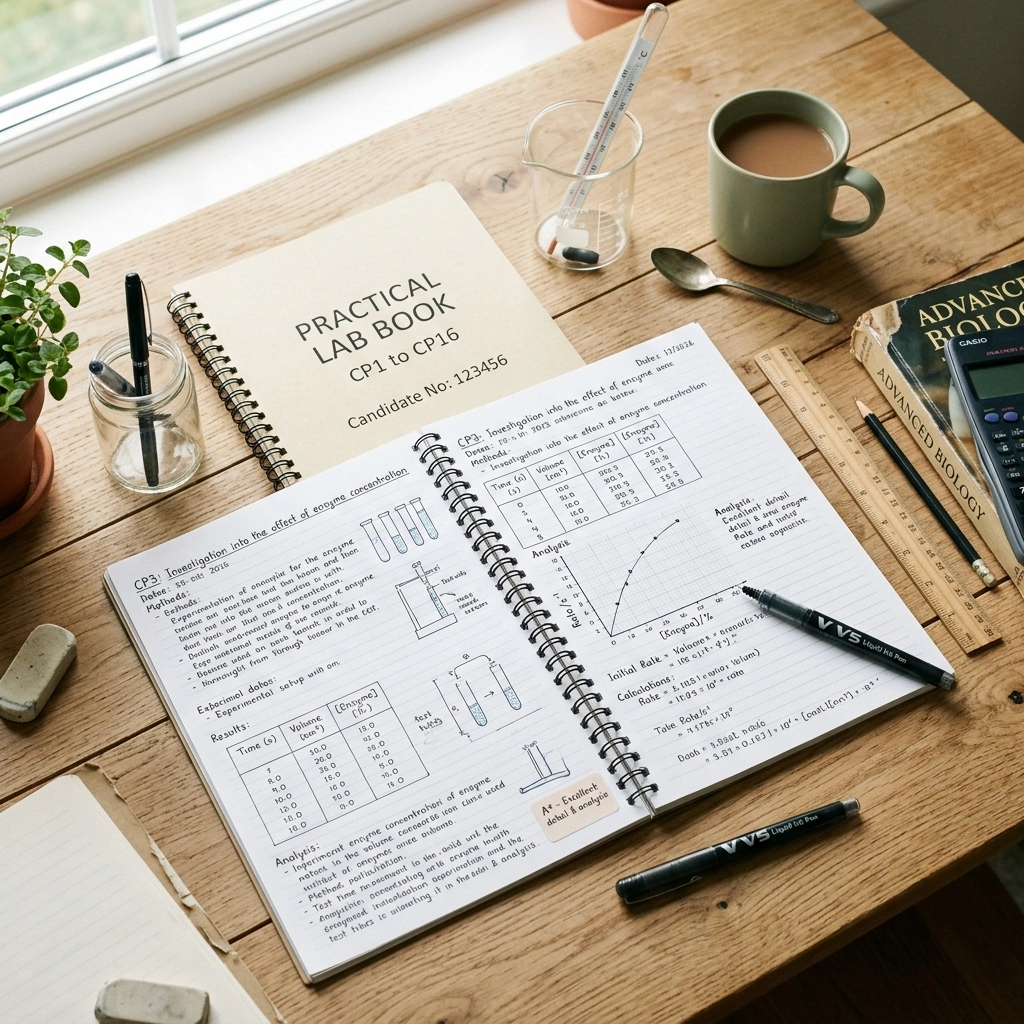
Hey there! If you are currently staring at a mountain of past papers and feeling that "Paper 3 panic" start to set in, I want you to take a deep breath. I’ve been exactly where you are. I remember sitting in my own student lab, smelling of slightly burnt sulfur and wondering why on earth I had to write down every single tiny detail of my titration. It felt like busywork at the time, but then I sat the exam.
I soon realized that Paper 3 isn't just another chemistry test: it’s a practical and synoptic challenge that rewards the students who truly understood what was happening at the lab bench.
At Chemistry with Chloe, I’ve helped hundreds of students transform their approach to this final hurdle. The secret isn't just memorizing definitions; it’s treating your Practical Lab Book as the ultimate revision guide. In this post, let’s embark on a journey through the 16 Core Practicals (CP1-CP16) and discover how they are your blueprint for A* success.
What Makes Edexcel Paper 3 So Different?
Before we dive into the experiments, we need to understand the beast we’re dealing with. Paper 3 is synoptic, which is a fancy way of saying "everything is fair game." You might get a question that starts with an organic synthesis (Topic 17/18), moves into a calculation about yield (Topic 5), and ends with a question about the entropy change of the reaction (Topic 13).
But the real "star of the show" in Paper 3 is the practical element. A huge chunk of the marks comes from your ability to plan, evaluate, and analyze experimental data. This is where your experience with the 16 Core Practicals becomes your greatest asset. If you can master the logic behind these experiments, you can handle any "novel" scenario the examiner throws at you.

Your Lab Book: The Underrated Revision Tool
Most students leave their lab book in a drawer at school once it’s been signed off. Don't be that student! Your lab book contains the "why" behind the "what." When you’re revising, I’d love to invite you to flip through those pages and look at your own mistakes. Did you forget to rinse the burette? Did you overshoot the end-point? Those "errors" are actually the most valuable parts of your revision.
In Paper 3, you are frequently asked to identify errors and improvements. By looking at your own recorded data, you can recall the exact moments things went wrong, making it much easier to explain them in an exam context.
The "Big Hitters": Practicals You Must Know Inside Out
While all 16 are important, certain practicals appear with legendary frequency. Let’s break down the heavyweights.
1. The Art of the Titration (CP1 & CP11)
Titrations are the bread and butter of Edexcel Chemistry. Whether it’s a simple acid-base titration in Topic 5 or a complex redox titration in CP11, the principles remain the same.
- CP1 (Standard Solutions): You must be able to describe how to make a standard solution from scratch. Mentioning the volumetric flask, the meniscus, and the "weighing by difference" technique is non-negotiable for those top marks.
- CP11 (Redox Titrations): This is a Paper 3 favorite. You’ll often be asked about the reaction between Manganate(VII) ions and iron(II) or ethanedioic acid. Remember: KMnO4 is its own indicator (it turns from colorless to a permanent pale pink).
Pro Tip: Examiners love asking why we use dilute sulfuric acid in these titrations. It’s to ensure there are enough H+ ions for the reduction of MnO4-, preventing the formation of brown MnO2 precipitate which would ruin your end-point!
2. Kinetics and the "Clock" Reactions (CP13)
Kinetics (Topic 9) is a massive part of the Edexcel A Level Chemistry spec. CP13 usually involves the "Iodine Clock" or the titration method for finding the rate of reaction.
In Paper 3, you might be asked to explain why we use a "quenching" agent (like sodium hydrogencarbonate) to stop the reaction at a specific time. You also need to be confident in moving between "time" and "rate" (Rate = 1/t). If you can explain the theory behind the graphs you drew in your lab book, you’re halfway to an A*.

3. Organic Synthesis and Purification (CP16)
Organic chemistry can feel overwhelming, but CP16 simplifies it by focusing on the process. Whether you are making aspirin or an ester, the steps are usually:
- Reflux (to ensure the reaction goes to completion without losing volatile reactants).
- Distillation (to separate the product).
- Purification (using a separating funnel and drying agents like anhydrous MgSO4).
- Recrystallisation (the holy grail of purification).
You need to know the steps for recrystallisation by heart: dissolve in a minimum volume of hot solvent, filter hot, cool to recrystallize, filter under reduced pressure (Buchner funnel), and wash with ice-cold solvent.
Mastering the Calculations
Paper 3 will test your math skills to the limit. You won't just be doing simple mole calculations; you’ll be calculating percentage uncertainties.
To find the percentage uncertainty, use this formula: (Total error in equipment / Measurement taken) x 100
Remember, for a burette or a balance where you take two readings (initial and final), you must double the error! This is a classic "trap" that catches out thousands of students every year. Being confident in these calculations will save you precious time during the exam. Check out our Formulae and Equations page for a refresher on the basics.
Errors and Improvements: The High-Mark Goldmine
In the practical section of Paper 3, you will often be given a student’s experimental method and asked to critique it. This is where your lab book revision pays off!
Common improvements you should keep in your back pocket include:
- Using a 3-decimal place balance to reduce the percentage uncertainty in mass.
- Insulating a calorimeter with a lid and polystyrene cup to prevent heat loss in energetics experiments.
- Repeating the experiment and calculating a mean (excluding anomalies) to improve the reliability of your results.

How I Transformed My Own Perspective
I’ll be honest: when I was a student, I thought the lab book was just a box-ticking exercise for the "Practical Endorsement." I didn't realize that by carefully recording my observations, I was actually building a mental library of chemical behavior.
When I started tutoring, I realized that the students who struggled the most with Paper 3 were the ones who treated the practicals as "magic shows" rather than logical processes. Once we started going back to the Core Practicals 1-16 and asking "What is the role of each piece of equipment?", their grades started to transform almost overnight. They became confident because they understood the "why" behind the chemistry.
Final Thoughts: You've Got This!
Paper 3 is definitely a challenge, but it’s also an opportunity to show off how much of a scientist you’ve become over the last two years. You aren't just a person who can memorize facts; you are someone who can handle chemicals, manage risks, and analyze data.
I’d love to invite you to take an afternoon this week to just sit with your lab book. Don't look at a textbook. Just look at your notes, your graphs, and your teacher's corrections. Use it as your guide to revision.
If you feel like you need a bit more structured help to master these concepts, we are always here to help. Whether it’s diving deep into Modern Analytical Techniques or mastering Redox equations, my goal is to make you feel completely confident heading into that exam hall. ??
Let’s make this final push count. Your A* is waiting! ???
Want more tips or personalized help? Contact us today and let’s get you ready for Paper 3 success! For more resources, you can always check out our full range of A-Level Chemistry services.
📄 Free AQA A Level Chemistry Revision Guides
⬇ Paper 1: Physical & Inorganic ⬇ Paper 2: Organic & Physical

Oxford-Educated Chemistry Specialist
With over 20 years of teaching experience at some of the UK’s top independent schools, I help ambitious students bridge the gap between hard work and top-tier results. I specialise in GCSE, A Level, and IB Chemistry tuition for students targeting Grade 9s and A*s. Based in the UK but working globally, I provide 1-1 online support for families in South and West London, Dubai, and Hong Kong, ensuring students are perfectly prepared for competitive medical applications and Oxbridge entries.
I’ve helped students achieve top grades from schools such as Alleyn’s, Dulwich College, Tonbridge, Sevenoaks, Brighton College, Wycombe Abbey, Caterham, St Paul’s, Dubai College, Dubai British School and Harrow International School Hong Kong.
Contact me archardchloe@gmail.com to discuss how I can help your child excel in Chemistry.